
Wayground
Review 23/24: LT 1.1 - Atoms, Ions, & Isotopes - Printable Science Worksheets year 11 - Wayground

Review 23/24: LT 1.1 - Atoms, Ions, & Isotopes

15 questions

11th - 11th Grade

Science

Review 23/24: LT 1.1 - Atoms, Ions, & Isotopes is a Grade 11 science worksheet that reviews how atomic structure identifies neutral atoms, ions, and isotopes. Students use proton, neutron, electron, atomic number, and mass number information to classify atoms, determine ion charges and electron counts, and interpret nuclear symbols. The free printable worksheet contains 15 questions: 14 multiple-choice items and one matching item. Students compare atoms of the same element, identify isotope relationships, determine the particles represented by nuclear notation, and explain how gaining or losing electrons changes charge. A complete answer key is included for checking student understanding or reviewing errors after practice.

Worksheet settings

Font size

S
M
L
XL
Worksheets

Review 23/24: LT 1.1 - Atoms, Ions, & Isotopes

Total questions: 15

Name
Class
Date
1.

An atom that has 6 protons, 8 neutrons, and 6 electrons is -

a)

a neutral atom

b)

an ion.

c)

an isotope.

2.

Atoms of the same element with a different number of electrons are called ___________.

a)

elements

b)

isotopes

c)

ions

d)

neutral

3.

Atoms of the same element with a different number of neutrons are called _________.

a)

elements

b)

isotopes

c)

ions

d)

neutral

4.

An ion with a positive charge has __________.

a)

the same number of protons and electrons.

b)

lost a proton.

c)

lost an electron.

d)

gained an electron.

5.

When an atom loses an electron, it becomes a(n) _____________ ion.

a)
positive
b)
negative
c)
neutral
d)
polyatomic
6.

How many electrons does the following ion have?

a)

10

b)

12

c)

14

d)

22

7.

How many electrons does the following ion have?

a)

3

b)

7

c)

10

d)

14

8.

Which is true about the following chlorine atom?

a)

17 protons and 36 neutrons

b)

17 protons and 19 electrons

c)

17 protons and 19 neutrons

d)

36 protons and 17 neutrons

9.

Which is true of the following beryllium atom?

a)

4 protons and 9 neutrons

b)

5 neutrons and 4 electrons

c)

9 protons and 4 neutrons

d)

4 protons and 2 electrons

10.
What do these isotopes of carbon all have in common?
a)
neutrons & mass number
b)
atomic number and neutrons
c)
atomic number and electrons
d)
protons, atomic number, and mass number
11.

If X is the symbol for an element, which of the following two symbols represent isotopes of the same element?    

I. 7735X  II. 7733X  III. 8137X  IV. 8135 X

a)
I and II
b)
III and IV
c)
I and IV
d)
I and III
12.

The nuclear symbol for an element is, 7735X . Match the following information:

Atomic Number

35

Mass Number

77

Neutrons

42

13.
What charge does an atom have if it LOSES an electron? 
a)
Positive (+)
b)
Negative (-)
14.
What charge does an atom have if it GAINS an electrons?
a)
Positive (+)
b)
Negative (-)
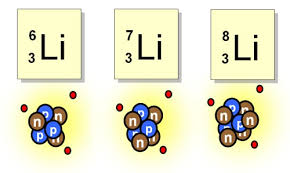
15.

The difference between these lithium isotopes is -

a)

the number of protons

b)

the atomic number

c)

the number of neutrons

d)

the number of electrons

Answer Key

Review 23/24: LT 1.1 - Atoms, Ions, & Isotopes

Total questions: 15

1.
a)

a neutral atom

2.
c)

ions

3.
b)

isotopes

4.
c)

lost an electron.

5.
a) positive
6.
a)

10

7.
c)

10

8.
c)

17 protons and 19 neutrons

9.
d)

4 protons and 2 electrons

10.
c) atomic number and electrons
11.
c) I and IV
12.

Atomic Number

 - 

35

, 

Mass Number

 - 

77

, 

Neutrons

 - 

42

13.
a) Positive (+)
14.
b) Negative (-)
15.
c)

the number of neutrons

FAQs

What does this atoms, ions, and isotopes worksheet cover?

This Grade 11 science worksheet uses 14 multiple-choice questions and one matching item to help students distinguish neutral atoms, ions, and isotopes from their numbers of protons, neutrons, and electrons. Students also interpret nuclear symbols, determine electron counts and charges, and identify atomic number, mass number, and neutron information.

How can I use this worksheet to teach atoms, ions, and isotopes?

Introduce the worksheet by reviewing that protons identify the element, neutrons change the isotope, and electrons determine whether an atom is neutral or charged. Have students annotate the nuclear symbols and explain their reasoning before completing the multiple-choice items, then use the matching question to reinforce atomic number, mass number, and neutrons.

What mistakes should I watch for when students complete this worksheet?

Watch for students confusing isotopes, which differ in neutrons, with ions, which differ in electrons. Students may also reverse the charge changes—losing an electron produces a positive ion, while gaining an electron produces a negative ion—or confuse atomic number with mass number when reading the nuclear-symbol and matching items.

How do I assign and grade this atoms, ions, and isotopes worksheet?

On Wayground, assign it either as a printable PDF or as a digital quiz; both versions cover the 15-item review and include a complete answer key. Printable submissions can be graded by scanning student work with the Wayground for Teachers app, while the digital quiz supports online response collection and grading.

How can I differentiate this atoms, ions, and isotopes worksheet for my students?

Use the worksheet’s Advanced Settings to adjust font spacing and font size for the multiple-choice and nuclear-symbol matching items, or enable a dyslexia-friendly font. You can also translate the worksheet into another language while preserving its focus on identifying subatomic particles, charges, and isotope relationships.

Where can I find more worksheets like this on Wayground?

Wayground offers a comprehensive collection of free printable worksheets and practice problems across subjects, with downloadable PDFs and answer keys to help students master essential skills and concepts. Browse more resources at https://wayground.com/en-us/worksheets.