

Wayground
Lab Safety Rules - Printable Science Worksheets year 6 - Wayground

Lab Safety Rules

25 questions

6th - 6th Grade

Science

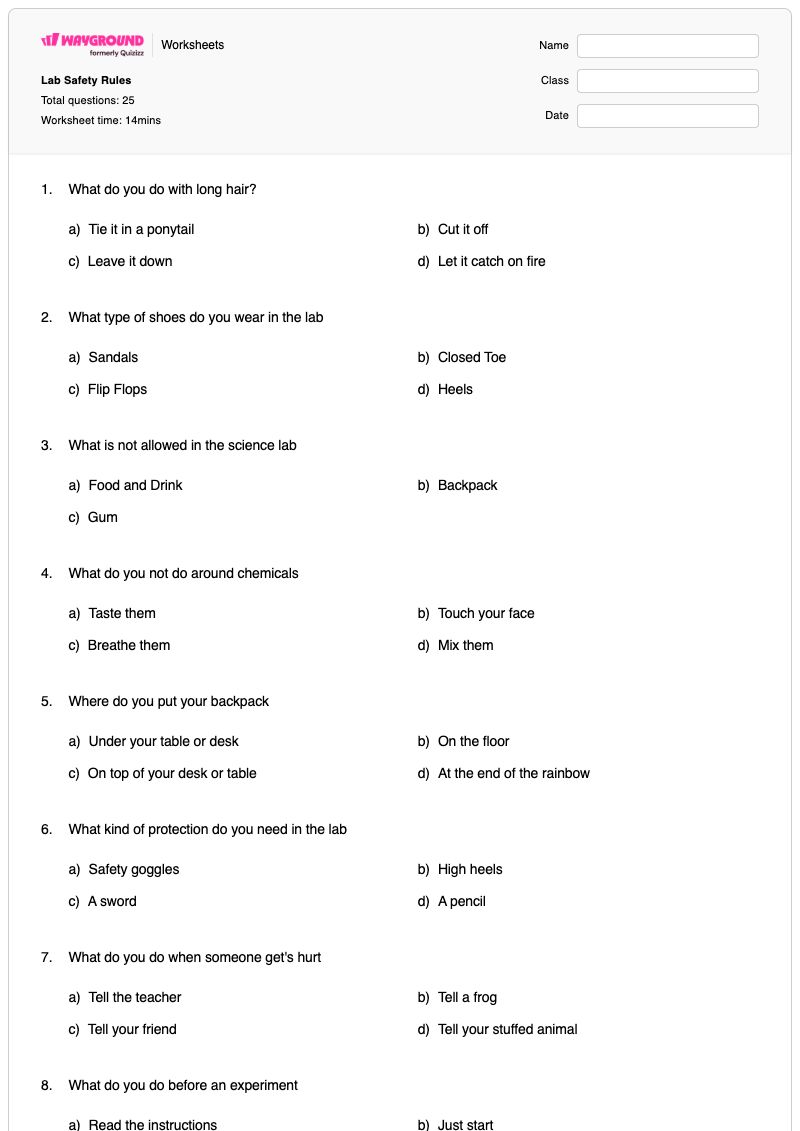
Lab Safety Rules is a free printable Grade 6 science worksheet that helps students identify and apply essential procedures for working safely in a laboratory. Students review expectations for personal protection, clothing and hair, backpacks, food and drink, chemical handling, experiment instructions, injury reporting, cleanup, horseplay, sink use, and laboratory behavior. The worksheet contains 25 questions: 21 multiple-choice items and 4 multiple-select items. Students must distinguish between safe and unsafe actions, including selecting all practices that are not allowed around chemicals and in the lab. An answer key is included for efficient review, correction, or assessment. Use this worksheet to introduce lab expectations before an investigation, reinforce safety routines during a science unit, or check whether students can recognize the correct response to common laboratory situations.

Worksheet settings

Font size

S
M
L
XL
Worksheets

Lab Safety Rules

Total questions: 25

Name
Class
Date
1.

What do you do with long hair?

a)

Tie it in a ponytail

b)

Cut it off

c)

Leave it down

d)

Let it catch on fire

2.

What type of shoes do you wear in the lab

a)

Sandals

b)

Closed Toe

c)

Flip Flops

d)

Heels

3.

What is not allowed in the science lab

a)

Food and Drink

b)

Backpack

c)

Gum

4.

What do you not do around chemicals

a)

Taste them

b)

Touch your face

c)

Breathe them

d)

Mix them

5.

Where do you put your backpack

a)

Under your table or desk

b)

On the floor

c)

On top of your desk or table

d)

At the end of the rainbow

6.

What kind of protection do you need in the lab

a)

Safety goggles

b)

High heels

c)

A sword

d)

A pencil

7.

What do you do when someone get's hurt

a)

Tell the teacher

b)

Tell a frog

c)

Tell your friend

d)

Tell your stuffed animal

8.

What do you do before an experiment

a)

Read the instructions

b)

Just start

c)

Rip the instructions and start

d)

Ask your friend to add you on minecraft

9.

What do you do at the end of class

a)

Leave the mess

b)

Clean up the mess

c)

Make bigger mess

d)

Talk to a friend

10.

Acrylic nails are..

a)

Not allowed in the lab

b)

Allowed in the lab

c)

Very pretty

11.

What are you not supposed to do in the lab?

a)

Horseplay

b)

Be respectful

c)

Mix chemicals

d)

Learn

12.

What is not allowed in the sink?

a)

Solids

b)

Chemicals

c)

Food

d)

A rainbow

13.

What kind of clothing is not allowed

a)

Loose clothing

b)

Tight clothing

c)

Rainbow clothing

d)

White clothing

14.

In the lab I should...

a)

Work quietly

b)

Be loud

c)

Be messy

d)

Eat a banana

15.

The laboratory tables should...

a)

Not be sat on

b)

Be painted

c)

Be colorful

d)

Be messy

16.

Do not leave...

a)

Your laboratory table

b)

Your dog

c)

Your house

d)

The road

17.

Learn the location of...

a)

The fire extingsher

b)

Safety shower

c)

Your house

d)

Your dog

18.

If you where contact lenses...

a)

Tell your teacher

b)

Tell your friend

c)

Wear safety goggles anyway

d)

Take them out before class

19.

When you want to pick up a hot piece of glass you should...

a)

Just grab it

b)

Use tongs

c)

Pick up the coolest piece

d)

Pour water on it

20.

Hot glass looks...

a)

like cold glass

b)

Very clear

c)

like hot glass

21.

What should be worn at all times in the lab?

a)

An apron

b)

Safety goggles

c)

High heels

d)

A dress

22.

If a laboratory fire happens you should...

a)

Tell your teacher

b)

Pour water on it

c)

Let it burn

d)

Sit on it

23.

If a lab experiment is not done you should...

a)

Discuss it with your teacher

b)

Just not do it

c)

Sneak in

d)

Do it at lunch

24.

If acid is splashed on your skin you should

a)

Wash with lotion

b)

Wash with soap and water

c)

Wash with juice

d)

Just rub it off with a towel

25.

If you do not understand the instructions you should?

a)

Ask your teacher

b)

Ask your friend

c)

Ask the chemicals

d)

Ask a frog

Answer Key

Lab Safety Rules

Total questions: 25

1.
a)

Tie it in a ponytail

2.
b)

Closed Toe

3.
a)

Food and Drink

, c)

Gum

4.
a)

Taste them

, b)

Touch your face

, c)

Breathe them

5.
a)

Under your table or desk

6.
a)

Safety goggles

7.
a)

Tell the teacher

8.
a)

Read the instructions

9.
b)

Clean up the mess

10.
a)

Not allowed in the lab

11.
a)

Horseplay

12.
a)

Solids

13.
a)

Loose clothing

14.
a)

Work quietly

15.
a)

Not be sat on

16.
a)

Your laboratory table

17.
a)

The fire extingsher

, b)

Safety shower

18.
a)

Tell your teacher

19.
b)

Use tongs

20.
a)

like cold glass

21.
b)

Safety goggles

, a)

An apron

22.
a)

Tell your teacher

23.
a)

Discuss it with your teacher

24.
b)

Wash with soap and water

25.
a)

Ask your teacher

FAQs

What does the Lab Safety Rules worksheet cover?

This Grade 6 science worksheet uses 21 multiple-choice and 4 multiple-select questions to assess whether students can identify safe laboratory practices. Students distinguish appropriate actions—such as tying back long hair, wearing closed-toe shoes and safety goggles, reading instructions, reporting injuries to the teacher, and cleaning up—from unsafe behaviors such as horseplay, tasting chemicals, or touching their faces around chemicals.

How can I use this worksheet to teach lab safety rules?

Introduce the worksheet before a laboratory investigation by modeling a few routines, such as securing long hair, storing backpacks under the desk, and reading instructions before beginning. Have students explain why each selected response is safe or unsafe, then use the multiple-select items to discuss why several actions around chemicals may be prohibited. Review the answer key as a class and turn missed items into specific safety expectations for the next experiment.

What mistakes should I watch for when students complete this lab safety worksheet?

Watch for students choosing only one response on the multiple-select questions, especially when identifying actions that are not allowed around chemicals or in the lab. Students may also confuse general classroom behavior with laboratory rules—for example, selecting “tell your friend” instead of telling the teacher about an injury, or overlooking that loose clothing, acrylic nails, food, and gum are not allowed. Check that students distinguish “read the instructions” and “clean up the mess” from unsafe choices to start immediately or leave the workspace messy.

How do I assign and grade the Lab Safety Rules worksheet?

You can assign this lab safety worksheet as a printable PDF or as a digital quiz on Wayground. It includes a complete answer key for checking the 21 multiple-choice and 4 multiple-select responses, and printable submissions can be graded by scanning student work with the Wayground for Teachers app. The printable format also gives schools an option for reducing screen time.

How can I differentiate this lab safety worksheet for my students?

In the worksheet’s Advanced Settings, adjust font spacing or choose a larger font size to make the safety scenarios and answer choices easier to read. You can also enable a dyslexia-friendly font or translate the worksheet into another language so students can focus on identifying safe and unsafe laboratory actions.

Where can I find more worksheets like this on Wayground?

Wayground offers a comprehensive collection of free printable worksheets and practice problems across all subjects, with downloadable PDFs and answer keys to support essential skills and concepts. Browse more resources at https://wayground.com/en-us/worksheets.