

Law of Conservation of Mass and Balancing Equations
Created by Leah Dowell
24 questions
9th - 12th Grade
Science
Updated May 2026
This Grade 9–12 science worksheet, Law of Conservation of Mass and Balancing Equations, helps students apply conservation of mass to chemical reactions. Across 24 questions—23 multiple choice and one multiple-select—students identify the law, calculate missing reactant or product masses, determine atom counts, distinguish reactants from products, and recognize chemical changes such as burning, fireworks, and hair dyeing.
Students also interpret whether equations are balanced, identify products, select the correct coefficients, and complete balancing problems involving compounds such as magnesium chloride and hydrochloric acid. The combination of conceptual questions, mass calculations, equation analysis, and one multiple-select item reinforces that atoms are conserved while coefficients—not subscripts—are adjusted to balance an equation. This free printable worksheet includes a complete answer key and is suitable for introducing, practicing, or checking understanding of conservation of mass and balancing chemical equations.
Worksheet settings
Font size
S
M
L
XL
Worksheets
Law of Conservation of Mass and Balancing Equations
Total questions: 24
Name
Class
Date
1.
What is the Law of Conservation of Mass?
a)
Mass is created in a chemical reaction
b)
Mass is created in a physical change
c)
New chemicals formed from a chemical reaction have a larger overall mass than the original reactants
d)
Mass is never created or destroyed
2.
In reaction A +B --> C, reactants A + B have a total mass of 9g. What is the mass of product C?
a)
4g
b)
5g
c)
9g
d)
14g
3.
In reaction A +B --> C, reactant A has a mass of 4g and product C has a mass of 9g. What is the mass of reactant B
a)
4g
b)
5g
c)
9g
d)
14g
4.
7 g of hydrogen reacts with 17 g of oxygen to produce ______ g of water
a)
14
b)
24
c)
38
d)
62
5.
During a chemical reaction matter cannot be created or destroyed.
a)
True
b)
False
6.
How many Hydrogen atoms must be present in the products after a reaction between the following reactants: 2SO2+2H2O2
a)
2
b)
3
c)
4
d)
8
7.
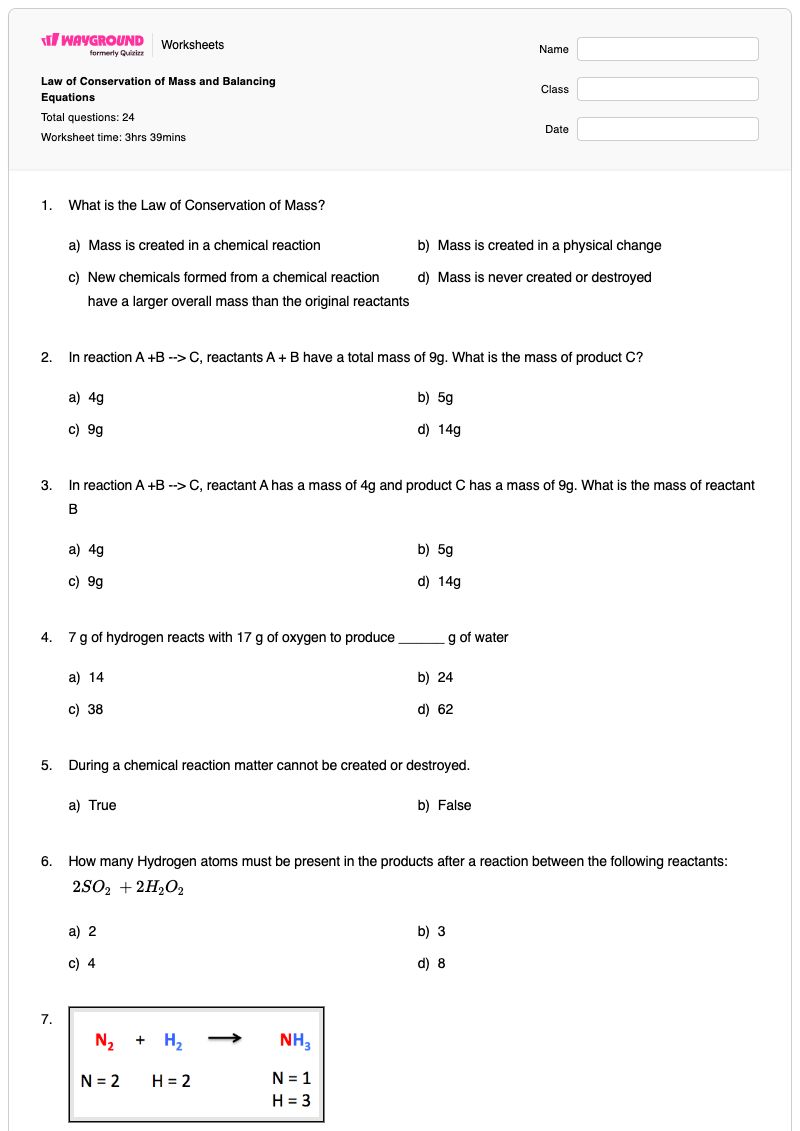
Is this equation balanced?
a)
Yes
b)
No
8.
In the equation shown, what are the product(s)?
a)
N2 + H2
b)
NH3
9.
Is this equation balanced?
a)
Yes
b)
No
10.
To balance an equation you should:
a)
ONLY change subscripts.
b)
ONLY change coefficients.
c)
Change BOTH subscripts and coefficients.
11.
Which are the reactants in the following reaction? 2Mg + O2 ---> 2MgO
a)
Mg and O
b)
MgO
c)
Mg and MgO
d)
O and MgO
12.
Balance this equation: MgCl2 --> Mg4+ Cl2
a)
It's already balanced.
b)
4MgCl2 --> Mg4+ 4Cl2
c)
4MgCl2 --> Mg4+ 5Cl2
13.
Mg + ___ HCl → MgCl2 + H2
a)
1
b)
2
c)
3
d)
4
14.
Identify ALL of the chemical changes
a)
Boiling water
b)
Burning a marshmallow
c)
Fireworks going off
d)
Cutting your hair
e)
Dying your hair
15.
The following chemical reaction occurs.
2H2O2 → 2H2O + O2
How many atoms of hydrogen are involved in the reaction?
a)
1
b)
2
c)
4
d)
8
16.
What coefficient for O2 demonstrates the law of conservation of mass?
CH4(g) + __O2(g) → CO2(g) + 2H2O(g)
a)
1
b)
2
c)
3
d)
4
17.
Two clear solutions are mixed together in a beaker. Which result would indicate a chemical reaction had occurred between these solutions?
a)
increase of volume in the beaker
b)
decrease of volume in the beaker
c)
increase in temperature of the beaker
18.
John and Lisa collected a sample of ocean water and placed it in a jar. Within a couple of days, the water had evaporated and salt was visible at the bottom of the jar. This is an example of a
a)
physical change
b)
chemical change
c)
new substance being formed
19.
What are the larger numbers that you CAN CHANGE in a chemical equation?
a)
Coefficient
b)
Products
c)
Reactants
d)
Subscripts
20.
How many HCl molecules do you need to balance this equation? Mg + __HCl ---> MgCl2 + H2
a)
1
b)
2
c)
3
d)
4
21.
Balance this equation:
H2 + Cl2 ---> HCl
a)
It is balanced.
b)
H2 + Cl2 ---> 2HCl
c)
3H2 + Cl2 ---> 6HCl
d)
H2 + 3Cl2 ---> 6HCl
22.
Balance this equation:
HgO ---> Hg + O2
a)
It is balanced.
b)
2HgO ---> 2Hg + O2
c)
2HgO ---> Hg + O2
d)
HgO ---> Hg + 2O2
23.
Balance this equation: P4+O2 --> P2O3
a)
3 P4+ O2 --> 2 P2O3
b)
P4+ O2 --> 2 P2O3
c)
P4+ 3 O2 --> 2 P2O3
d)
P4 + O2 --> P4O2
24.
Which of the following is balanced?
a)
Mg + HCl --> H2 + MgCl2
b)
H2O + CO2 --> H2CO3
c)
KClO3 --> KCl + O2
d)
H2 + O2 --> H2O
Answer Key
Law of Conservation of Mass and Balancing Equations
Total questions: 24
1.
d)
Mass is never created or destroyed
2.
c)
9g
3.
b)
5g
4.
b)
24
5.
a)
True
6.
c)
4
7.
b)
No
8.
b)
NH3
9.
a)
Yes
10.
b)
ONLY change coefficients.
11.
a) Mg and O
12.
b) 4MgCl2 --> Mg4+ 4Cl2
13.
b) 2
14.
b)
Burning a marshmallow
, c)
Fireworks going off
, e)
Dying your hair
15.
c)
4
16.
d)
4
17.
c)
increase in temperature of the beaker
18.
a)
physical change
19.
a) Coefficient
20.
b) 2
21.
b)
H2 + Cl2 ---> 2HCl
22.
b)
2HgO ---> 2Hg + O2
23.
c) P4+ 3 O2 --> 2 P2O3
24.
b)
H2O + CO2 --> H2CO3
140 %
Browse by subjects
Browse by grades
Browse by format
FAQs
What does this worksheet cover, and how does it help students learn conservation of mass and balancing equations?
This Grade 9–12 science worksheet uses 23 multiple-choice questions and one multiple-select question to build skills with conservation of mass and balancing chemical equations. Students calculate missing masses, count atoms, identify reactants and products, judge whether equations are balanced, and choose coefficients that conserve each element.
How can I use this worksheet to teach conservation of mass and balancing chemical equations?
Use the conservation-of-mass questions first to model how total reactant mass determines total product mass and how missing masses can be found. Then have students annotate reactants, products, and atom counts in the equation items before practicing the rule that balancing changes coefficients, not subscripts; finish by discussing why each selected coefficient makes the element totals match.
What mistakes should I watch for when students complete this conservation of mass worksheet?
Watch for students treating product mass as larger or smaller than total reactant mass, reversing reactants and products, or miscounting atoms from a chemical formula. In the balancing items, a common error is changing subscripts instead of coefficients; students may also mark an equation balanced without checking every element or select only one correct chemical change in the multiple-select question.
How do I assign and grade this conservation of mass and balancing equations worksheet?
The worksheet is available as a printable PDF and as a digital quiz on Wayground, and it includes a complete answer key for the mass calculations, atom-counting items, and equation-balancing questions. Printable submissions can be graded by scanning student work with the Wayground for Teachers app.
How can I differentiate this worksheet for my students?
For the equation-reading and multiple-choice items in this worksheet, use Advanced Settings to adjust font spacing and font size so formulas, options, and symbols are easier to follow. You can also enable a dyslexia-friendly font or translate the worksheet into another language through Advanced Settings.
Where can I find more worksheets like this on Wayground?
Wayground offers a broad collection of free printable worksheets and practice problems across subjects, with downloadable PDFs and answer keys to support essential skills and concepts. Browse more resources at https://wayground.com/en-us/worksheets.