

Wayground
Algebra 2 Change of Base Rule for Log Classwork - Printable Mathematics Worksheets - Wayground

Algebra 2 Change of Base Rule for Log Classwork

10 questions

11th - 11th Grade

Mathematics

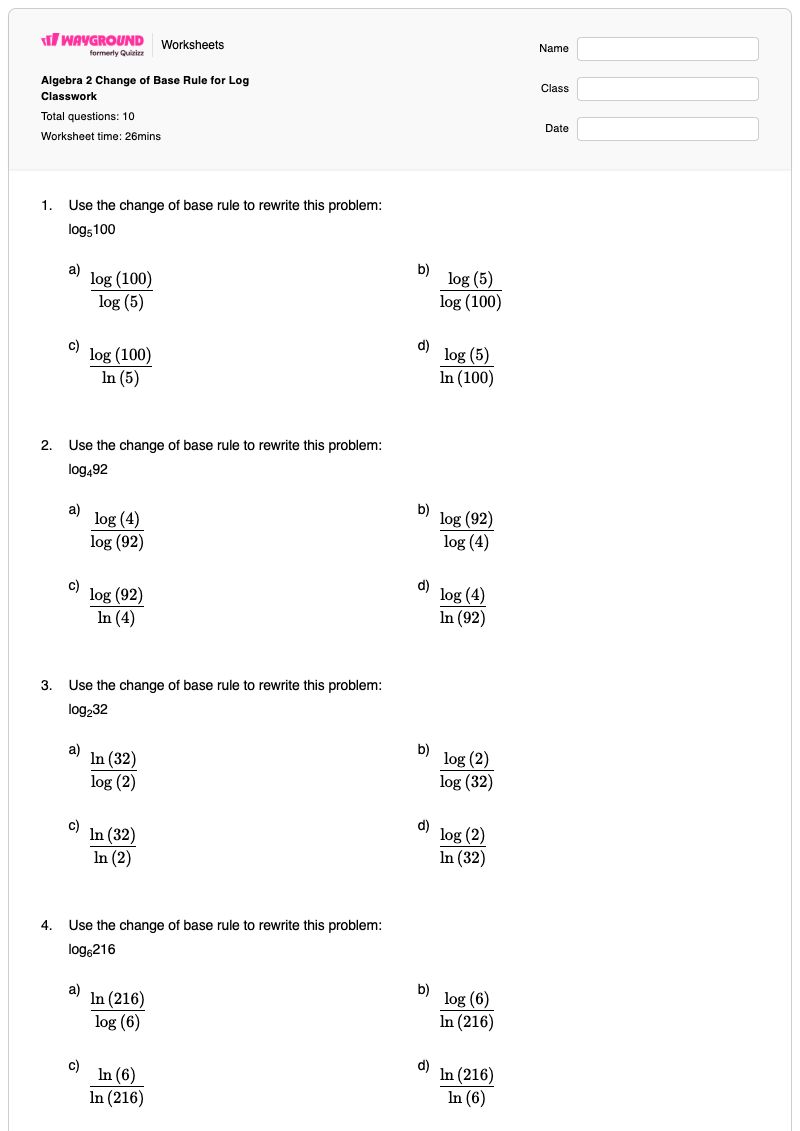
This Grade 11 Algebra 2 worksheet focuses on using the change of base rule for logarithms. Students complete 10 multiple-choice questions: the first six ask them to rewrite logarithms with bases such as 5, 4, 2, 6, and 7, while the final four ask them to expand logarithmic expressions using the same rule. The format gives students repeated practice recognizing the structure of a logarithm and selecting an equivalent form. Use this free printable worksheet for guided classwork, independent practice, or a quick check of students’ fluency with logarithmic transformations. Its answer key supports efficient review and helps teachers identify whether errors come from reversing the numerator and denominator, confusing the logarithm’s base and argument, or applying the rule incorrectly when expanding an expression. The worksheet is designed for Algebra 2 mathematics instruction and can be used alongside direct modeling of the change of base rule.

Worksheet settings

Font size

S
M
L
XL
WaygroundWorksheets

Algebra 2 Change of Base Rule for Log Classwork

Total questions: 10

Name
Class
Date
1.

Use the change of base rule to rewrite this problem:

log5100

a)

log⁡(100)log⁡(5)\frac{\log\left(100\right)}{\log\left(5\right)}

b)

log⁡(5)log⁡(100)\frac{\log\left(5\right)}{\log\left(100\right)}

c)

log⁡(100)ln⁡(5)\frac{\log\left(100\right)}{\ln\left(5\right)}

d)

log⁡(5)ln⁡(100)\frac{\log\left(5\right)}{\ln\left(100\right)}

2.

Use the change of base rule to rewrite this problem:

log492

a)

log⁡(4)log⁡(92)\frac{\log\left(4\right)}{\log\left(92\right)}

b)

log⁡(92)log⁡(4)\frac{\log\left(92\right)}{\log\left(4\right)}

c)

log⁡(92)ln⁡(4)\frac{\log\left(92\right)}{\ln\left(4\right)}

d)

log⁡(4)ln⁡(92)\frac{\log\left(4\right)}{\ln\left(92\right)}

3.

Use the change of base rule to rewrite this problem:

log232

a)

ln⁡(32)log⁡(2)\frac{\ln\left(32\right)}{\log\left(2\right)}

b)

log⁡(2)log⁡(32)\frac{\log\left(2\right)}{\log\left(32\right)}

c)

ln⁡(32)ln⁡(2)\frac{\ln\left(32\right)}{\ln\left(2\right)}

d)

log⁡(2)ln⁡(32)\frac{\log\left(2\right)}{\ln\left(32\right)}

4.

Use the change of base rule to rewrite this problem:

log6216

a)

ln⁡(216)log⁡(6)\frac{\ln\left(216\right)}{\log\left(6\right)}

b)

log⁡(6)ln⁡(216)\frac{\log\left(6\right)}{\ln\left(216\right)}

c)

ln⁡(6)ln⁡(216)\frac{\ln\left(6\right)}{\ln\left(216\right)}

d)

ln⁡(216)ln⁡(6)\frac{\ln\left(216\right)}{\ln\left(6\right)}

5.

Use the change of base rule to rewrite this problem:

log264

a)

log⁡8(64)log⁡3(2)\frac{\log_8\left(64\right)}{\log_3\left(2\right)}

b)

log⁡5(64)log⁡5(2)\frac{\log_5\left(64\right)}{\log_5\left(2\right)}

c)

ln⁡(2)ln⁡(64)\frac{\ln\left(2\right)}{\ln\left(64\right)}

d)

ln⁡(64)log⁡(2)\frac{\ln\left(64\right)}{\log\left(2\right)}

6.

Use the change of base rule to rewrite this problem:

log7256

a)

log⁡5(256)log⁡3(7)\frac{\log_5\left(256\right)}{\log_3\left(7\right)}

b)

log⁡2(256)log⁡2(7)\frac{\log_2\left(256\right)}{\log_2\left(7\right)}

c)

ln⁡(7)ln⁡(256)\frac{\ln\left(7\right)}{\ln\left(256\right)}

d)

ln⁡(256)log⁡(7)\frac{\ln\left(256\right)}{\log\left(7\right)}

7.

Use the change of base rule to expand this problem:

ln⁡(50)\ln\left(50\right)

a)

log⁡5(50)log⁡8(e)\frac{\log_5\left(50\right)}{\log_8\left(e\right)}

b)

log⁡4(50)log⁡4(e)\frac{\log_4\left(50\right)}{\log_4\left(e\right)}

c)

log⁡(50)log⁡(10)\frac{\log\left(50\right)}{\log\left(10\right)}

d)

ln⁡(50)log⁡(e)\frac{\ln\left(50\right)}{\log\left(e\right)}

8.

Use the change of base rule to expand this problem:

ln⁡(84)\ln\left(84\right)

a)

log⁡5(84)log⁡5(e)\frac{\log_5\left(84\right)}{\log_5\left(e\right)}

b)

log⁡4(84)log⁡6(e)\frac{\log_4\left(84\right)}{\log_6\left(e\right)}

c)

log⁡(84)log⁡(10)\frac{\log\left(84\right)}{\log\left(10\right)}

d)

ln⁡(84)log⁡(e)\frac{\ln\left(84\right)}{\log\left(e\right)}

9.

Use the change of base rule to expand this problem:

log⁡(35)\log\left(35\right)

a)

log⁡(10)ln⁡(35)\frac{\log\left(10\right)}{\ln\left(35\right)}

b)

log⁡(35)ln⁡(10)\frac{\log\left(35\right)}{\ln\left(10\right)}

c)

log⁡3(35)log⁡3(10)\frac{\log_3\left(35\right)}{\log_3\left(10\right)}

d)

log⁡9(10)log⁡9(35)\frac{\log_9\left(10\right)}{\log_9\left(35\right)}

10.

Use the change of base rule to expand this problem:

log⁡(9)\log\left(9\right)

a)

log⁡(10)ln⁡(9)\frac{\log\left(10\right)}{\ln\left(9\right)}

b)

log⁡(9)ln⁡(10)\frac{\log\left(9\right)}{\ln\left(10\right)}

c)

log⁡3(10)log⁡3(9)\frac{\log_3\left(10\right)}{\log_3\left(9\right)}

d)

log⁡5(9)log⁡5(10)\frac{\log_5\left(9\right)}{\log_5\left(10\right)}

WaygroundAnswer Key

Algebra 2 Change of Base Rule for Log Classwork

Total questions: 10

1.
a)

log⁡(100)log⁡(5)\frac{\log\left(100\right)}{\log\left(5\right)}

2.
b)

log⁡(92)log⁡(4)\frac{\log\left(92\right)}{\log\left(4\right)}

3.
c)

ln⁡(32)ln⁡(2)\frac{\ln\left(32\right)}{\ln\left(2\right)}

4.
d)

ln⁡(216)ln⁡(6)\frac{\ln\left(216\right)}{\ln\left(6\right)}

5.
b)

log⁡5(64)log⁡5(2)\frac{\log_5\left(64\right)}{\log_5\left(2\right)}

6.
b)

log⁡2(256)log⁡2(7)\frac{\log_2\left(256\right)}{\log_2\left(7\right)}

7.
b)

log⁡4(50)log⁡4(e)\frac{\log_4\left(50\right)}{\log_4\left(e\right)}

8.
a)

log⁡5(84)log⁡5(e)\frac{\log_5\left(84\right)}{\log_5\left(e\right)}

9.
c)

log⁡3(35)log⁡3(10)\frac{\log_3\left(35\right)}{\log_3\left(10\right)}

10.
d)

log⁡5(9)log⁡5(10)\frac{\log_5\left(9\right)}{\log_5\left(10\right)}

FAQs

What does this Algebra 2 worksheet cover?

This worksheet builds fluency with the change of base rule through 10 multiple-choice questions. Students first rewrite logarithms with different bases, including bases 5, 4, 2, 6, and 7, then use the rule to expand four logarithmic expressions. Selecting equivalent forms helps students connect logarithm notation to a common-base representation.

How can I use this worksheet to teach the change of base rule?

Model one rewrite item by identifying the logarithm’s argument and base before substituting them into the change of base form. Then have students explain why the numerator represents the argument and the denominator represents the base, before moving to the expansion items. Use students’ choices to discuss whether each option preserves the original logarithm.

What mistakes should I watch for on this logarithm worksheet?

Students may reverse the argument and base when rewriting, placing the logarithm of the base in the numerator. They may also confuse the base with the number being evaluated or treat the final four expansion questions as simple rewrites. Ask students to label both parts of each logarithm before choosing an answer.

How do I assign and grade this worksheet?

This worksheet is available as a printable PDF and as a digital quiz on Wayground, so you can use the 10 multiple-choice items for paper-based or online practice. It includes a complete answer key, and printable submissions can be graded by scanning student work with the Wayground for Teachers app. The printable format can also support schools that are reducing screen time.

How do the rewrite and expansion questions build different logarithm skills?

The first six multiple-choice items ask students to convert individual logarithms into an equivalent change-of-base form, while the final four ask them to expand logarithmic expressions. Reviewing the two groups separately helps students distinguish applying the rule to a single logarithm from using it as part of a longer algebraic transformation.

Where can I find more worksheets like this on Wayground?

Wayground offers a broad collection of free printable worksheets and practice problems across subjects, with downloadable PDFs and answer keys to support mastery of essential skills and concepts. Browse more resources at https://wayground.com/en-us/worksheets.