
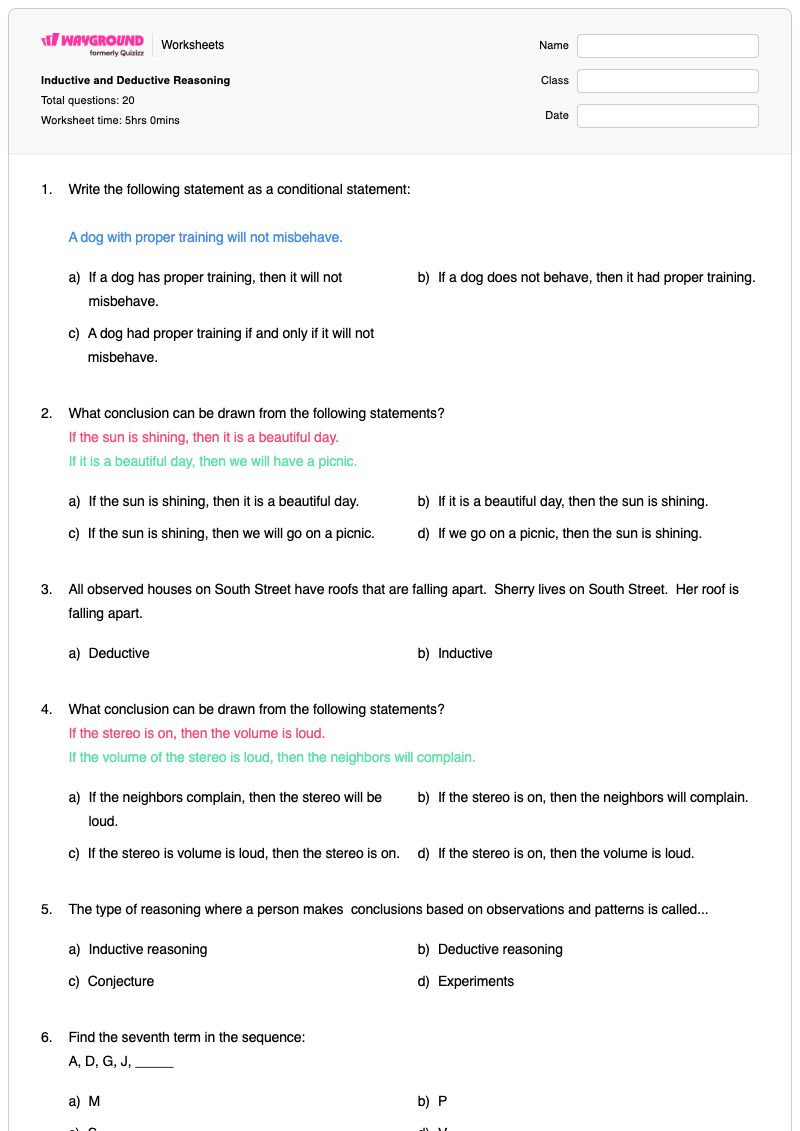

This Grade 8 mathematics worksheet gives students focused practice with inductive and deductive reasoning through 20 multiple-choice questions. Students identify whether conclusions come from observations or stated facts, extend letter and number patterns, and use patterns to make conjectures. They also work with conditional statements by identifying hypotheses and conclusions, chaining related statements, and distinguishing a statement from its converse, inverse, or contrapositive.
The questions also introduce counterexamples as a way to show that a conditional claim is false, including selecting a number that disproves a divisibility statement. This combination helps students connect pattern recognition with formal logical reasoning and mathematical language. The worksheet is suitable for Grade 8 math instruction, guided practice, independent review, or an assessment of foundational reasoning skills. It is available as a free printable worksheet with a complete answer key for efficient checking.
Worksheet settings
Font size
S
M
L
XL
Worksheets
Inductive and Deductive Reasoning
Total questions: 20
Name
Class
Date
1.
Write the following statement as a conditional statement:
A dog with proper training will not misbehave.
a)
If a dog has proper training, then it will not misbehave.
b)
If a dog does not behave, then it had proper training.
c)
A dog had proper training if and only if it will not misbehave.
2.
What conclusion can be drawn from the following statements? If the sun is shining, then it is a beautiful day. If it is a beautiful day, then we will have a picnic.
a)
If the sun is shining, then it is a beautiful day.
b)
If it is a beautiful day, then the sun is shining.
c)
If the sun is shining, then we will go on a picnic.
d)
If we go on a picnic, then the sun is shining.
3.
All observed houses on South Street have roofs that are falling apart. Sherry lives on South Street. Her roof is falling apart.
a)
Deductive
b)
Inductive
4.
What conclusion can be drawn from the following statements? If the stereo is on, then the volume is loud. If the volume of the stereo is loud, then the neighbors will complain.
a)
If the neighbors complain, then the stereo will be loud.
b)
If the stereo is on, then the neighbors will complain.
c)
If the stereo is volume is loud, then the stereo is on.
d)
If the stereo is on, then the volume is loud.
5.
The type of reasoning where a person makes conclusions based on observations and patterns is called...
a)
Inductive reasoning
b)
Deductive reasoning
c)
Conjecture
d)
Experiments
6.
Find the seventh term in the sequence:
A, D, G, J, _____
a)
M
b)
P
c)
S
d)
V
7.
Where would the next red square be?
a)
bottom left
b)
top right
c)
top left
d)
bottom right
8.
What are the next two numbers in this pattern? 12, 17, 22, 27, ___, ___
a)
32, 37
b)
30, 37
c)
30, 33
d)
32, 35
9.
This is used to prove that a possible Conditional Statement is false.
a)
Counterexample
b)
Inductive Reasoning
c)
Concluding statement
d)
Negation
10.
Which number is a counterexample to the following statement? : All numbers that are divisible by 2 are divisible by 4
a)
0
b)
12
c)
28
d)
42
11.
Deductive reasoning means...
a)
Guessing without any information
b)
Sounding knowledgeable even when you are not
c)
Testing and observing patterns to make conjectures
d)
Drawing conclusions from situations based on facts and definitions
12.
Identify the hypothesis and conclusion of the conditional statement: If you give me twenty dollars, then I will be your best friend.
a)
Hypothesis: I will be your best friend Conclusion: you give me twenty dollars
b)
Hypothesis: you give me twenty dollars Conclusion: I will be your best friend
c)
Hypothesis: if you have to pay for friends Conclusion: then you probably should reevaluate your life
d)
Hypothesis: you will not have to pay twenty dollars Conclusion: if you have lots of friends
13.
Given, "If angles are congruent, then the measures of the angles are equal." Identify the contrapositive.
a)
If the measures of the angles are equal, then the angles are congruent.
b)
If angles are not congruent, then the measures of the angles are not equal.
c)
If the measures of the angles are not equal, then the angles are not congruent.
d)
If the angles are not congruent, then the measure of the angles are equal.
14.
What is this mean?
a)
Conditional Statement
b)
Converse
c)
Inverse
d)
Contrapositive
15.
Conditional: If Maria gets married, then the reception will be at the country club. What is this statement: If the reception is at the country club, then Maria will be getting married.
a)
Converse
b)
Inverse
c)
Contrapositive
d)
Negation
16.
If it is a number, then it is either positive or negative. What is an appropriate counterexample?
a)
10
b)
-2
c)
0
d)
True. There is no counterexample.
17.
Which is a counterexample to the following statement?
If an angle is obtuse, then it is 125° .
a)
90°
b)
57°
c)
160°
d)
180°
18.
Which two statements make up the following biconditionals: "A polygon is a triangle if and only if it has exactly 3 sides."
a)
1. If a polygon is a triangle, then the polygon has exactly three sides. 2 If a polygon has exactly three sides then it is a triangle
b)
1. If a polygon is not a triangle, then the polygon does not have three side. 2. If a polygon does not have three sides,then it is not a triangle.
c)
1. A polygon is a triangle. 2. The polygon has three sides.
19.
When can a biconditional statement be written?
a)
When the inverse and the converse are both true
b)
When the original statement (conditional statement) & the contrapositive are both true.
c)
When the converse is true.
d)
When the original statement (conditional statement) and the converse are both true.
20.
"A bird is an animal that flies" is not a good definition because:
a)
It does not use clearly understood terms.
b)
It is not precise.
c)
It is not reversible.
d)
A bird is not an animal.
Answer Key
Inductive and Deductive Reasoning
Total questions: 20
1.
a)
If a dog has proper training, then it will not misbehave.
2.
c) If the sun is shining, then we will go on a picnic.
3.
b) Inductive
4.
b) If the stereo is on, then the neighbors will complain.
5.
a) Inductive reasoning
6.
c)
S
7.
c) top left
8.
a) 32, 37
9.
a)
Counterexample
10.
d) 42
11.
d)
Drawing conclusions from situations based on facts and definitions
12.
b) Hypothesis: you give me twenty dollars Conclusion: I will be your best friend
13.
c) If the measures of the angles are not equal, then the angles are not congruent.
14.
d) Contrapositive
15.
a) Converse
16.
c) 0
17.
c)
160°
18.
a)
1. If a polygon is a triangle, then the polygon has exactly three sides. 2 If a polygon has exactly three sides then it is a triangle
19.
d) When the original statement (conditional statement) and the converse are both true.
20.
c)
It is not reversible.
140 %
Browse by subjects
Browse by grades
Browse by format
FAQs
What does this inductive and deductive reasoning worksheet cover?
This Grade 8 math worksheet uses 20 multiple-choice questions to practice identifying inductive versus deductive reasoning, extending letter and number patterns, and analyzing conditional statements. Students identify hypotheses and conclusions, recognize converses and contrapositives, chain conditional statements, and select counterexamples that disprove claims.
How can I use this worksheet to teach inductive and deductive reasoning?
Introduce the worksheet by having students compare a pattern-based conclusion, such as extending a sequence, with a conclusion drawn from stated facts. Then model one conditional statement by labeling its hypothesis and conclusion before students work through the items on converses, contrapositives, and chained conclusions. Ask students to explain why a selected number is a counterexample rather than simply choosing an answer.
What mistakes should I watch for when students complete this worksheet?
Students may reverse a conditional statement when identifying its hypothesis and conclusion or confuse a converse with a contrapositive. They may also label pattern-based observations as deductive reasoning, miss the constant change in a sequence, or choose an even number that is also divisible by 4 instead of a true counterexample. For chained statements, check that students follow the given direction rather than infer the reverse implication.
How do I assign and grade this worksheet?
Wayground provides this worksheet as a printable PDF and as a digital quiz, and it includes a complete answer key for all 20 multiple-choice questions. You can grade printable submissions by scanning student work with the Wayground for Teachers app. The printable version can also support instruction in settings that are reducing screen time.
How can I differentiate this worksheet for my students?
Use the worksheet’s Advanced Settings to adjust font spacing or increase the font size so the conditional statements, answer choices, and pattern items are easier to read. You can also apply a dyslexia-friendly font or translate the worksheet into another language while keeping its multiple-choice format.
Where can I find more worksheets like this on Wayground?
Wayground offers a broad collection of free printable worksheets and practice problems across all subjects, with downloadable PDFs and answer keys to support essential skills and concepts. Browse more resources at https://wayground.com/en-us/worksheets.