

Wayground
CE Overview Practice - Printable ELA Worksheets year 6 - Wayground

CE Overview Practice

Crystal Rivas

Created by Crystal Rivas

19 questions

6th Grade

ELA

Updated Oct 2026

CE Overview Practice is a Grade 6 English worksheet focused on citing textual evidence within the RACE paragraph structure. Students identify textual evidence, distinguish directly stated information from implied meaning, recognize source genres, and match citation terms such as title, author, quotation marks, and citation. They also practice ordering the lead-in, evidence, and citation; selecting evidence that supports a claim; identifying a citation; and completing source- and article-related spelling and title-format items. This free printable worksheet combines 19 items in matching, multiple-choice, drag-and-drop, multiple-select, ordering, fill-in-the-blank, classification, drawing, and dropdown formats. It gives students varied practice applying citation conventions rather than only recalling definitions, including listening and spelling tasks for “article” and “source.” An answer key is included, making it useful for guided instruction, independent practice, or a quick Grade 6 check of students’ readiness to support written answers with evidence.

Worksheet settings

Font size

S
M
L
XL
WaygroundWorksheets

CE Overview Practice

Total questions: 19

Name
Class
Date
1.

Match the three components of citing evidence.

Title, author, genre

Lead in

"borrowed text from the source" inside quotation marks

Evidence

(Source 1).

Citation

2.
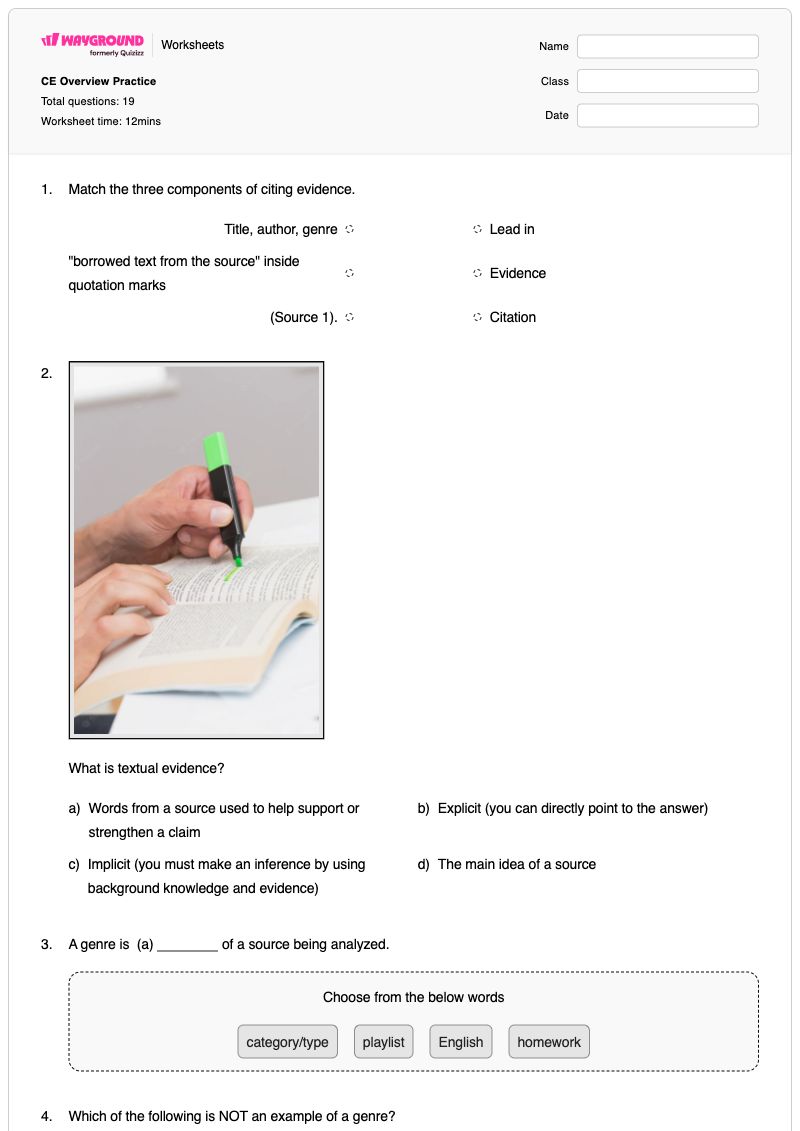
What is textual evidence?

What is textual evidence?

a)

Words from a source used to help support or strengthen a claim

b)

Explicit (you can directly point to the answer)

c)

Implicit (you must make an inference by using background knowledge and evidence)

d)

The main idea of a source

3.

A genre is ​ (a)   of a source being analyzed.

Choose from the below words
category/type
playlist
English
homework
4.

Which of the following is NOT an example of a genre?

a)

Novel

b)

Video

c)

Pencil

d)

Article

5.

Match the following

Genre

Type of source (article, video, story...

Title

Name of source

Author

The person who wrote the source

Citation

(Source 1).

Quotation Marks

"around evidence"

6.

At Ramona, we write paragraphs using the RACE structure. For the "C" or citing evidence, which of the following three statements are true?

a)

You should pick evidence that SUPPORTS or PROVES your answer

b)

Begin with a lead in (title, author, genre)

c)

You do not have to use "quotation marks" around the evidence

d)

Always cite your source with a citation (Source 1).

7.

You must always put your textual evidence in quotation marks?

a)

True

b)

False

8.

Which of the following is a citation?

a)

Lead in

b)

Genre

c)

(Source 1).

d)

Textual Evidence

9.

Please order the three components needed when citing evidence.

a)

Lead in

b)

Evidence

c)

Citation

1)
2)
3)
10.

If you are trying to cite a source and the source number is not listed, what should you write?

a)

(Source 1).

b)

Source 4

c)

Yell at Mrs. Rivas until she answers you

d)

3

11.

We will read many novels and stories this year. When punctuating the title of a story or novel it should be...

a)
all lower case

all lower case

b)
in "quotation marks"

in "quotation marks"

c)
italicized

italicized

d)
underlined

underlined

12.

Articles are one of the most common genres of sources we will analyze this year. When punctuating the title of an article it should be...

a)
all lower case

all lower case

b)
in "quotation marks"

in "quotation marks"

c)
italicized

italicized

d)
underlined

underlined

13.

Listen to the recording and then type in the correct spelling

(a)  

14.

Listen to the recording and then type in the correct spelling

(a)  

15.

Organize these options into the right categories

Categorize the following

Directly stated in the text

implied; the reader must use background knowledge

Words from a source used to support an answer

Explicit Evidence
Implicit Evidence
Both
16.

A lead-in has three pieces. In order, they are the ​ (a)   ​ of the source, the source's ​ (b)   and it's ​ (c)   .

Choose from the below words
author
genre
title
17.

Which of the following are text genres we will study in English class?

(Choose all that apply!)

a)

story

b)

novel

c)

article

d)

Chromebook

18.

Where should the quotation marks go? Draw " " where they should be in this textual evidence.

Where should the quotation marks go? Draw " " where they should be in this textual evidence.
19.

Textual evidence is ​ (a)   from a source or text that a writer uses to support an ​ (b)   .

Choose from the below words
words
answer
ingredients
recipe
WaygroundAnswer Key

CE Overview Practice

Total questions: 19

1.

Title, author, genre

 - 

Lead in

, 

"borrowed text from the source" inside quotation marks

 - 

Evidence

, 

(Source 1).

 - 

Citation

2.
a)

Words from a source used to help support or strengthen a claim

3.
category/type
4.
c)

Pencil

5.

Genre

 - 

Type of source (article, video, story...

, 

Title

 - 

Name of source

, 

Author

 - 

The person who wrote the source

, 

Citation

 - 

(Source 1).

, 

Quotation Marks

 - 

"around evidence"

6.
a)

You should pick evidence that SUPPORTS or PROVES your answer

, b)

Begin with a lead in (title, author, genre)

, d)

Always cite your source with a citation (Source 1).

7.
a)

True

8.
c)

(Source 1).

9.
a, b, c
10.
a)

(Source 1).

11.
c)

12.
b)

13.
article
14.
source
15.
Explicit Evidence

Directly stated in the text

Implicit Evidence

implied; the reader must use background knowledge

Both

Words from a source used to support an answer

16.
title, author, genre
17.
a)

story

, b)

novel

, c)

article

18.
n/a
19.
words, answer

FAQs

What does the CE Overview Practice worksheet cover?

This Grade 6 English worksheet teaches students to cite textual evidence using the RACE structure. Across 19 varied items, students identify evidence and genres, distinguish explicit from implied information, and apply the sequence of lead-in, quoted evidence, and citation. Matching, ordering, multiple-select, classification, and other formats require students to use the citation components rather than simply define them.

How can I use this worksheet to teach citing textual evidence?

Introduce the RACE “C” step by modeling how a source’s title, author, and genre create a lead-in before quoted evidence and a citation. Then have students complete the matching and ordering items before the multiple-choice and multiple-select questions, explaining why chosen evidence supports an answer. Use the classification items to discuss the difference between information stated directly and meaning inferred with background knowledge.

What mistakes should I watch for on the CE Overview Practice worksheet?

Students may confuse a lead-in, the quoted textual evidence, and the source citation, or place those three components in the wrong order. Watch for students selecting evidence that does not support the claim, omitting quotation marks, or treating an implied idea as directly stated. They may also mistake a genre for a non-source object or confuse the citation format with the source title or author.

How do I assign and grade the CE Overview Practice worksheet?

CE Overview Practice is available as a printable PDF and as a digital quiz on Wayground, with a complete answer key for all 19 items. You can print it for written practice or assign the digital version for online responses. Printable submissions can also be graded by scanning student work with the Wayground for Teachers app.

How can I differentiate this worksheet for my students?

In the worksheet’s Advanced Settings, adjust font spacing and font size to make the matching, ordering, and written-response items easier to navigate. You can also enable a dyslexia-friendly font for the citation terms and source vocabulary, or translate the worksheet into another language to support access to the instructions and prompts.

Where can I find more worksheets like this on Wayground?

Wayground offers a broad collection of free printable worksheets and practice problems across subjects, with downloadable PDFs and answer keys to help students build essential skills and concepts. Browse more resources at https://wayground.com/en-us/worksheets.