
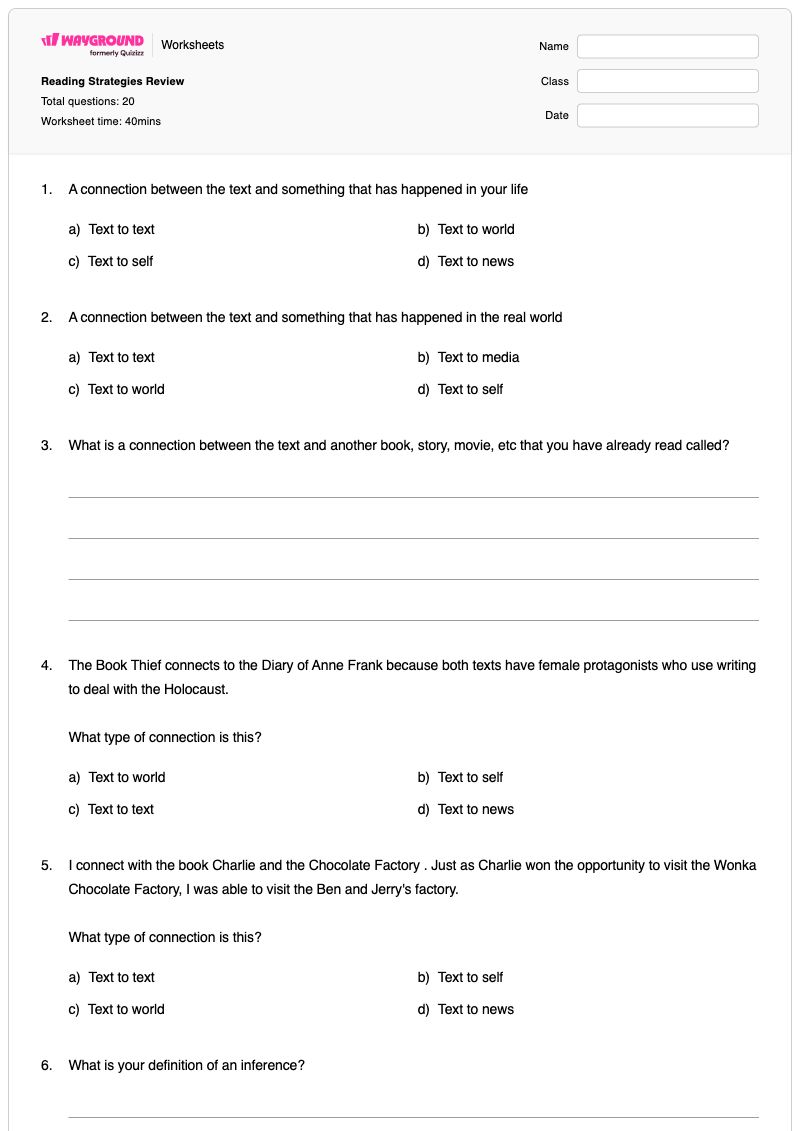

Reading Strategies Review is a free printable English worksheet for Grade 6 students that checks understanding of essential active-reading strategies. Across 20 questions—11 multiple-choice, 4 open-ended, 4 multiple-select, and 1 fill-in-the-blank—students identify text-to-self, text-to-text, and text-to-world connections; define inference; activate prior knowledge; visualize details; ask strategy-based questions; make predictions; and distinguish active from passive reading.
The worksheet combines terminology review with examples from texts and real-world situations, requiring students to classify connections and explain how they think as readers. Open-ended prompts ask students to define inference and generate questions for different connection types, while selected-response items check precise recognition of strategies and their purposes. Use it as a review, formative assessment, or independent practice activity. This free printable worksheet includes a complete answer key for efficient checking and feedback.
Worksheet settings
Font size
S
M
L
XL
Worksheets
Reading Strategies Review
Total questions: 20
Name
Class
Date
1.
A connection between the text and something that has happened in your life
a)
Text to text
b)
Text to world
c)
Text to self
d)
Text to news
2.
A connection between the text and something that has happened in the real world
a)
Text to text
b)
Text to media
c)
Text to world
d)
Text to self
3.
What is a connection between the text and another book, story, movie, etc that you have already read called?
4 lines
4.
The Book Thief connects to the Diary of Anne Frank because both texts have female protagonists who use writing to deal with the Holocaust.
What type of connection is this?
a)
Text to world
b)
Text to self
c)
Text to text
d)
Text to news
5.
I connect with the book Charlie and the Chocolate Factory . Just as Charlie won the opportunity to visit the Wonka Chocolate Factory, I was able to visit the Ben and Jerry's factory.
What type of connection is this?
a)
Text to text
b)
Text to self
c)
Text to world
d)
Text to news
6.
What is your definition of an inference?
4 lines
7.
The Lion, the Witch, and the Wardrobe connects to the American Revolution because just like the Colonists fought against Great Britain, the four siblings fight against the White Witch.
a)
Text to world
b)
Text to text
c)
Text to self
d)
Text to media
8.
When we ---- we ask ourselves what we already know about the topic.
(a)
9.
What are some things we could visualize while reading?
a)
What the setting looks like
b)
What the characters look like
c)
What we remember the character looks like in a movie
d)
10.
Which is NOT a strategy we have learned?
a)
Ask questions
b)
Make predictions
c)
Make a connection
d)
Skim the text
11.
What is one question you could ask yourself if you are making a text to SELF connection?
4 lines
12.
What is one question you could ask yourself when making a text to TEXT connection?
4 lines
13.
Which of the following are questions you could ask yourself while making a text to WORLD connection?
a)
How does this relate to my life?
b)
What does this remind me of in another text I read?
c)
What does this remind me of in the real world?
d)
How are events in this text the same as events that are happening in the world today?
14.
When you make a _________, you are guessing what will happen next
a)
Clarifying
b)
Prediction
c)
Connection
15.
____________ reading means being an interested and focused reader
a)
Passive
b)
Active
c)
Bored
16.
An inference is...
a)
Text evidence + what you know
b)
Retelling a text
c)
Making a guess without evidence
d)
Information written directly into the text.
17.
Create mental images of the settings, characters, and events in the text.
a)
Connect
b)
Visualize
c)
Clarify
d)
Evaluate
18.
What is Questioning?
a)
Asking questions of the text after you read
b)
Asking questions of the text as you read
Questions you have about the text may:
Come before you read
During reading
After reading
c)
Asking questions of the text before you read
d)
Only asking questions of the text during reading
19.
What do good readers do when they are reading?
a)
Visualize while they are reading.
b)
Talk to their mom about what they are going to do over the weekend.
c)
Just keep reading even if it doesn't make sense.
d)
Wonder why their teacher loves the color purple
20.
How confident do you feel about using these reading strategies?
a)
I feel okay
b)
I need a little more practice
c)
I am super confused
d)
I feel great and I could teach someone else
Answer Key
Reading Strategies Review
Total questions: 20
1.
c)
Text to self
2.
c)
Text to world
3.
n/a
4.
c)
Text to text
5.
b)
Text to self
6.
n/a
7.
a)
Text to world
8.
activate prior knowledge
9.
b)
What the characters look like
, a)
What the setting looks like
, c)
What we remember the character looks like in a movie
, d)
10.
d)
Skim the text
11.
n/a
12.
n/a
13.
c)
What does this remind me of in the real world?
, d)
How are events in this text the same as events that are happening in the world today?
14.
b) Prediction
15.
b) Active
16.
a) Text evidence + what you know
17.
b) Visualize
18.
b)
Asking questions of the text as you read
Questions you have about the text may:
Come before you read
During reading
After reading
19.
a) Visualize while they are reading.
20.
n/a
140 %
Browse by subjects
Browse by grades
Browse by format
FAQs
What does the Reading Strategies Review worksheet cover?
This Grade 6 English worksheet reviews active-reading strategies through 20 mixed-format questions. Students classify text-to-self, text-to-text, and text-to-world connections, define inference, activate prior knowledge, identify visualization and prediction strategies, and write questions they can ask themselves while reading.
How can I use this worksheet to teach reading strategies?
Introduce the three connection types with a shared example, then have students explain why a situation connects to their life, another text, or the real world. Use the worksheet’s examples—such as comparing The Book Thief with The Diary of Anne Frank—to model text-to-text thinking, and follow the open-ended prompts with discussion about questions readers ask themselves.
What mistakes should I watch for when students complete this reading strategies worksheet?
Students may confuse text-to-self with text-to-world connections, especially when a text event resembles a personal experience and a broader real-world event. Also watch for students labeling a connection as a prediction, treating “skimming the text” as one of the reviewed strategies, or giving a question that does not match the required connection type.
How do I assign and grade this Reading Strategies Review worksheet?
Assign it as a printable PDF or as a digital quiz on Wayground. The worksheet includes a complete answer key, and printable submissions can be graded by scanning student work with the Wayground for Teachers app. The printable format also gives schools an option for reducing screen time while reviewing reading strategies.
How can I differentiate this reading strategies worksheet for my students?
In the worksheet’s Advanced Settings, adjust font spacing and font size to make the multiple-choice, multiple-select, fill-in-the-blank, and open-ended items easier to navigate. You can also apply a dyslexia-friendly font or translate the worksheet into another language when that better supports access to its reading-strategy prompts.
Where can I find more worksheets like this on Wayground?
Wayground offers a comprehensive collection of free printable worksheets and practice problems across subjects, with downloadable PDFs and answer keys to support essential skills and concepts. Browse more resources at https://wayground.com/en-us/worksheets.