


Wayground
Demand - Printable Social studies Worksheets year 12 - Wayground

Demand

Kyle Anderson

By Kyle Anderson

10 questions

12th - 12th Grade

Social studies

1.8K plays

Updated Sept 2026

This Grade 12 Social Studies economics worksheet builds students’ understanding of demand and how consumers respond to price changes. It covers the definition of demand, the law of demand, changes in quantity demanded, changes in demand, and elasticity. Students complete eight multiple-choice questions and two multiple-select questions that require them to distinguish related economic terms and interpret examples of elastic and inelastic demand. The worksheet is especially useful for checking whether students can apply demand vocabulary to real-world price-and-purchasing situations rather than relying on definitions alone. Items address increases and decreases in quantity demanded and ask students to identify situations in which consumers respond strongly or weakly to price changes. This free printable worksheet is designed for Grade 12 economics instruction, review, or assessment and includes a complete answer key for efficient grading.

Worksheet settings

Font size

S
M
L
XL
WaygroundWorksheets

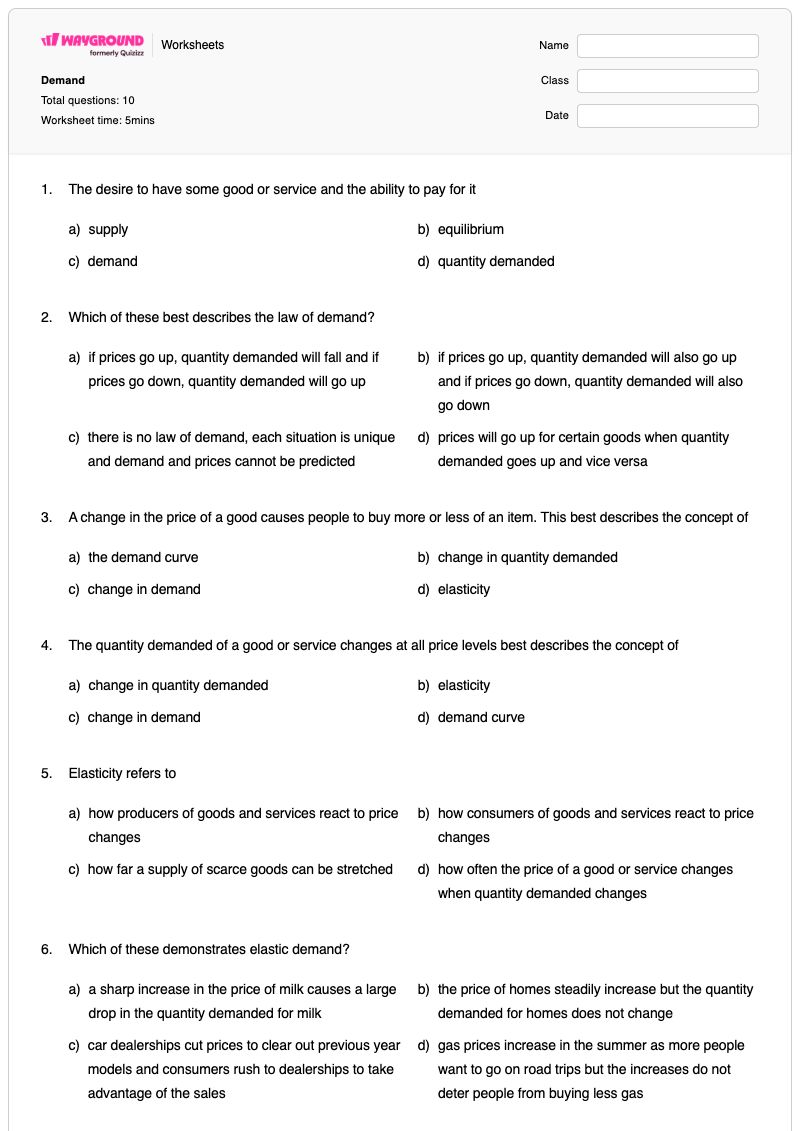
Demand

Total questions: 10

Name
Class
Date
1.

The desire to have some good or service and the ability to pay for it

a)

supply

b)

equilibrium

c)

demand

d)

quantity demanded

2.

Which of these best describes the law of demand?

a)

if prices go up, quantity demanded will fall and if prices go down, quantity demanded will go up

b)

if prices go up, quantity demanded will also go up and if prices go down, quantity demanded will also go down

c)

there is no law of demand, each situation is unique and demand and prices cannot be predicted

d)

prices will go up for certain goods when quantity demanded goes up and vice versa

3.

A change in the price of a good causes people to buy more or less of an item. This best describes the concept of

a)

the demand curve

b)

change in quantity demanded

c)

change in demand

d)

elasticity

4.

The quantity demanded of a good or service changes at all price levels best describes the concept of

a)

change in quantity demanded

b)

elasticity

c)

change in demand

d)

demand curve

5.

Elasticity refers to

a)

how producers of goods and services react to price changes

b)

how consumers of goods and services react to price changes

c)

how far a supply of scarce goods can be stretched

d)

how often the price of a good or service changes when quantity demanded changes

6.

Which of these demonstrates elastic demand?

a)

a sharp increase in the price of milk causes a large drop in the quantity demanded for milk

b)

the price of homes steadily increase but the quantity demanded for homes does not change

c)

car dealerships cut prices to clear out previous year models and consumers rush to dealerships to take advantage of the sales

d)

gas prices increase in the summer as more people want to go on road trips but the increases do not deter people from buying less gas

7.

Which of these demonstrates inelastic demand? (multiple answers)

a)

a cold snap destroys an apple crop causing prices to jump, however, people still buy apples and quantity demanded does not change

b)

Super Bowl tickets hit record high prices but are still sold out in a matter of minutes and starting going for even higher prices on resale sites

c)

concert tickets are not selling well, so the venue drops prices by 80%; the tickets sell out shortly thereafter

d)

a restaurant starts charging a $10 delivery fee, delivery orders drop by 50% in the first month

8.

Which of these shows a decrease in the quantity demanded?

a)
Which of these shows a decrease in the quantity demanded?
b)
Which of these shows a decrease in the quantity demanded?
c)
Which of these shows a decrease in the quantity demanded?
d)
Which of these shows a decrease in the quantity demanded?
9.

Which of these shows an increase in the quantity demanded?

a)
Which of these shows an increase in the quantity demanded?
b)
Which of these shows an increase in the quantity demanded?
c)
Which of these shows an increase in the quantity demanded?
d)
Which of these shows an increase in the quantity demanded?
10.

Which of these demonstrates inelastic demand?

a)
Which of these demonstrates inelastic demand?
b)
Which of these demonstrates inelastic demand?
c)
Which of these demonstrates inelastic demand?
d)
Which of these demonstrates inelastic demand?
WaygroundAnswer Key

Demand

Total questions: 10

1.
c)

demand

2.
a)

if prices go up, quantity demanded will fall and if prices go down, quantity demanded will go up

3.
b)

change in quantity demanded

4.
c)

change in demand

5.
b)

how consumers of goods and services react to price changes

6.
a)

a sharp increase in the price of milk causes a large drop in the quantity demanded for milk

, c)

car dealerships cut prices to clear out previous year models and consumers rush to dealerships to take advantage of the sales

7.
a)

a cold snap destroys an apple crop causing prices to jump, however, people still buy apples and quantity demanded does not change

, b)

Super Bowl tickets hit record high prices but are still sold out in a matter of minutes and starting going for even higher prices on resale sites

8.
a)
9.
b)
10.
d)

FAQs

What does this demand worksheet cover?

This Grade 12 economics worksheet uses eight multiple-choice and two multiple-select questions to assess demand vocabulary and consumer responses to price changes. Students distinguish demand from quantity demanded, identify the law of demand, separate a change in quantity demanded from a change in demand, and classify examples as elastic or inelastic demand.

How can I use this worksheet to teach the difference between demand and quantity demanded?

Introduce demand as both the desire for a good or service and the ability to pay, then review how price changes affect quantity demanded under the law of demand. Before students complete the multiple-choice items, have them explain whether a situation reflects movement in quantity demanded or a broader change in demand; use the multiple-select elasticity scenarios afterward to discuss how strongly consumers respond to price changes.

What mistakes should I watch for when students complete this demand worksheet?

Students may confuse demand with quantity demanded, treating a price-driven change in purchases as a change in demand. They may also reverse the law of demand by saying quantity demanded rises when price rises, or select only one answer on the multiple-select questions about elastic and inelastic demand. Check that students use the size of the purchasing response—not simply the fact that a price changed—to classify elasticity.

How do I assign and grade this demand worksheet?

The worksheet is available as a printable PDF and as a digital quiz on Wayground, with a complete answer key covering all eight multiple-choice and two multiple-select questions. You can grade printable submissions by scanning student work with the Wayground for Teachers app. The printable option also supports schools that want to reduce screen time.

How can I differentiate this demand worksheet for my students?

Use the worksheet’s Advanced Settings to adjust font spacing and font size so the demand definitions and price-response scenarios are easier to read. You can also apply a dyslexia-friendly font or translate the worksheet into another language, helping students access the multiple-choice and multiple-select questions without changing the economics concepts being assessed.

Where can I find more worksheets like this on Wayground?

Wayground offers a comprehensive collection of free printable worksheets and practice problems across subjects, with downloadable PDFs and answer keys to help students master essential skills and concepts. Browse more resources at https://wayground.com/en-us/worksheets.