Mean, Median, Mode, Range, & Outlier is a Grade 4–6 mathematics worksheet that builds fluency with five measures of data. Students calculate means from whole-number and decimal sets, find an average from test grades, determine medians—including the average of two middle values—identify a single mode or two modes, calculate range, and select outliers in numerical data. The final multiple-choice question asks students to predict how adding a score of 100 changes an existing average.
The worksheet contains 12 questions: 11 fill-in-the-blank items and 1 multiple-choice item. It gives students focused practice choosing and applying the correct procedure for each measure rather than only recognizing definitions. This free printable worksheet includes a complete answer key, making it suitable for independent practice, review, homework, or a quick check of understanding after instruction.
Worksheet settings
Font size
S
M
L
XL
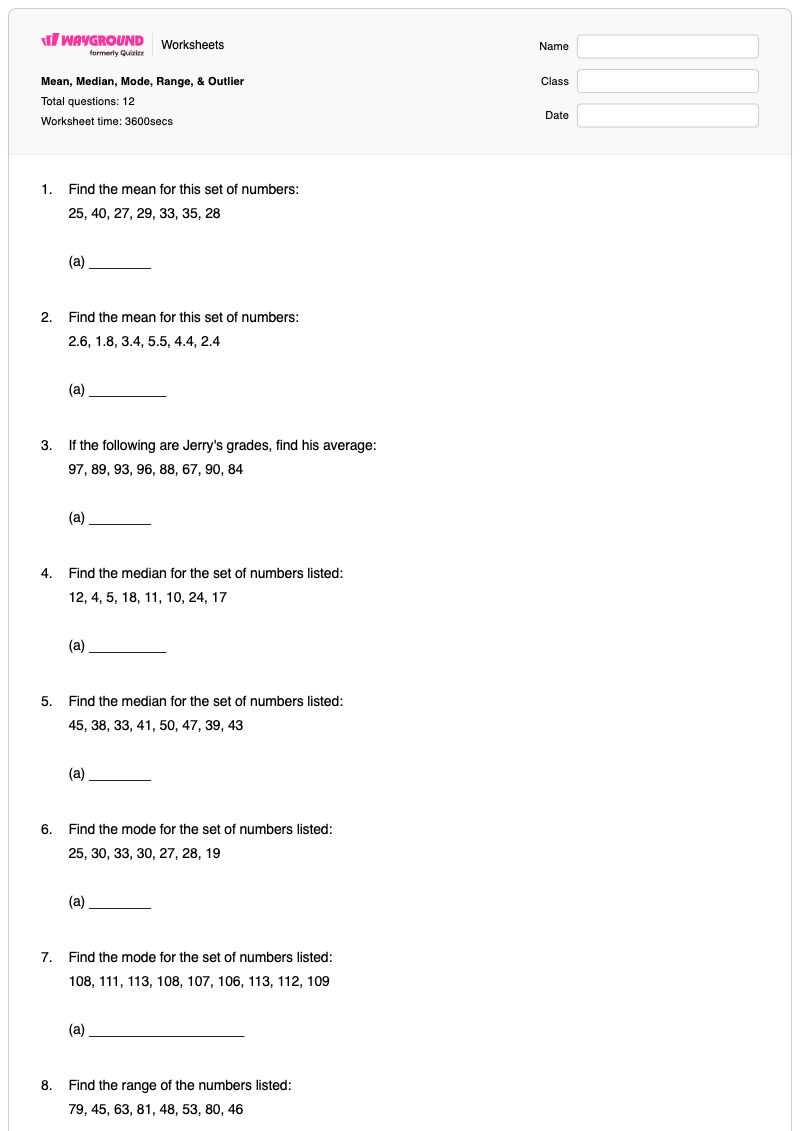
Worksheets
Mean, Median, Mode, Range, & Outlier
Total questions: 12
Name
Class
Date
1.
Find the mean for this set of numbers:
25, 40, 27, 29, 33, 35, 28
(a)
2.
Find the mean for this set of numbers:
2.6, 1.8, 3.4, 5.5, 4.4, 2.4
(a)
3.
If the following are Jerry's grades, find his average:
97, 89, 93, 96, 88, 67, 90, 84
(a)
4.
Find the median for the set of numbers listed:
12, 4, 5, 18, 11, 10, 24, 17
(a)
5.
Find the median for the set of numbers listed:
45, 38, 33, 41, 50, 47, 39, 43
(a)
6.
Find the mode for the set of numbers listed:
25, 30, 33, 30, 27, 28, 19
(a)
7.
Find the mode for the set of numbers listed:
108, 111, 113, 108, 107, 106, 113, 112, 109
(a)
8.
Find the range of the numbers listed:
79, 45, 63, 81, 48, 53, 80, 46
(a)
9.
Find the range of the numbers listed:
13, 12, 8, 10, 14, 7, 8, 4, 16, 12, 3, 11, 9
(a)
10.
Find the outlier for the numbers listed:
88, 84, 91, 77, 45, 100, 94, 72
(a)
11.
Find the outlier for the numbers listed:
1.07, 2.1, 1.13, 10.1, 2.3, 1.9, 2.01
(a)
12.
If Barbara had the following scores on her tests; 76, 87, 73, 85, 91, & 78, how would making a 100 on her next test affect her average?
a)
Barbara's average would go up
b)
Barbara's average would go down
c)
Barbara's average wouldn't change
Answer Key
Mean, Median, Mode, Range, & Outlier
Total questions: 12
1.
31
2.
3.35
3.
88
4.
11.5
5.
42
6.
30
7.
108 and 113, 113 and 108, 108 & 113, 113 & 108, 108and113, 113and108, 108&113, 113&108, 108, 113, 113, 108
8.
36
9.
13
10.
45
11.
10.1
12.
a)
Barbara's average would go up
140 %
Browse by subjects
Browse by grades
Browse by format
FAQs
What does the Mean, Median, Mode, Range, & Outlier worksheet cover?
This Grade 4–6 mathematics worksheet uses 11 fill-in-the-blank questions and 1 multiple-choice question to practise calculating mean, median, mode, and range, identifying outliers, and interpreting how a new score affects an average. Students work with whole numbers, decimals, grade averages, even-sized data sets that require averaging two middle values, and a data set with two modes.
How can I use this worksheet to teach mean, median, mode, range, and outliers?
Use the fill-in-the-blank items to model one measure at a time: add and divide for the mean, order the data before finding the median, identify repeated values for the mode, subtract the least value from the greatest for the range, and compare unusually distant values when identifying an outlier. Finish with the Barbara score question to discuss why adding 100 makes an existing average go up, asking students to explain the change rather than only select an answer.
What mistakes should I watch for when students complete this worksheet?
Students may divide by the wrong number when finding the mean, fail to order the values before finding the median, or choose a repeated value without noticing that the mode question has two modes. They may also subtract in the wrong direction for range or overlook the unusually distant values 45 and 10.1 in the outlier questions. For the final multiple-choice item, check that students understand a new score above the current average raises the average.
How do I assign and grade this worksheet?
This worksheet is available as a printable PDF and as a digital quiz on Wayground, and it includes a complete answer key for the 12 questions. You can grade printable submissions by scanning student work with the Wayground for Teachers app, or review responses through the digital quiz. The printable format can also support schools that are reducing screen time.
How can I differentiate this worksheet for my students?
In the worksheet’s Advanced Settings, adjust font spacing and font size to make the numerical fill-in-the-blank items and the final multiple-choice question easier to read. You can also select a dyslexia-friendly font or translate the worksheet into another language when those options support access to the mean, median, mode, range, and outlier tasks.
Where can I find more worksheets like this on Wayground?
Wayground offers a broad collection of free printable worksheets and practice problems across subjects, with downloadable PDFs and answer keys to help students build essential skills and concepts. Browse more resources at https://wayground.com/en-us/worksheets.


 Worksheets