
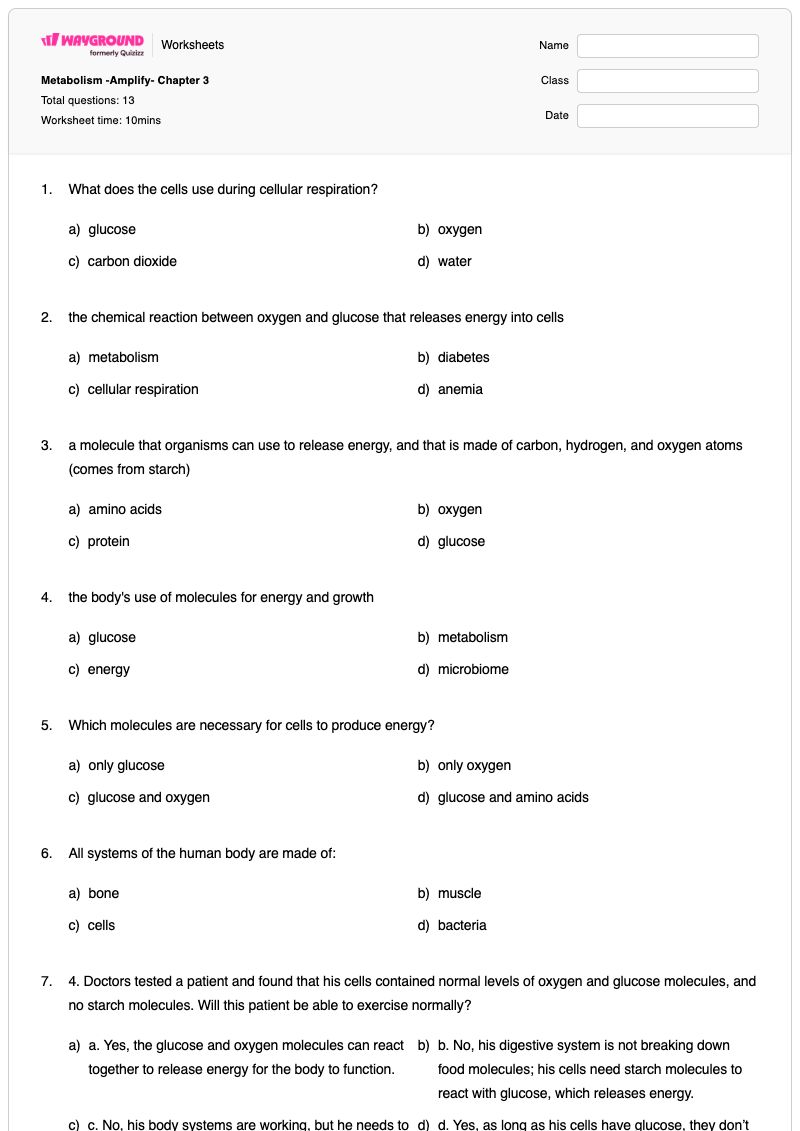

Metabolism -Amplify- Chapter 3 is a Grade 7 science worksheet that builds understanding of how cells obtain and use energy. Students identify the molecules involved in cellular respiration, distinguish glucose, oxygen, metabolism, and related terms, and explain that glucose and oxygen react in mitochondria to produce energy, carbon dioxide, and water. The worksheet also connects cellular processes to body systems, including digestion and respiration.
The 13-item assessment includes one multiple-select question and 12 multiple-choice questions. Students apply their understanding to a patient exercise scenario, identify where physical food breakdown begins, recognize the respiratory system’s role in gas exchange, and determine how increased oxygen affects cellular respiration and energy production. This free printable worksheet is suitable for Grade 7 science instruction, review, or formative assessment and includes a complete answer key for efficient checking.
Worksheet settings
Font size
S
M
L
XL
Worksheets
Metabolism -Amplify- Chapter 3
Total questions: 13
Name
Class
Date
1.
What does the cells use during cellular respiration?
a)
glucose
b)
oxygen
c)
carbon dioxide
d)
water
2.
the chemical reaction between oxygen and glucose that releases energy into cells
a)
metabolism
b)
diabetes
c)
cellular respiration
d)
anemia
3.
a molecule that organisms can use to release energy, and that is made of carbon, hydrogen, and oxygen atoms (comes from starch)
a)
amino acids
b)
oxygen
c)
protein
d)
glucose
4.
the body's use of molecules for energy and growth
a)
glucose
b)
metabolism
c)
energy
d)
microbiome
5.
Which molecules are necessary for cells to produce energy?
a)
only glucose
b)
only oxygen
c)
glucose and oxygen
d)
glucose and amino acids
6.
All systems of the human body are made of:
a)
bone
b)
muscle
c)
cells
d)
bacteria
7.
4. Doctors tested a patient and found that his cells contained normal levels of oxygen and glucose molecules, and no starch molecules. Will this patient be able to exercise normally?
a)
a. Yes, the glucose and oxygen molecules can react together to release energy for the body to function.
b)
b. No, his digestive system is not breaking down food molecules; his cells need starch molecules to react with glucose, which releases energy.
c)
c. No, his body systems are working, but he needs to eat different food; in cells, only amino acids can react with oxygen to release energy
d)
d. Yes, as long as his cells have glucose, they don’t need anything else to release energy for the body to function.
8.
What do we call the body's use of molecules for energy and growth?
a)
glucose
b)
metabolism
c)
energy
d)
microbiome
9.
Which body part begins the physical breakdown of food?
a)
the mouth
b)
the heart
c)
the stomach
d)
the lungs
10.
Which human body system take in oxygen and releases carbon dioxide?
a)
respiratory
b)
digestive
c)
circulatory
d)
integumentary
11.
Oxygen and glucose enter the cell and go into the mitochondria and _________and____________comes out of the mitochondria.
a)
protein and carbon dioxide
b)
fiber and water
c)
amino acids and protein
d)
carbon dioxide and water
12.
Which molecule do organisms get from the air?
a)
glucose
b)
amino acids
c)
carbon dioxide
d)
oxygen
13.
What effect does more oxygen in your cells have on cellular respiration?
a)
It harms cellular respiration which decreases the energy cells create
b)
It harms cellular respiration which increases the energy cells create
c)
It improves cellular respiration which decreases the energy cells create
d)
It improves cellular respiration which increases the energy cells create
Answer Key
Metabolism -Amplify- Chapter 3
Total questions: 13
1.
a)
glucose
, b)
oxygen
, d)
water
2.
c)
cellular respiration
3.
d)
glucose
4.
b)
metabolism
5.
c)
glucose and oxygen
6.
c)
cells
7.
a)
a. Yes, the glucose and oxygen molecules can react together to release energy for the body to function.
8.
b)
metabolism
9.
a)
the mouth
10.
a)
respiratory
11.
d)
carbon dioxide and water
12.
d)
oxygen
13.
d)
It improves cellular respiration which increases the energy cells create
140 %
Browse by subjects
Browse by grades
Browse by format
FAQs
What does this worksheet cover, and how does it help students understand cellular respiration?
This Grade 7 science worksheet uses one multiple-select and 12 multiple-choice questions to assess how glucose and oxygen support cellular respiration. Students identify metabolism as the body’s use of molecules for energy and growth, trace glucose and oxygen to the mitochondria, and recognize carbon dioxide and water as products. The questions also connect these cellular events to digestion, respiration, and the function of body systems.
How can I use this worksheet to teach metabolism and cellular respiration?
Introduce the worksheet by reviewing where organisms obtain glucose and oxygen, then use the first multiple-select item to discuss which molecules cells use during cellular respiration. Have students explain the mitochondria item in their own words and connect it to the patient exercise scenario. Finish by discussing how the mouth, digestive system, and respiratory system help supply cells with the materials needed for energy release.
What mistakes should I watch for when students complete this metabolism worksheet?
Watch for students selecting carbon dioxide as an input of cellular respiration or treating starch as a molecule that cells need to react with glucose. Students may also confuse metabolism with cellular respiration, choose the digestive system instead of the respiratory system for oxygen and carbon dioxide exchange, or reverse the products carbon dioxide and water. In the oxygen question, check that students understand more oxygen improves cellular respiration and increases the energy cells create.
How do I assign and grade this metabolism worksheet?
This worksheet is available as a printable PDF and as a digital quiz on Wayground, so you can assign the format that fits your lesson. It includes a complete answer key for the one multiple-select item and 12 multiple-choice questions. Printable student work can also be graded by scanning it with the Wayground for Teachers app.
How can I differentiate this cellular respiration worksheet for my students?
Use the worksheet’s Advanced Settings to adjust font spacing or increase the font size, making the cellular respiration questions and answer choices easier to read. You can also enable a dyslexia-friendly font or translate the worksheet into another language when those options support access to the metabolism and body-systems content.
Where can I find more worksheets like this on Wayground?
Wayground offers a comprehensive collection of free printable worksheets and practice problems across all subjects, with downloadable PDFs and answer keys to help students master essential skills and concepts. Browse more resources at https://wayground.com/en-us/worksheets.