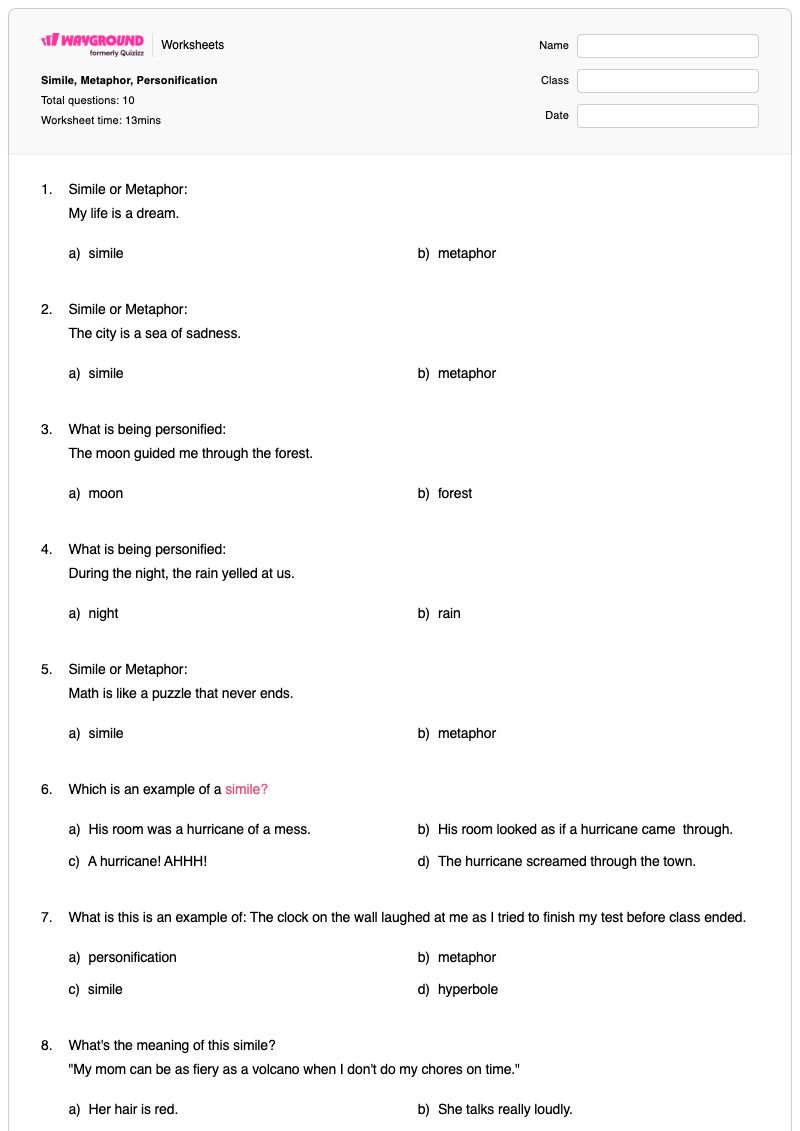
This Grade 6 English worksheet helps students distinguish among similes, metaphors, and personification. Across 10 questions—9 multiple-choice items and 1 multiple-select item—students classify figurative language, identify the object being personified, recognize similes in context, and interpret the meaning of a comparison such as describing someone as “as fiery as a volcano.”
The examples use familiar situations involving school, family, weather, animals, and everyday experiences, giving students practice applying figurative-language definitions rather than memorizing them in isolation. The worksheet is suitable for guided instruction, independent practice, or a quick formative assessment of students’ ability to recognize comparison clues and explain implied meaning. It is a free printable worksheet with a complete answer key for convenient checking.
Worksheet settings
Font size
S
M
L
XL
Worksheets
Simile, Metaphor, Personification
Total questions: 10
Name
Class
Date
1.
Simile or Metaphor: My life is a dream.
a)
simile
b)
metaphor
2.
Simile or Metaphor: The city is a sea of sadness.
a)
simile
b)
metaphor
3.
What is being personified: The moon guided me through the forest.
a)
moon
b)
forest
4.
What is being personified: During the night, the rain yelled at us.
a)
night
b)
rain
5.
Simile or Metaphor: Math is like a puzzle that never ends.
a)
simile
b)
metaphor
6.
Which is an example of a simile?
a)
His room was a hurricane of a mess.
b)
His room looked as if a hurricane came through.
c)
A hurricane! AHHH!
d)
The hurricane screamed through the town.
7.
What is this is an example of: The clock on the wall laughed at me as I tried to finish my test before class ended.
a)
personification
b)
metaphor
c)
simile
d)
hyperbole
8.
What's the meaning of this simile? "My mom can be as fiery as a volcano when I don't do my chores on time."
a)
Her hair is red.
b)
She talks really loudly.
c)
She gets really angry.
d)
She spits when she talks.
9.
Check all responses that ARE similes.
a)
Watching this movie is like watching grass grow.
b)
Those kids are fighting like cats and dogs.
c)
I like to eat steak and potatoes.
d)
He should have threw it away as he walked by the trash can.
e)
He is as fast as a cheetah.
10.
This is a simile:
I slept like a log.
a)
True
b)
False
Answer Key
Simile, Metaphor, Personification
Total questions: 10
1.
b) metaphor
2.
b) metaphor
3.
a) moon
4.
b) rain
5.
a) simile
6.
b) His room looked as if a hurricane came through.
7.
a) personification
8.
c) She gets really angry.
9.
a)
Watching this movie is like watching grass grow.
, b)
Those kids are fighting like cats and dogs.
, e)
He is as fast as a cheetah.
10.
a)
True
140 %
Browse by subjects
Browse by grades
Browse by format
FAQs
What does the Simile, Metaphor, Personification worksheet cover?
This Grade 6 English worksheet uses 9 multiple-choice questions and 1 multiple-select question to assess whether students can identify similes, metaphors, and personification. Students classify statements such as “My life is a dream,” identify what is being personified in sentences about the moon, rain, and a clock, select all sentences that are similes, and interpret a simile’s intended meaning.
How can I use this worksheet to teach similes, metaphors, and personification?
Introduce the three forms by having students look for comparison clues such as “like,” “as,” or “as if,” then contrast those with direct comparisons and human actions given to nonhuman things. Work through one classification item together, ask students to explain why the moon, rain, or clock is being personified, and then use the multi-select item to discuss why each option does or does not meet the definition. Finish with the meaning question to connect figurative language to its implied idea, not just its surface words.
What mistakes should I watch for when students complete this figurative-language worksheet?
Students may label every comparison containing “as” or “like” incorrectly without checking how the phrase functions, or confuse a metaphor such as “My life is a dream” with a simile. They may also choose the setting instead of the object receiving human actions in the personification items, interpret “fiery as a volcano” literally, or select only one correct response in the multi-select question. Remind students to evaluate each option independently and identify the intended meaning.
How do I assign and grade this simile, metaphor, and personification worksheet?
The worksheet is available as a printable PDF and as a digital quiz on Wayground, and it includes a complete answer key for all 10 items. Printable submissions can be graded by scanning student work with the Wayground for Teachers app, while the digital quiz can be assigned and reviewed online.
How can I differentiate this worksheet for my students?
Use the worksheet’s Advanced Settings to adjust font spacing or increase the font size so the figurative-language examples and answer choices are easier to follow. You can also enable a dyslexia-friendly font or translate the worksheet into another language, while keeping the simile, metaphor, and personification questions intact.
Where can I find more worksheets like this on Wayground?
Wayground offers a broad collection of free printable worksheets and practice problems across subjects, with downloadable PDFs and answer keys to support essential skills and concepts. Browse more resources at https://wayground.com/en-us/worksheets.

 Worksheets