

Wayground
Money, Banking, and the Federal Reserve - Printable Social studies Worksheets 10th Grade - Wayground

Money, Banking, and the Federal Reserve

Michael Anglemire

Created by Michael Anglemire

16 questions

10th Grade

Social studies

Updated Mar 2026

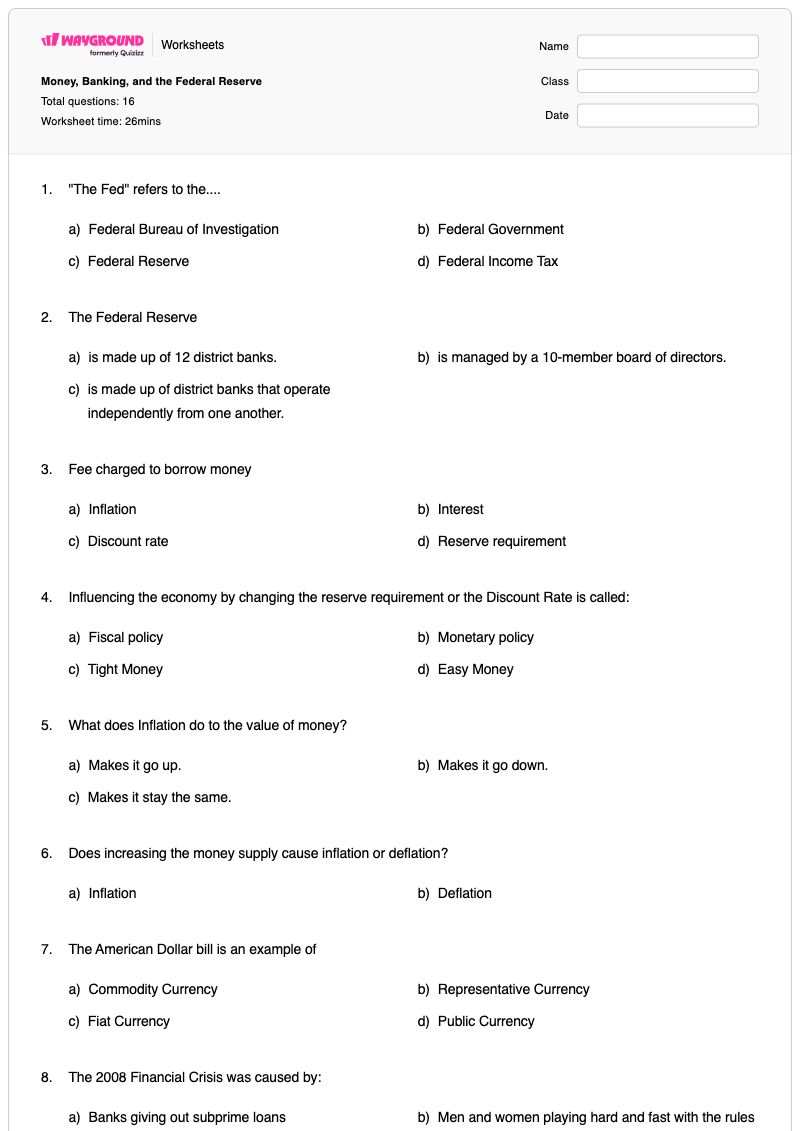
Money, Banking, and the Federal Reserve is a Grade 10 social studies worksheet that checks students’ understanding of core economics vocabulary and institutions. Across 16 questions—15 multiple-choice items and one multiple-select item—students identify the Federal Reserve and its 12 district banks, distinguish monetary policy from related terms, and explain how inflation and changes in the money supply affect money’s value. They also classify the dollar as fiat currency and connect subprime loans to the 2008 financial crisis. The worksheet further asks students to apply definitions of interest, character, capacity, and capital in lending, and to distinguish money’s roles as a medium of exchange, unit of account, and store of value. These targeted questions help students match economic terms with their meanings and recognize how banking concepts operate in real-world contexts. It is a free printable worksheet with a complete answer key for classroom practice, review, or assessment.

Worksheet settings

Font size

S
M
L
XL
WaygroundWorksheets

Money, Banking, and the Federal Reserve

Total questions: 16

Name
Class
Date
1.

"The Fed" refers to the....

a)

Federal Bureau of Investigation

b)

Federal Government

c)

Federal Reserve

d)

Federal Income Tax

2.

The Federal Reserve

a)

is made up of 12 district banks.

b)

is managed by a 10-member board of directors.

c)

is made up of district banks that operate independently from one another.

3.
Fee charged to borrow money
a)
Inflation
b)
Interest
c)
Discount rate
d)
Reserve requirement
4.

Influencing the economy by changing the reserve requirement or the Discount Rate is called:

a)

Fiscal policy

b)

Monetary policy

c)

Tight Money

d)

Easy Money

5.
What does Inflation do to the value of money?
a)
Makes it go up.
b)
Makes it go down.
c)
Makes it stay the same.
6.
Does increasing the money supply cause inflation or deflation?
a)
Inflation
b)
Deflation
7.
The American Dollar bill is an example of
a)
Commodity Currency
b)
Representative Currency
c)
Fiat Currency
d)
Public Currency
8.

The 2008 Financial Crisis was caused by:

a)

Banks giving out subprime loans

b)

Men and women playing hard and fast with the rules

c)

The Illuminati

9.

Character:

a)

Will you pay back the loan?

b)

Can you pay the loan back?

c)

What can the bank take if you don't take back the loan?

10.

Capacity:

a)

Can you pay back the loan?

b)

Will you pay back the loan?

c)

What can the bank take if you don't pay back the loan?

11.

Capital:

a)

What can the bank take if you don't pay back the loan?

b)

Will you pay back the loan?

c)

Can you pay back the loan?

12.

Medium of exchange:

a)

Money is accepted in exchange for goods/services

b)

Money is a measurement of value

c)

Money can maintain value over time

13.

Unit of Account:

a)

Money is a measurement of value

b)

Money is accepted in exchange for goods/services

c)

Money can maintain value over time

14.

Store of Value:

a)

Money can maintain value over time

b)

Money is a measurement of value

c)

Money is accepted in exchange for goods/services

15.

Subprime loan:

a)

Loans made to people who have struggled to pay back loans in the past

b)

Loans made to people who always pay their loans promptly

c)

Loans made to people who have excellent character, capacity, and capital

d)

Loans made to people who are a little shady

16.

Check all that apply. The money supply is:

a)

Total Amount of money in existence

b)

Currency (cash)

c)

Checking Accounts

d)

Savings Accounts

e)

Credit Cards

WaygroundAnswer Key

Money, Banking, and the Federal Reserve

Total questions: 16

1.
c)

Federal Reserve

2.
a)

is made up of 12 district banks.

3.
b) Interest
4.
b)

Monetary policy

5.
b) Makes it go down.
6.
a) Inflation
7.
c) Fiat Currency
8.
a)

Banks giving out subprime loans

9.
a)

Will you pay back the loan?

10.
a)

Can you pay back the loan?

11.
a)

What can the bank take if you don't pay back the loan?

12.
a)

Money is accepted in exchange for goods/services

13.
a)

Money is a measurement of value

14.
a)

Money can maintain value over time

15.
a)

Loans made to people who have struggled to pay back loans in the past

16.
c)

Checking Accounts

, b)

Currency (cash)

, a)

Total Amount of money in existence

FAQs

What does the Money, Banking, and the Federal Reserve worksheet cover?

This Grade 10 economics worksheet uses 15 multiple-choice questions and one multiple-select question to assess money, banking, and Federal Reserve concepts. Students identify the Fed and its 12 district banks, connect reserve requirements and the discount rate to monetary policy, explain inflation’s effect on money’s value, classify fiat currency, and apply the definitions of character, capacity, capital, and money’s three functions.

How can I use this worksheet to teach money, banking, and Federal Reserve concepts?

Introduce the vocabulary in clusters: Federal Reserve structure and monetary policy, money and inflation, lending decisions, and the functions of money. Have students justify each answer by explaining why a term such as interest, discount rate, character, or capacity fits the question, then use the 2008 financial crisis and subprime-loan items as a short real-world discussion about lending risk.

What mistakes should I watch for when students complete this worksheet?

Students may confuse interest, the fee charged to borrow money, with the discount rate, or mistake monetary policy for fiscal policy. Watch for reversals among character, capacity, and capital, and for confusion between the medium of exchange, unit of account, and store of value. Students may also mix up inflation’s effect on money’s value or select representative currency instead of fiat currency for the dollar.

How do I assign and grade this worksheet?

The Money, Banking, and the Federal Reserve worksheet is available as a printable PDF and as a digital quiz on Wayground, and it includes a complete answer key. Printable submissions can be graded by scanning student work with the Wayground for Teachers app.

How can I differentiate this worksheet for my students?

In the worksheet’s Advanced Settings, adjust font spacing or choose a larger font size to make the multiple-choice options and economic vocabulary easier to read. You can also apply a dyslexia-friendly font or translate the worksheet into another language when those changes support access to the banking and Federal Reserve terms.

Where can I find more worksheets like this on Wayground?

Wayground offers a comprehensive collection of free printable worksheets and practice problems across subjects, with downloadable PDFs and answer keys to help students master essential skills and concepts. Browse more worksheets at https://wayground.com/en-us/worksheets.