Arrays Repeat Addition is a Grade 2 mathematics worksheet that helps students interpret rectangular arrays as equal groups. Through 22 questions—21 multiple-choice items and one multiple-select item—students identify rows, columns, and equal groups; connect arrays to repeated addition sentences; and write multiplication equations represented by arrays. The questions also ask students to recognize when more than one repeated-addition sentence describes the same array.
This worksheet supports a clear progression from visual models to number sentences. Students count across and down an array, distinguish rows from columns, match repeated addends to the groups shown, and connect those representations to multiplication facts such as 4 × 8 = 32. It is a free printable worksheet with a complete answer key, suitable for Grade 2 math practice, independent work, review, or a quick check of students’ understanding of arrays and repeated addition.
Worksheet settings
Font size
S
M
L
XL
Worksheets
Arrays Repeat Addition
Total questions: 22
Name
Class
Date
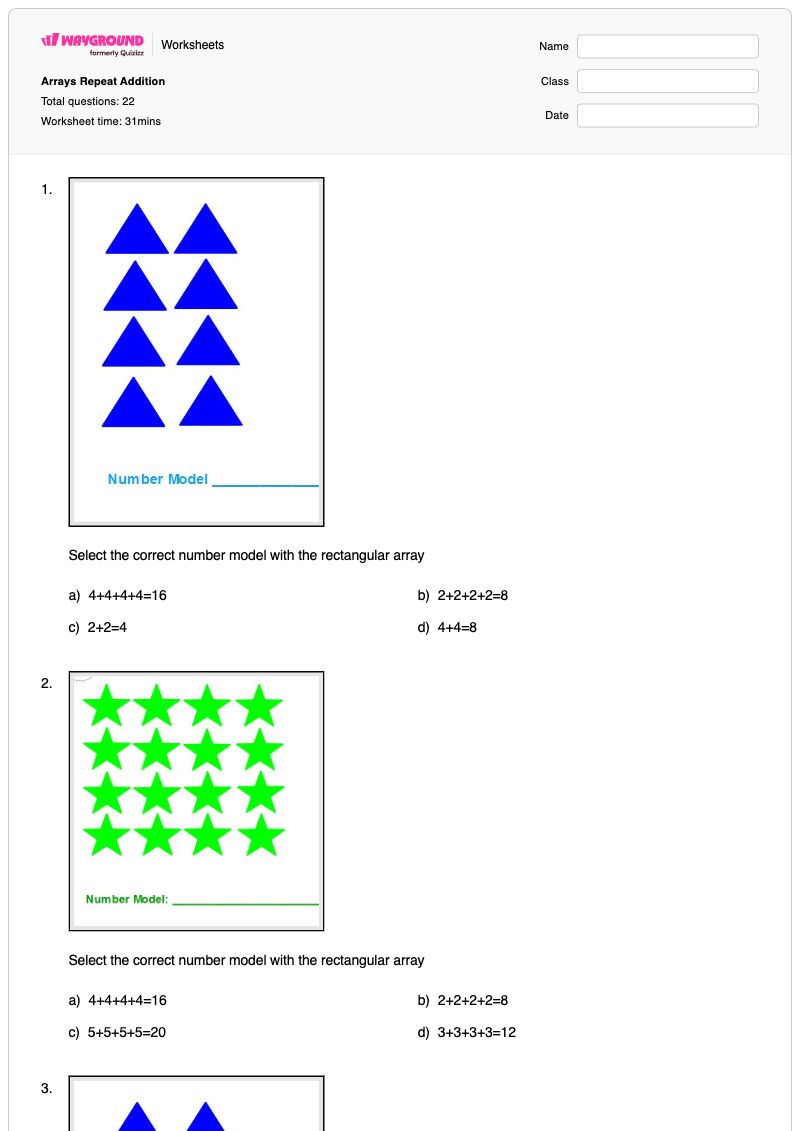
1.
Select the correct number model with the rectangular array
a)
4+4+4+4=16
b)
2+2+2+2=8
c)
2+2=4
d)
4+4=8
2.
Select the correct number model with the rectangular array
a)
4+4+4+4=16
b)
2+2+2+2=8
c)
5+5+5+5=20
d)
3+3+3+3=12
3.
How many rows in this array?
a)
2
b)
4
c)
8
d)
6
4.
Which repeated addition sentence describes this rectangular array?
a)
2+2+2+2=8
b)
3+3+3+3+3=15
c)
5+5+5+5+5=25
d)
4+4+4+4+4=20
5.
What is circled in the array?
a)
row
b)
column
6.
What is circled in the array?
a)
row
b)
column
7.
hat is the repeated addition sentence for this array? ( There may be more than one answer!)
a)
4 + 4 = 8
b)
2 + 2 + 2 = 6
c)
1 + 1 = 2
d)
3 + 3 = 6
8.
What is this array in repeat addition?
a)
5 + 5 + 5
b)
3 + 3 + 3 + 3 + 3
c)
Both are correct.
9.
How many equal groups are there in this picture?
a)
3
b)
4
c)
2
10.
a)
3 + 3 + 3 + 3 + 3 = 15
b)
3 + 3 + 3 = 9
c)
7 + 7 + 1 = 15
d)
5 + 5 + 5 + 5 = 20
11.
Which one goes across ?
a)
columns
b)
rows
12.
What multiplication sentence does this array show?
a)
4 X 8 = 32
b)
4 X 8 = 31
c)
5 X 8 = 32
d)
4 X 8
13.
What multiplication sentence does this array show?
a)
5 X 7 = 34
b)
5 X 7 = 35
c)
5 X 7
d)
4 X 7 = 35
14.
What moves side to side, left to right?
a)
rows
b)
columns
15.
Write the multiplication sentence represented by this array.
a)
6 x 4 = 24
b)
4 x 6 = 24
c)
4 x 4 = 16
d)
4 x 4 = 24
16.
What multiplication sentence does this array show?
a)
4 X 8 = 32
b)
4 X 8 = 31
c)
5 X 8 = 32
d)
4 X 8
17.
Which equation matches this array?
a)
5 x 3 = 15
b)
3 x 5 = 15
c)
4 x 3 = 12
d)
3 x 4 = 12
18.
Which equation matches this array?
a)
3 x 6 =18
b)
6 x 3 = 18
c)
3 x 2 = 6
d)
2 x 3 = 6
19.
Which equation matches this array?
a)
3 x 5 = 15
b)
5 x 3 = 15
c)
3 x 4 = 12
d)
4 x 3 = 12
20.
Which equation matches this array?
a)
5 x 3 = 15
b)
4 x 3 = 12
c)
3 x 4 = 12
d)
3 x 5 = 15
21.
Which one goes up and down?
a)
columns
b)
rows
22.
Which one goes across ?
a)
columns
b)
rows
Answer Key
Arrays Repeat Addition
Total questions: 22
1.
b) 2+2+2+2=8
2.
a) 4+4+4+4=16
3.
b) 4
4.
c) 5+5+5+5+5=25
5.
b)
column
6.
a)
row
7.
d)
3 + 3 = 6
, b)
2 + 2 + 2 = 6
8.
c)
Both are correct.
9.
a)
3
10.
a)
3 + 3 + 3 + 3 + 3 = 15
11.
b) rows
12.
a)
4 X 8 = 32
13.
b)
5 X 7 = 35
14.
a)
rows
15.
b) 4 x 6 = 24
16.
a)
4 X 8 = 32
17.
a)
5 x 3 = 15
18.
d)
2 x 3 = 6
19.
c) 3 x 4 = 12
20.
c) 3 x 4 = 12
21.
a) columns
22.
b) rows
140 %
Browse by subjects
Browse by grades
Browse by format
FAQs
What does the Arrays Repeat Addition worksheet cover?
This Grade 2 worksheet uses rectangular-array questions to build students’ ability to identify rows, columns, and equal groups, then represent those arrays with repeated-addition and multiplication sentences. Its 21 multiple-choice items and one multiple-select item require students to match visual arrays to equations, count groups, and recognize when more than one repeated-addition sentence can describe the same array.
How can I use this worksheet to teach arrays and repeated addition?
Begin by having students point out the rows, columns, and equal groups in each array before they look at the answer choices. Then ask them to explain whether they are counting across or down, write the corresponding repeated-addition sentence, and connect it to the multiplication sentence. Use the multiple-select item to discuss why different-looking repeated-addition sentences can represent the same total.
What mistakes should I watch for when students complete this array worksheet?
Students may confuse rows with columns, especially when deciding which groups move across the array and which move up and down. They may also choose the correct factors but an incorrect product, or count the number of groups instead of the number in each group. In the multiple-select item, watch for students who select only one valid repeated-addition sentence instead of recognizing both representations.
How do I assign and grade the Arrays Repeat Addition worksheet?
You can assign this worksheet as a printable PDF or as a digital quiz on Wayground, and it includes a complete answer key for checking the array, repeated-addition, and multiplication responses. Printable submissions can be graded by scanning student work with the Wayground for Teachers app. The printable option can also support schools that are reducing screen time.
How can I differentiate this arrays and repeated-addition worksheet for my students?
For students who need more visual space around the array diagrams and equations, use the worksheet’s Advanced Settings to adjust font spacing or increase the font size. You can also apply a dyslexia-friendly font to the rows, columns, and number sentences, or translate the worksheet into another language when language support is needed.
Where can I find more worksheets like this on Wayground?
Wayground offers a broad collection of free printable worksheets and practice problems across subjects, with downloadable PDFs and answer keys to support mastery of essential skills and concepts. Browse more resources at https://wayground.com/en-us/worksheets.


 Worksheets


