
Free Body Diagrams is a Grade 8 physics worksheet that helps students interpret force representations and reason about how forces affect an object. Across 20 questions—19 multiple choice and 1 multiple select—students identify what the arrows represent, use arrow length and direction to compare forces, recognize gravity, friction, tension, and normal force, and distinguish balanced from unbalanced forces.
Students also practise calculating net force by adding forces in the same direction and subtracting forces in opposite directions. Diagram-based items ask them to identify missing forces, match a situation to a free-body diagram, and determine force values and directions. This free printable worksheet with an answer key is suitable for guided practice, independent review, or a Grade 8 physics assessment.
Worksheet settings
Font size
S
M
L
XL
Worksheets
Free Body Diagrams
Total questions: 20
Name
Class
Date
1.
What does the F stand for on a free-body diagram?
a)
Free
b)
Fan
c)
Net
d)
Force
2.
In a force diagram, or free-body diagram, the size/length of the arrow tells you this about the force:
a)
relative strength
b)
relative distance
c)
relative direction
3.
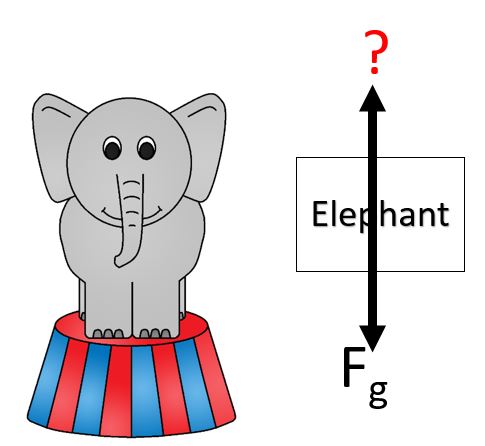
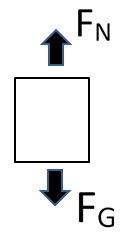
Which of the following is true about this free-body diagram?
a)
the forces are are balanced
b)
the object is free-falling
c)
the object is moving upward
d)
the forces are unbalanced
4.
In a force diagram, or free-body diagram, the pointy-end of the arrow tells you this about the force:
a)
relative strength
b)
relative distance
c)
relative direction
5.
When determining the NET force on an object you should (TWO correct answers)
a)
subtract forces in opposite directions
b)
add forces in the same direction
c)
divide by velocity
d)
multiply by acceleration
6.
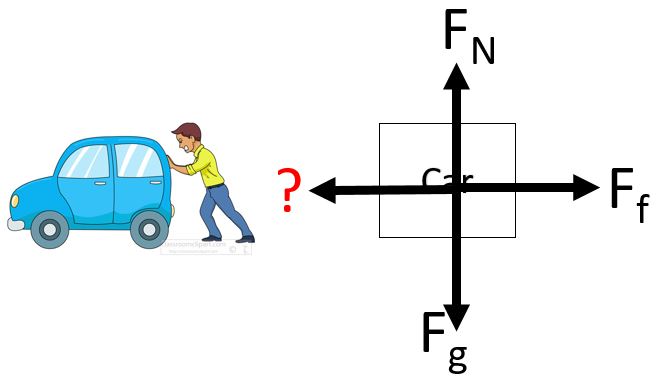
Name the missing force...
a)
weight force
b)
normal force
c)
applied force
d)
frictional force
7.
A hockey puck glides to the right across the ice at a constant speed.
a)
b)
c)
d)
8.
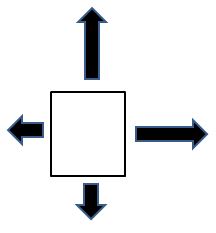
The down-arrow in this diagram is most-likely:
a)
gravity
b)
normal
c)
a push or pull
d)
friction
9.
If this object were moving right, the left-arrow in this diagram is most-likely:
a)
gravity
b)
normal
c)
a push or pull
d)
friction
10.
The force exerted by ropes and chains is called
a)
tension
b)
normal
c)
elastic
d)
mechanical
11.
The force that keeps objects on top of surfaces instead of letting them sink into the surface is known as:
a)
normal
b)
abnormal
c)
static
d)
inertia
12.
Match description with free-body diagram.
a)
A book is at rest on a tabletop.
b)
A gymnast holding onto a bar, is suspended motionless in mid-air. The bar is supported by two ropes that attach to the ceiling. Diagram the forces acting on the combination of gymnast and bar.
c)
An egg is free-falling from a nest in a tree. Neglect air resistance.
d)
A flying squirrel is gliding (no wingflaps) from a tree to the ground at constant velocity. Consider air resistance.
13.
What is the NET FORCE of this diagram?
a)
17 N, right
b)
17 N, left
c)
23 N, right
d)
12 N, up
14.
Determine the force at G:
a)
30 N
b)
20 N
c)
50 N
d)
0 N
15.
What can you tell about the forces on F and H?
a)
They must be unbalanced.
b)
They are negative.
c)
They must be the same.
d)
They are equal to the net force.
16.
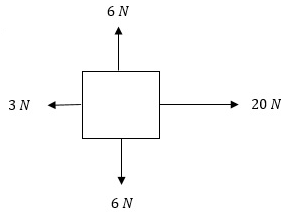
What is the NET FORCE of this diagram?
a)
17 N, right
b)
17 N, left
c)
23 N, right
d)
12 N, up
17.
Calculate the net force acting upon the object.
a)
10 N north
b)
10 N south
c)
14.1 N east
d)
0 N
18.
Calculate the net force acting upon the object.
a)
10 N east
b)
0 N
c)
14.1 N east
d)
20 N north
19.
Determine the missing force at C:
a)
700 N
b)
200 N
c)
0 N
d)
1100 N
20.
Name the missing force...
a)
applied force
b)
weight force
c)
tension force
d)
drag
Answer Key
Free Body Diagrams
Total questions: 20
1.
d)
Force
2.
a)
relative strength
3.
a)
the forces are are balanced
4.
c)
relative direction
5.
a)
subtract forces in opposite directions
, b)
add forces in the same direction
6.
b) normal force
7.
b)
8.
a)
gravity
9.
d)
friction
10.
a)
tension
11.
a)
normal
12.
a) A book is at rest on a tabletop.
13.
a)
17 N, right
14.
c)
50 N
15.
c)
They must be the same.
16.
a)
17 N, right
17.
d) 0 N
18.
a) 10 N east
19.
d)
1100 N
20.
a) applied force
140 %
Browse by subjects
Browse by grades
Browse by format
FAQs
What does the Free Body Diagrams worksheet cover?
This Grade 8 physics worksheet uses 19 multiple-choice questions and 1 multiple-select question to practise reading free-body diagrams. Students identify force types, interpret arrow direction and relative length, determine whether forces are balanced, and calculate net force by combining forces in the same or opposite directions.
How can I use this worksheet to teach students to read free-body diagrams?
Introduce the arrow conventions first: the arrowhead shows relative direction, while arrow length shows relative strength. Then model how to identify forces such as gravity, friction, tension, and normal force before having students work through the missing-force, diagram-matching, and net-force items. Ask students to explain how the arrows support each answer, especially when deciding whether forces are balanced.
What mistakes should I watch for when students complete this free-body-diagram worksheet?
Students may confuse arrow length with direction, identify the downward arrow as a normal force instead of gravity, or overlook friction when an object moves across a surface. Watch for errors in net-force items caused by adding opposite-direction forces rather than subtracting them, and check that students select both correct rules in the multiple-select question. Students may also confuse normal force with tension when identifying a missing force.
How do I assign and grade this Free Body Diagrams worksheet?
Wayground provides this worksheet as a printable PDF and as a digital quiz, with a complete answer key for all 20 questions. You can grade printable submissions by scanning student work with the Wayground for Teachers app, or review responses through the digital quiz.
How can I differentiate this free-body-diagram worksheet for my students?
Under the worksheet’s Advanced Settings, adjust font spacing or font size to make the force diagrams, labels, and answer choices easier to read. You can also apply a dyslexia-friendly font or translate the worksheet into another language while keeping the diagram-identification and net-force practice intact.
Where can I find more worksheets like this on Wayground?
Wayground offers a broad collection of free printable worksheets and practice problems across subjects, with downloadable PDFs and answer keys to support mastery of essential skills and concepts. Browse more resources at https://wayground.com/en-us/worksheets.