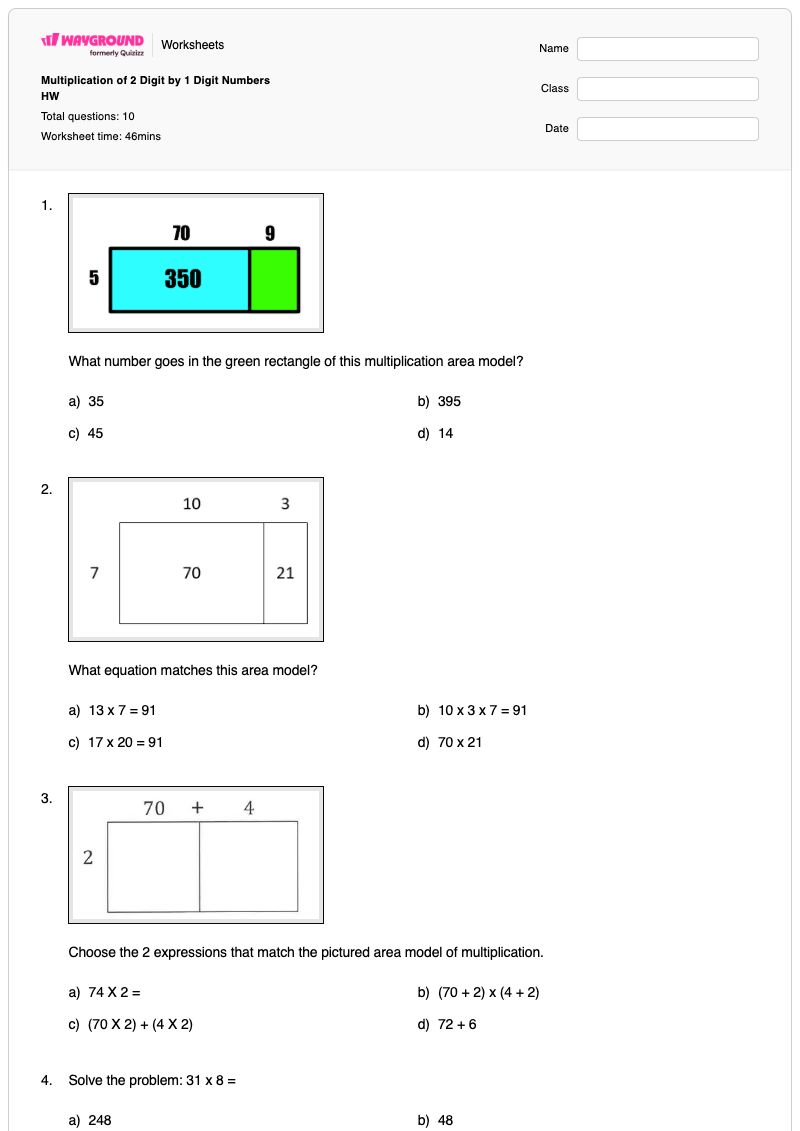
This Grade 4 mathematics worksheet helps students multiply two-digit numbers by one-digit numbers using area models, partial products, equations, and standard computation. Across 10 questions, students identify a missing area-model value, match models to equations, select equivalent partial-product expressions, solve products such as 31 × 8, 23 × 5, and 62 × 7, and interpret multiplication in a real-world snack problem. It also includes place-value multiplication with 600 × 30 and 400 seeds on each of 5 trays.
The worksheet combines visual reasoning with numerical fluency, helping students connect decomposed factors to accurate products. Nine questions are multiple choice, and one is multiple select, requiring students to recognize more than one expression that represents an area model. This free printable worksheet is designed for Grade 4 practice, homework, independent work, or a quick formative check, and it includes a complete answer key for efficient review.
Worksheet settings
Font size
S
M
L
XL
Worksheets
Multiplication of 2 Digit by 1 Digit Numbers HW
Total questions: 10
Name
Class
Date
1.
What number goes in the green rectangle of this multiplication area model?
a)
35
b)
395
c)
45
d)
14
2.
What equation matches this area model?
a)
13 x 7 = 91
b)
10 x 3 x 7 = 91
c)
17 x 20 = 91
d)
70 x 21
3.
Choose the 2 expressions that match the pictured area model of multiplication.
a)
74 X 2 =
b)
(70 + 2) x (4 + 2)
c)
(70 X 2) + (4 X 2)
d)
72 + 6
4.
Solve the problem: 31 x 8 =
a)
248
b)
48
c)
824
d)
38
5.
23 x 5
a)
125
b)
135
c)
115
d)
105
6.
62 x 7
a)
442
b)
434
c)
414
d)
444
7.
Which expression shows partial products to solve
3 x 45?
a)
(30 x 4) + (30 x 5)
b)
3 x 40 x 5
c)
3 x (4 + 5)
d)
(3 x 40) + (3 x 5)
8.
Evaluate the expression:
600 x 30
a)
1,800
b)
18,000
c)
2,400
d)
24,000
9.
Ms. Logan is roasting pumpkin seeds for a snack. She has 5 trays with 400 seeds on each tray. How many seeds is she roasting?
a)
2,000
b)
200
c)
5,400
d)
20,000
10.
Solve the multiplication area model for 38 x 6
a)
288
b)
228
c)
84
d)
44
Answer Key
Multiplication of 2 Digit by 1 Digit Numbers HW
Total questions: 10
1.
c)
45
2.
a)
13 x 7 = 91
3.
a)
74 X 2 =
, c)
(70 X 2) + (4 X 2)
4.
a)
248
5.
c) 115
6.
b) 434
7.
d)
(3 x 40) + (3 x 5)
8.
b)
18,000
9.
a)
2,000
10.
b)
228
140 %
Browse by subjects
Browse by grades
Browse by format
FAQs
What does this worksheet cover?
This Grade 4 worksheet practices multiplying two-digit numbers by one-digit numbers through area models, partial products, matching equations, and direct computation. Its 10 items ask students to identify model values, choose equations or expressions that represent decomposed products, solve examples such as 31 × 8 and 62 × 7, and apply multiplication to a tray-and-seed word problem.
How can I use this worksheet to teach two-digit by one-digit multiplication?
Begin by modeling how an area model decomposes a number such as 45 into tens and ones, then connect each region to a partial product. Have students explain why an expression such as (3 × 40) + (3 × 5) represents 3 × 45 before assigning the computation items. Use the multiple-select area-model question as a discussion prompt about why two different-looking expressions can represent the same product.
What mistakes should I watch for when students complete this multiplication worksheet?
Watch for students choosing an equation that does not match the area model, especially when they confuse a factor with a partial product or reverse the place-value parts. In the multiple-select item, students may select an expression that combines the decomposed factors incorrectly instead of adding the two partial products. Also check products involving zeros, such as 600 × 30, and answers to the word problem for misplaced zeros or an incorrect operation.
How do I assign and grade this multiplication worksheet?
Wayground provides this worksheet as a printable PDF and as a digital quiz, and it includes a complete answer key for checking the area-model, partial-product, computation, and word-problem responses. For printable submissions, scan student work with the Wayground for Teachers app to help grade the completed worksheet efficiently.
How can I differentiate this area-model multiplication worksheet for my students?
In the worksheet’s Advanced Settings, adjust font spacing or choose a larger font size to make the area-model prompts, equations, and answer choices easier to read. You can also apply a dyslexia-friendly font or translate the worksheet into another language while keeping its multiplication practice format.
Where can I find more worksheets like this on Wayground?
Wayground offers a broad collection of free printable worksheets and practice problems across subjects, with downloadable PDFs and answer keys to support mastery of essential skills and concepts. Browse more resources at https://wayground.com/en-us/worksheets.

 Worksheets


