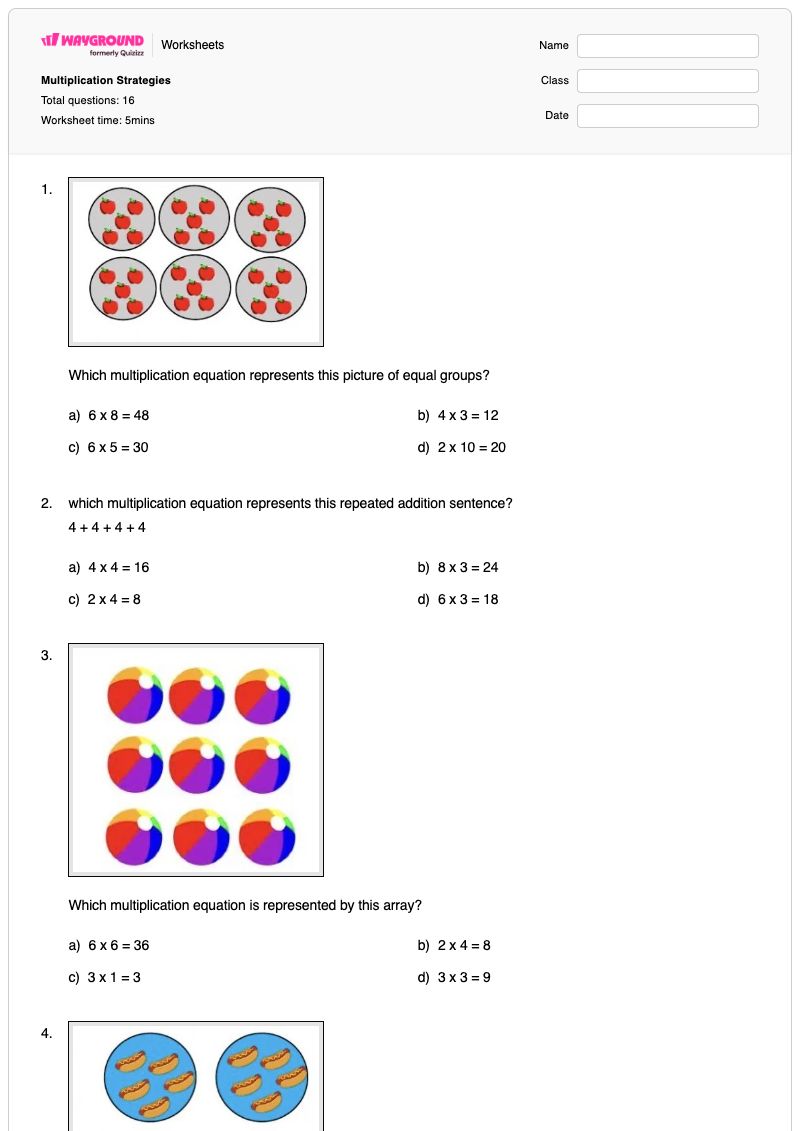
Multiplication Strategies is a Grade 3 mathematics worksheet that helps students connect visual and symbolic representations of multiplication. Students identify equations for pictures of equal groups, arrays, and repeated-addition sentences, including examples such as 7 + 7 + 7 and 6 + 6 + 6 + 6. This practice reinforces how factors and products describe the number of groups and the number in each group.
The worksheet includes 16 questions: 15 multiple-choice items and 1 open-ended item. It is useful for introducing or reviewing multiplication representations, checking whether students can translate between models and equations, and identifying errors before moving to more advanced multiplication strategies. This free printable worksheet includes a complete answer key for efficient review and assessment.
Worksheet settings
Font size
S
M
L
XL
Worksheets
Multiplication Strategies
Total questions: 16
Name
Class
Date
1.
Which multiplication equation represents this picture of equal groups?
a)
6 x 8 = 48
b)
4 x 3 = 12
c)
6 x 5 = 30
d)
2 x 10 = 20
2.
which multiplication equation represents this repeated addition sentence?
4 + 4 + 4 + 4
a)
4 x 4 = 16
b)
8 x 3 = 24
c)
2 x 4 = 8
d)
6 x 3 = 18
3.
Which multiplication equation is represented by this array?
a)
6 x 6 = 36
b)
2 x 4 = 8
c)
3 x 1 = 3
d)
3 x 3 = 9
4.
Which multiplication equation represents this picture of equal groups?
a)
5 x 3 = 15
b)
2 x 5 = 10
c)
4 x 4 = 16
d)
3 x 3 = 9
5.
Which multiplication equation represents this array?
a)
3 x 4 = 12
b)
2 x 2 = 4
c)
2 x 3 = 6
d)
5 x 1 = 5
6.
Which multiplication equation represents this repeated addition sentence?
7 + 7 + 7
a)
8 x 3 = 24
b)
4 x 5 = 20
c)
6 x 3 = 18
d)
7 x 3 = 21
7.
Which multiplication equation represents these equal groups?
a)
8 x 3 = 24
b)
5 x 3 = 15
c)
4 x 4 = 16
d)
3 x 7 = 21
8.
Which multiplication equation represents this array?
a)
7 x 5 = 35
b)
9 x 1 = 9
c)
3 x 4 = 12
d)
2 x 2 = 4
9.
Which multiplication equation represents this array?
a)
5 x 5 = 25
b)
4 x 5 = 20
c)
6 x 4 = 24
d)
8 x 7 = 42
10.
Which multiplication equation represents this repeated addition sentence?
6 + 6 + 6 + 6
a)
6 x 1 = 6
b)
5 x 8 = 40
c)
6 x 4 = 24
d)
9 x 3 = 18
11.
Which multiplication equation represents this repeated addition sentence?
2 + 2 + 2 + 2 + 2 + 2
a)
2 x 6 = 12
b)
3 x 3 = 9
c)
6 x 3 = 18
d)
5 x 4 = 20
12.
Which multiplication equation represents this picture of equal groups?
a)
6 x 5 = 30
b)
4 x 2 = 8
c)
12 x 1 = 12
d)
5 x 9 = 45
13.
Which multiplication equation represents this picture of equal groups?
a)
8 x 2 =16
b)
6 x 6 = 36
c)
2 x 2 = 4
d)
3 x 3 = 9
14.
Which repeated multiplication equation represents this repeated addition sentence?
9 + 9 + 9
a)
9 x 3 = 27
b)
2 x 1 = 2
c)
5 x 5 = 25
d)
7 x 8 =56
15.
Which multiplication equation represents this array?
a)
8 x 8 = 64
b)
2 x 7 = 14
c)
4 x 5 = 20
d)
3 x 4 = 12
16.
What is your favorite multiplication strategy to use?
4 lines
Answer Key
Multiplication Strategies
Total questions: 16
1.
c)
6 x 5 = 30
2.
a)
4 x 4 = 16
3.
d)
3 x 3 = 9
4.
b)
2 x 5 = 10
5.
c)
2 x 3 = 6
6.
d)
7 x 3 = 21
7.
a)
8 x 3 = 24
8.
c)
3 x 4 = 12
9.
a)
5 x 5 = 25
10.
c)
6 x 4 = 24
11.
a)
2 x 6 = 12
12.
b)
4 x 2 = 8
13.
a)
8 x 2 =16
14.
a)
9 x 3 = 27
15.
c)
4 x 5 = 20
16.
n/a
140 %
Browse by subjects
Browse by grades
Browse by format
FAQs
What does the Multiplication Strategies worksheet help Grade 3 students learn?
This Grade 3 mathematics worksheet helps students represent equal groups, arrays, and repeated-addition sentences with multiplication equations. Its 15 multiple-choice questions and 1 open-ended item require students to identify the matching factors and product, building fluency in translating concrete and additive models into multiplication notation.
How can I use this worksheet to teach multiplication representations?
Introduce one model at a time by showing an equal-groups picture, an array, and a repeated-addition sentence, then ask students to explain what each factor counts. Have students complete the corresponding multiple-choice items and justify why the correct equation matches the number of groups and the amount in each group before using the open-ended item for independent explanation or review.
What mistakes should I watch for when students complete this multiplication worksheet?
Students may reverse the factors, count the total objects without identifying the groups, or choose an equation whose product is plausible but whose factors do not match the model. In repeated-addition items, watch for confusing the repeated addend with the number of terms; in array items, students may count rows and columns inconsistently.
How do I assign and grade the Multiplication Strategies worksheet?
You can use this worksheet as a printable PDF or assign it as a digital quiz on Wayground. It includes a complete answer key, and printable submissions can be graded by scanning student work with the Wayground for Teachers app.
How can I differentiate this worksheet for my students?
Under the worksheet’s Advanced Settings, adjust font spacing or font size to make the multiplication equations, arrays, and equal-groups items easier to read. You can also apply a dyslexia-friendly font or translate the worksheet into another language when that supports access to the visual and repeated-addition tasks.
Where can I find more free worksheets like this on Wayground?
Wayground offers a comprehensive collection of free printable worksheets and practice problems across all subjects, with downloadable PDFs and answer keys to support essential skills and concepts. Browse more resources at https://wayground.com/en-us/worksheets.

 Worksheets


