

Wayground
Neuromuscular Junction Review - Printable Science Worksheets year 12 - Wayground

Neuromuscular Junction Review

Heather L Woznicki

Created by Heather L Woznicki

20 questions

12th Grade

Science

Updated Jan 2026

Neuromuscular Junction Review is a Grade 12 science worksheet that builds understanding of how a motor neuron communicates with a skeletal muscle fiber to initiate contraction. Across 20 questions—19 multiple choice and 1 multiple-select—students distinguish key terms such as neuromuscular junction, motor unit, synaptic cleft, acetylcholine, synaptic vesicles, sarcolemma, and motor end plate. The worksheet also asks students to interpret a neuromuscular-junction diagram, identify labeled structures, recognize the role of acetylcholine, determine what makes up a motor unit, and connect the junction’s function to skeletal muscle contraction. It provides focused review of terminology, structure identification, and basic neuromuscular signaling for Grade 12 learners. This free printable worksheet includes a complete answer key for efficient review, independent practice, or assessment.

Worksheet settings

Font size

S
M
L
XL
WaygroundWorksheets

Neuromuscular Junction Review

Total questions: 20

Name
Class
Date
1.

The location where the motor neuron reaches the sarcolemma of the muscle fiber is the _____.

a)

Neurotransmitter

b)

Acetylcholine

c)

Synaptic cleft

d)

Neuromuscular Junction

2.

One neuron and all the skeletal muscle cells it stimulates is the ____ ___.

a)

Neurotransmitter

b)

Neuromuscular junction

c)

Motor unit

d)

Synaptic cleft

3.

The physical gap space between the neuron and sarcolemma of the muscle fiber is the ____ ___.

a)

Synaptic cleft

b)

Neurotransmitter

c)

Motor unit

d)

Neuromuscular junction

4.

What is the specific neurotransmitter that stimulates the muscle contraction?

a)

GABA

b)

Acetylcholine

c)

Serotonin

d)

Dopamine

5.

What is the name of the structure that stores neurotransmitters?

a)

Synaptic cleft

b)

Acetylcholine

c)

Receptors

d)

Synaptic vesicles

6.
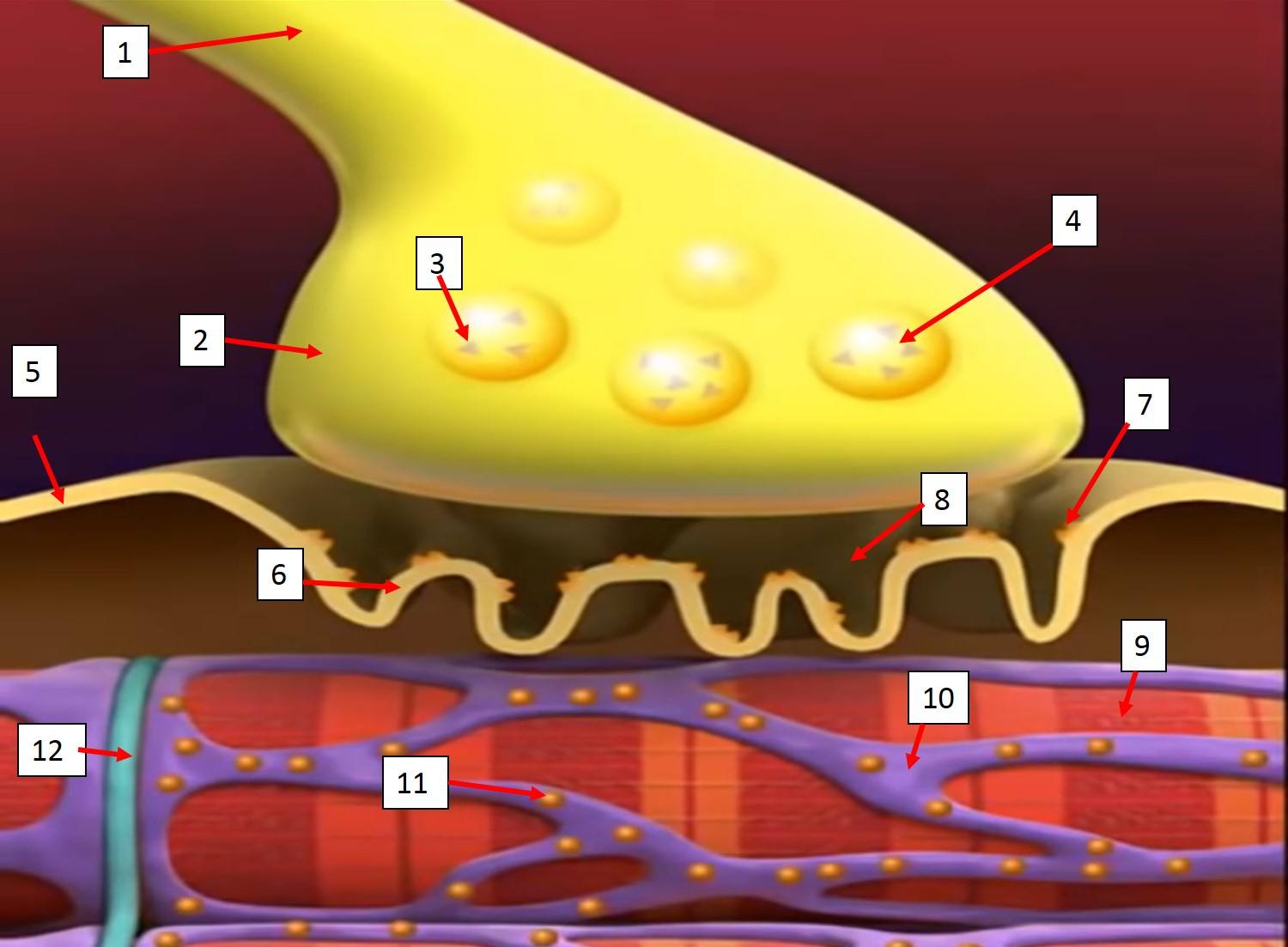
The neurotransmitter stored in the axon terminal identified as #3
a)
Acetylcholine
b)
Protein Channel
c)
Calcium Ion (Ca2+)
d)
Syanptic Cleft
7.

What is acetylcholine?

a)

an ion pump on the postsynaptic membrane

b)

a source of energy for muscle contraction

c)

a component of thick myofilaments

d)

a neurotransmitter that stimulates skeletal muscle to contract

8.
What is number 6 pointing to?

What is number 6 pointing to?

a)

a muscle cell

b)

a synaptic vesicle

c)

a neurotransmitter

d)

a neuron

9.
What is the function of this entire diagram?

What is the function of this entire diagram?

a)

controlling a nerve

b)

controlling a skeletal muscle contraction

c)

endocytosis

d)

inserting a musle on a bone

10.

Click all that apply. Which of these make up a motor unit?

a)

Motor neuron

b)

Muscle Fibers

c)

Muscle

d)

Nerve

11.

Which muscle characteristic allows the muscle to return to resting length after contraction/shortening?

a)

Contractility

b)

Excitability

c)

Extensibility

d)

Tension

12.
The cell membrane of a skeletal muscle fiber is called the:

The cell membrane of a skeletal muscle fiber is called the:

a)

sarcomere

b)

myofilament

c)

sarcolemma

d)

sarcoplasm

13.

Skeletal Muscle contraction is initiated when the ________ sends a message/signal to the muscle cell.  

a)

Muscle cell

b)

Motor Neuron

c)

Gland

d)

None of the above

14.
Identify structure 4 in the diagram.

Identify structure 4 in the diagram.

a)

synaptic cleft

b)

sarcolemma

c)

vesicle

d)

Ca2+ ion

15.
Identify structure 3 in the diagram.

Identify structure 3 in the diagram.

a)

synaptic cleft

b)

motor end plate

c)

axon terminal

d)

ACh

16.
Identify structure 2 in the diagram.

Identify structure 2 in the diagram.

a)

synaptic cleft

b)

motor end plate

c)

axon terminal

d)

ACh

17.
Identify structure 1 in the diagram.

Identify structure 1 in the diagram.

a)

synaptic cleft

b)

motor end plate

c)

axon terminal of motor neuron

d)

ACh

18.

Which type of signaling mechanism is electrical and is produced inside of cells?

a)

Sensory Signal

b)

Neurotransmitter

c)

ACh

d)

Action Potential

19.

Which of the following is true about the relationship between the term synapse and NMJ?

a)

A synapse is a type of NMJ

b)

The NMJ is a type of synapse

c)

Both are types of synaptic clefts

d)

Both are substructures of the muscle fiber

20.

Which type of signaling mechanism is chemical and is used to communicate between cells?

a)

Sensory Signal

b)

Neurotransmitter

c)

Graded Potential

d)

Action Potential

WaygroundAnswer Key

Neuromuscular Junction Review

Total questions: 20

1.
d)

Neuromuscular Junction

2.
c)

Motor unit

3.
a)

Synaptic cleft

4.
b)

Acetylcholine

5.
d)

Synaptic vesicles

6.
a) Acetylcholine
7.
d)

a neurotransmitter that stimulates skeletal muscle to contract

8.
b)

a synaptic vesicle

9.
b)

controlling a skeletal muscle contraction

10.
a)

Motor neuron

, b)

Muscle Fibers

11.
c)

Extensibility

12.
c)

sarcolemma

13.
b)

Motor Neuron

14.
a)

synaptic cleft

15.
b)

motor end plate

16.
d)

ACh

17.
c)

axon terminal of motor neuron

18.
d)

Action Potential

19.
b)

The NMJ is a type of synapse

20.
b)

Neurotransmitter

FAQs

What does the Neuromuscular Junction Review worksheet cover?

This Grade 12 science worksheet reviews how a motor neuron signals a skeletal muscle fiber at the neuromuscular junction. Its 20 items use multiple-choice and multiple-select questions to test terminology, diagram-based structure identification, the role of acetylcholine and synaptic vesicles, the components of a motor unit, and the connection between neural signaling and skeletal muscle contraction.

How can I use this worksheet to teach neuromuscular-junction signaling?

Introduce the diagram and have students trace the signal from the motor neuron to the muscle fiber, naming the axon terminal, synaptic vesicles, synaptic cleft, acetylcholine, and sarcolemma as they go. Then use the worksheet’s terminology and diagram-identification questions for guided practice before assigning the full set independently, asking students to explain how the labeled structures support skeletal muscle contraction.

What mistakes should I watch for when students complete this worksheet?

Students may confuse the neuromuscular junction, the synaptic cleft, and the motor unit, even though these refer to different structures or groupings. Watch for confusion between acetylcholine and the synaptic vesicles that store it, misidentification of labeled diagram structures, and selection of muscle or nerve alone instead of motor neuron plus muscle fibers on the multiple-select item.

How do I assign and grade this Neuromuscular Junction Review worksheet?

The worksheet is available as a printable PDF and as a digital quiz on Wayground, and it includes a complete answer key for all 20 questions. Printable submissions can be graded by scanning student work with the Wayground for Teachers app, while the digital version supports online completion and grading.

How can I differentiate this neuromuscular-junction worksheet for my students?

In the worksheet’s Advanced Settings, adjust font spacing or font size to make the terminology and diagram-identification items easier to read. You can also apply a dyslexia-friendly font or translate the worksheet into another language when students need support accessing terms such as sarcolemma, acetylcholine, and synaptic cleft.

Where can I find more worksheets like this on Wayground?

Wayground offers a broad collection of free printable worksheets and practice problems across subjects, with downloadable PDFs and answer keys to help students master essential skills and concepts. Browse more resources at https://wayground.com/en-us/worksheets.