This Grade 1 mathematics worksheet helps students sort and classify geometric shapes by shape, color, and size. Across approximately 16 items, students identify the attribute used to organize a group, select figures that belong together, and place shapes into category-based classifications. Multiple-choice and multiple-select questions give students practice distinguishing which visual feature defines each group.
The worksheet also develops shape composition and decomposition. Students select pattern blocks that combine to make a target shape and determine which new shape results when two shapes are joined. These tasks connect classification with visual reasoning and support early geometry vocabulary and problem solving. This free printable worksheet is designed for Grade 1 math instruction, independent practice, review, or informal assessment, and it includes a complete answer key for checking student understanding.
Worksheet settings
Font size
S
M
L
XL
Worksheets
Sorting and Composing/Decomposing Shapes
Total questions: 16
Name
Class
Date
1.
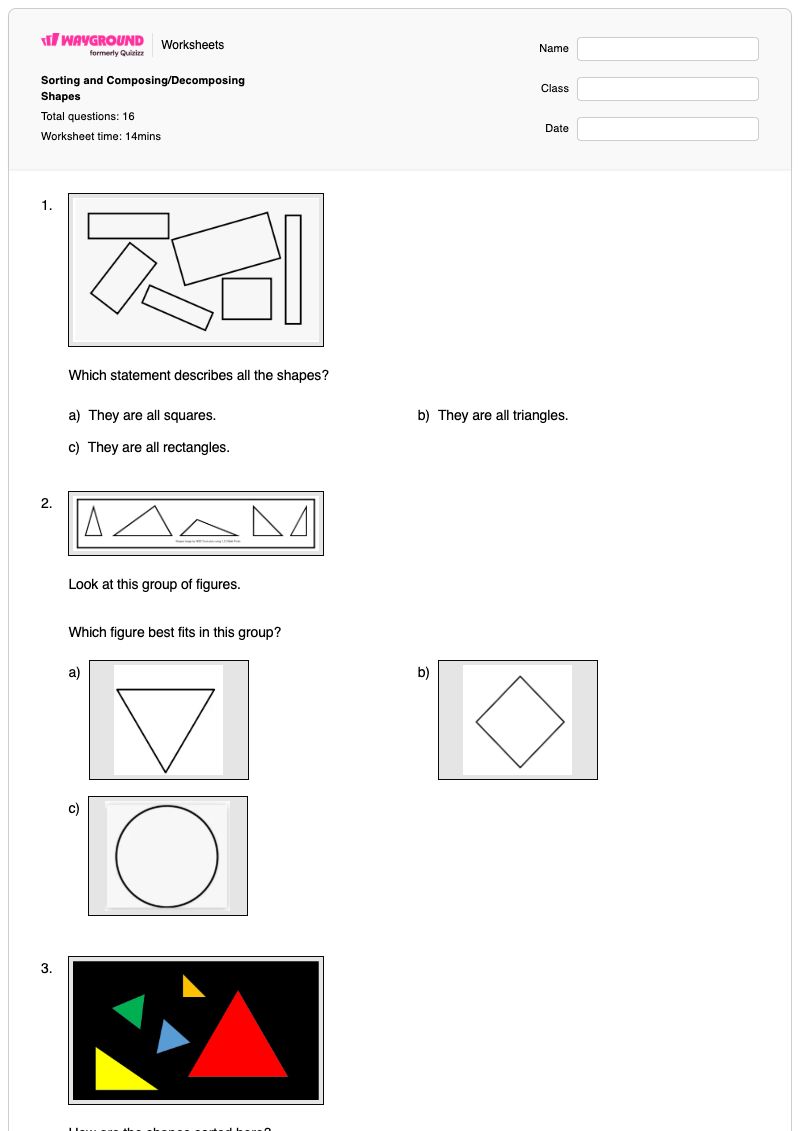
Which statement describes all the shapes?
a)
They are all squares.
b)
They are all triangles.
c)
They are all rectangles.
2.
Look at this group of figures.
Which figure best fits in this group?
a)
b)
c)
3.
How are the shapes sorted here?
a)
Shapes
b)
Color
c)
Size
4.
How are the shapes sorted here?
a)
Color
b)
Shapes
c)
Size
5.
How are the shapes sorted here?
a)
Size
b)
Shapes
c)
Color
6.
How are these shapes sorted?
a)
Shape
b)
Size
c)
Color
7.
How are these shapes sorted?
a)
Shape
b)
Size
c)
Color
8.
How are these shapes sorted?
a)
by size
b)
by shape
c)
by color
9.
How are these shapes sorted?
a)
by color
b)
by size
c)
by shape
10.
Sort the shapes into the following categories (Think of it like a Venn Diagram).
Categorize the following
Red
Red AND Circle
Circle
11.
Sort these shapes by category (Think like a Venn Diagram)
Categorize the following
Triangle
Triangle AND Blue
Blue
12.
Which two pattern blocks make this shape?
a)
b)
c)
d)
13.
Which 2 pattern blocks make this shape?
a)
b)
c)
d)
14.
Hannah put together the two shapes shown. What new shape did she make?
a)
rectangle
b)
square
c)
triangle
d)
trapezoid
15.
Ali joined 2 shapes together to make this shape. Which 2 shapes did Ali join together?
a)
2 triangles
b)
2 squares
c)
2 circles
d)
2 trapezoids
16.
How many triangles made this shape?
a)
1
b)
2
c)
3
d)
4
Answer Key
Sorting and Composing/Decomposing Shapes
Total questions: 16
1.
c)
They are all rectangles.
2.
a)
3.
a)
Shapes
4.
a)
Color
5.
a)
Size
6.
c)
Color
7.
a)
Shape
8.
b)
by shape
9.
a)
by color
10.
Red
Red AND Circle
Circle
11.
Triangle
Triangle AND Blue
Blue
12.
a) , d)
13.
c) , d)
14.
a)
rectangle
15.
a)
2 triangles
16.
d)
4
140 %
Browse by subjects
Browse by grades
Browse by format
FAQs
What does this worksheet cover?
This Grade 1 worksheet covers sorting shapes by shape, color, and size, classifying figures into categories, and composing or decomposing shapes with pattern blocks. Its multiple-choice, multiple-select, and classification items ask students to identify the rule organizing a group, place figures into categories, and determine which shapes combine to make a target or resulting shape.
How can I use this worksheet to teach sorting and composing shapes?
Introduce the worksheet by displaying several shapes and asking students whether they can sort them by one attribute at a time: shape, color, or size. As students complete the sorting and classification items, have them explain the rule they used and compare groups that are organized by different attributes. Then use the pattern-block and shape-composition questions to discuss how two smaller shapes can form a new shape.
What mistakes should I watch for when students complete this worksheet?
Students may choose a noticeable attribute, such as color, when an item is actually sorted by shape or size, or select more than one attribute on multiple-select questions. In the classification items, watch for shapes placed in a category without checking the category rule. For the pattern-block questions, students may identify a block that looks similar rather than checking whether the selected pieces exactly compose the target shape.
How do I assign and grade this worksheet?
This sorting and composing shapes worksheet is available as a printable PDF and as a digital quiz on Wayground. It includes a complete answer key, and printable submissions can be graded by scanning student work with the Wayground for Teachers app. The PDF option also supports classrooms that want to reduce screen time while students practice shape classification and composition.
How can I differentiate this worksheet for my students?
Use the worksheet’s Advanced Settings to adjust font spacing or choose a larger font size so the sorting prompts, classification directions, and shape-composition questions are easier to follow. You can also enable a dyslexia-friendly font or translate the worksheet into another language when helpful. These changes preserve the visual shape tasks while adapting the worksheet text for different readers.
Where can I find more worksheets like this on Wayground?
Wayground offers a comprehensive collection of free printable worksheets and practice problems across all subjects, including downloadable PDFs with answer keys. Browse more resources at https://wayground.com/en-us/worksheets.

 Worksheets


