

Wayground
Newton's 3 Laws of Motion - Printable Science Worksheets year 6 - Wayground

Newton's 3 Laws of Motion

15 questions

6th - 6th Grade

Science

This Grade 6 science worksheet helps students identify and apply Newton’s three laws of motion. Through 11 multiple-choice questions, students connect everyday situations—such as a toy car starting to move, a ball continuing in motion, or a person feeling a push back—to the laws of inertia, force and acceleration, and action and reaction. They also identify alternate names for the first and third laws and interpret the formula F = MA. The worksheet extends concept recognition into application. Students classify motion examples, use diagrams to determine whether forces are balanced and predict an object’s direction of travel, identify which object has greater acceleration in a hotspot item, match pictures to the correct law, and calculate force using mass and acceleration with proper units. It is a free printable worksheet with a complete answer key, suitable for Grade 6 science practice, review, or assessment.

Worksheet settings

Font size

S
M
L
XL
Worksheets

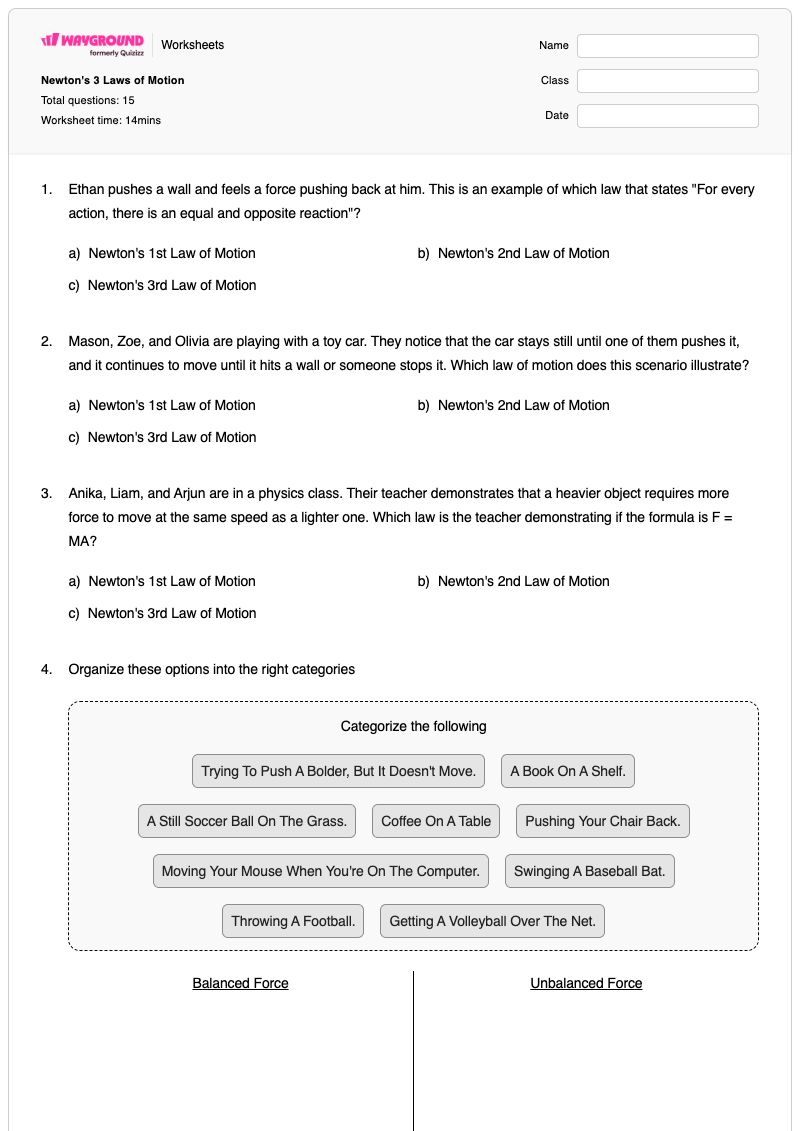
Newton's 3 Laws of Motion

Total questions: 15

Name
Class
Date
1.

Ethan pushes a wall and feels a force pushing back at him. This is an example of which law that states "For every action, there is an equal and opposite reaction"?

a)

Newton's 1st Law of Motion

b)

Newton's 2nd Law of Motion

c)

Newton's 3rd Law of Motion

2.

Mason, Zoe, and Olivia are playing with a toy car. They notice that the car stays still until one of them pushes it, and it continues to move until it hits a wall or someone stops it. Which law of motion does this scenario illustrate?

a)

Newton's 1st Law of Motion

b)

Newton's 2nd Law of Motion

c)

Newton's 3rd Law of Motion

3.

Anika, Liam, and Arjun are in a physics class. Their teacher demonstrates that a heavier object requires more force to move at the same speed as a lighter one. Which law is the teacher demonstrating if the formula is F = MA?

a)

Newton's 1st Law of Motion

b)

Newton's 2nd Law of Motion

c)

Newton's 3rd Law of Motion

4.

Organize these options into the right categories

Categorize the following

Trying to push a bolder, but it doesn't move.

A book on a shelf.

A still soccer ball on the grass.

Coffee on a table

Pushing your chair back.

Moving your mouse when you're on the computer.

Swinging a baseball bat.

Throwing a football.

Getting a volleyball over the net.

Balanced Force
Unbalanced Force
5.

What does F=MA stand for?

a)

Force = Motion x Velocity

b)

Friction = Matter x Aluminum

c)

Force = Mass x Acceleration

d)

Frequency = Matter x Acology

6.

Lucy and Jack are playing catch. Jack notices that the ball stays in motion until Lucy catches it or it hits the ground. This is an example of which law of motion?

a)

Newton's 1st Law of Motion

b)

Newton's 2nd Law of Motion

c)

Newton's 3rd Law of Motion

7.

During a physics experiment, Mia pushes a heavy box and feels a force pushing back. This scenario is an example of which law?

a)

Newton's 1st Law of Motion

b)

Newton's 2nd Law of Motion

c)

Newton's 3rd Law of Motion

8.

How much force is required to accelerate a 795 kg Lorinser Speedy by 15 m/s2

a)

11925

b)

11925 N

c)

53

d)

53 N

9.

Which object will have the greater acceleration? (Point to the letter)

10.

Diagram B has balanced force.

a)

True

b)

False

11.

What direction will Diagram B travel?

a)

It will move to the left.

b)

It will move to the right.

c)

It actually won't move.

d)

It will move up in the air.

12.

How much force is required to accelerate an 8.6 kg wagon by 15 m/s2? (Don't forget the Unit of Measurement)

(a)  

13.

What is another name for Newton's 1st Law of Motion?

a)

Acceleration

b)

Mass

c)

Friction

d)

Inertia

14.

What is another name for Newton's 3rd Law of Motion

a)

Action and Reaction

b)

Gravity

c)

Equal

d)

Inertia

15.

Which picture BEST represents each law? (Drag the picture down to the Law you think it should go to).

Newton's 2nd Law of Motion

Newton's 1st Law of Motion

Newton's 3rd Law of Motion

Answer Key

Newton's 3 Laws of Motion

Total questions: 15

1.
c)

Newton's 3rd Law of Motion

2.
a)

Newton's 1st Law of Motion

3.
b)

Newton's 2nd Law of Motion

4.
Balanced Force

Trying to push a bolder, but it doesn't move.

A book on a shelf.

A still soccer ball on the grass.

Coffee on a table

Unbalanced Force

Pushing your chair back.

Moving your mouse when you're on the computer.

Swinging a baseball bat.

Throwing a football.

Getting a volleyball over the net.

5.
c)

Force = Mass x Acceleration

6.
a)

Newton's 1st Law of Motion

7.
c)

Newton's 3rd Law of Motion

8.
b)

11925 N

9.
10.
b)

False

11.
a)

It will move to the left.

12.
129N, 129 N, 129 N
13.
d)

Inertia

14.
a)

Action and Reaction

15.

 - 

Newton's 2nd Law of Motion

, 

 - 

Newton's 1st Law of Motion

, 

 - 

Newton's 3rd Law of Motion

FAQs

What does the Newton’s 3 Laws of Motion worksheet cover?

This Grade 6 worksheet asks students to distinguish Newton’s first, second, and third laws in everyday scenarios, classify examples, match pictures to each law, and apply F = MA. Its 15 items also require students to interpret force diagrams, identify greater acceleration, determine motion direction, and calculate force with the correct unit.

How can I use this worksheet to teach Newton’s three laws of motion?

Introduce each law with a concrete example, then have students explain why the toy car, ball, wall-pushing, and heavy-box scenarios represent different laws. Use the classification and picture-matching items to sort examples by law before students complete the diagram questions and F = MA calculations, prompting them to justify the force, motion, or reaction they observe.

What mistakes should I watch for when students complete this Newton’s laws worksheet?

Students may confuse inertia with Newton’s second or third law, or select a law based on a familiar object rather than the force interaction described. Watch for errors in reading the force diagrams, especially treating Diagram B as balanced or choosing the wrong travel direction, and check that calculation responses include newtons, not just a number.

How do I assign and grade this Newton’s 3 Laws of Motion worksheet?

You can assign it as a printable PDF or as a digital quiz on Wayground, with the complete answer key available for checking the 11 multiple-choice items and the classification, hotspot, fill-in-the-blank, and matching tasks. For printable submissions, scan student work with the Wayground for Teachers app to grade responses efficiently.

How can I differentiate this Newton’s laws worksheet for my students?

In the worksheet’s Advanced Settings, adjust font spacing or font size to make the force scenarios, formulas, and diagram prompts easier to read. You can also enable a dyslexia-friendly font or translate the worksheet into another language when those options better support access to the motion questions.

Where can I find more worksheets like this on Wayground?

Wayground offers a comprehensive collection of free printable worksheets and practice problems across subjects, with downloadable PDFs and answer keys to help students master essential skills and concepts. Browse more resources at https://wayground.com/en-us/worksheets.