

Wayground
Force and Motion - Printable Science Worksheets year 6 - Wayground

Force and Motion

20 questions

6th - 6th Grade

Science

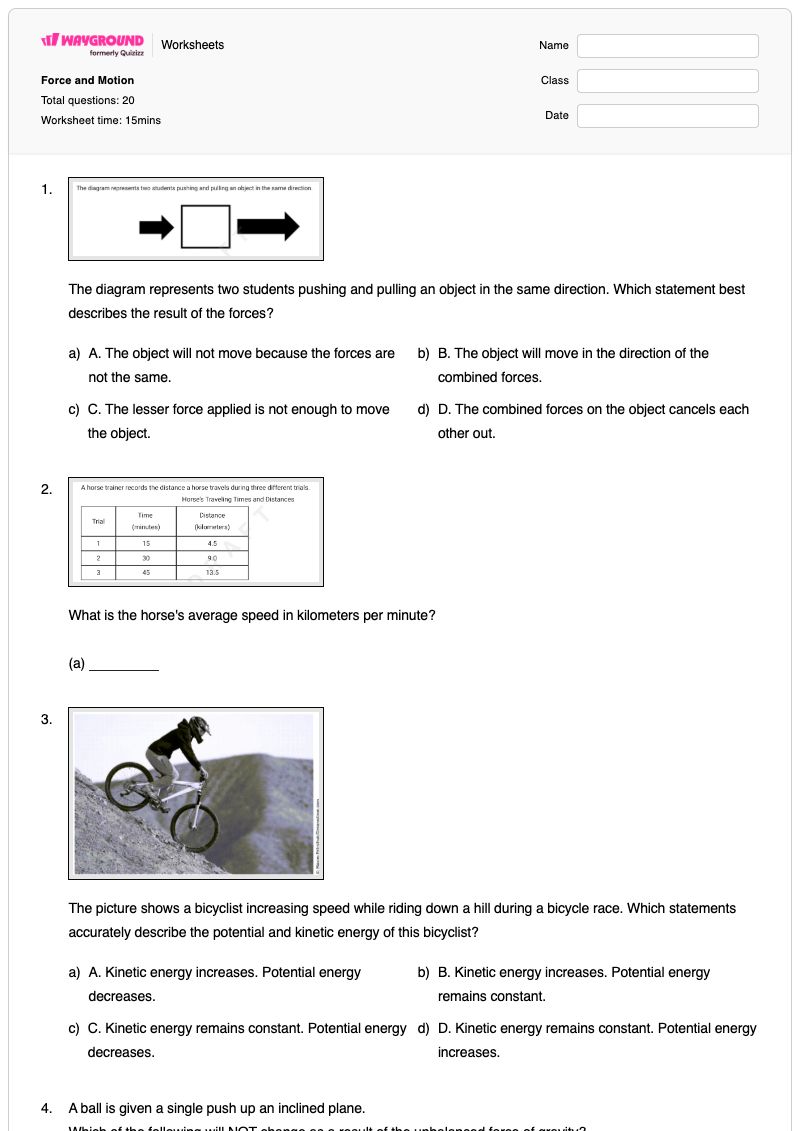
Force and Motion is a Grade 6 science worksheet that builds students’ ability to analyze how forces affect motion and how energy changes during movement. Across 20 questions, students answer multiple-choice and multiple-select items, complete fill-in-the-blank calculations, interpret force diagrams and speed or acceleration graphs, and identify changes in potential and kinetic energy. The questions include determining net force and direction, recognizing balanced and unbalanced forces, calculating average speed, and relating an object’s position to its energy. This worksheet supports assessment of both conceptual understanding and application. Students must use graph evidence to describe whether a car is speeding up, slowing down, or moving at constant speed; compare energy at different points on a track or during a bounce; and solve speed and distance problems using supplied values. It is a free printable worksheet with a complete answer key for Grade 6 science instruction, independent practice, or review.

Worksheet settings

Font size

S
M
L
XL
Worksheets

Force and Motion

Total questions: 20

Name
Class
Date
1.

The diagram represents two students pushing and pulling an object in the same direction. Which statement best describes the result of the forces?

a)

A. The object will not move because the forces are not the same.

b)

B. The object will move in the direction of the combined forces.

c)

C. The lesser force applied is not enough to move the object.

d)

D. The combined forces on the object cancels each other out.

2.

What is the horse's average speed in kilometers per minute?

(a)  

3.

The picture shows a bicyclist increasing speed while riding down a hill during a bicycle race. Which statements accurately describe the potential and kinetic energy of this bicyclist?

a)

A. Kinetic energy increases. Potential energy decreases.

b)

B. Kinetic energy increases. Potential energy remains constant.

c)

C. Kinetic energy remains constant. Potential energy decreases.

d)

D. Kinetic energy remains constant. Potential energy increases.

4.

A ball is given a single push up an inclined plane.

Which of the following will NOT change as a result of the unbalanced force of gravity?

a)

A. Position

b)

B. Speed

c)

C. Mass

d)

D. Direction

5.

PART A

This question has two parts. First, complete Part A. Then complete Part B.

The graph represents the movement of a car over the span of 8 seconds. What does the graph tell us about the movement of the car from 6 - 8 seconds?

a)

The car was speeding up.

b)

The car was slowing down.

c)

The car was not moving.

d)

The car was moving at constant speed.

6.

PART B

This question has two parts. First, complete Part A. Then complete Part B.

Which of the following statements BEST supports your answer to Part A?

a)

A. A straight line on a speed vs time graph demonstrates a car at rest.

b)

B. A straight line on a speed vs time graph demonstrates a car at constant speed.

c)

C. A diagonal line on a speed vs time graph moving upward on the y-axis demonstrates a car slowing down.

d)

D. A diagonal line on a speed vs time graph moving downward on the y-axis demonstrates a car slowing down.

7.

In the classroom demonstration shown below, a rubber ball is dropped from Position 1. The ball bounces as shown.

At which of these positions does the ball have both the greatest kinetic energy and the least potential energy?

a)

Position 1

b)

Position 2

c)

Position 3

d)

Position 4

8.

Analyze the acceleration graph. Identify the locations on the graph where an increase in speed can be observed. Select TWO correct answers.

a)

Blue

b)

Red

c)

Green

d)

Yellow

9.

During the first 2 hours of the trip, they traveled

(a)   km.

10.

A marble is given potential energy by being placed at Location W. When the marble is released, it rolls down the track. At which location does the marble have maximum kinetic energy?

a)

Location W

b)

Location X

c)

Location Y

d)

Location Z

11.

A block is pulled 0.90 m to the right in 2.5 s.

What is the block's average speed to the nearest hundredth of a m/s?

(a)  

12.
At which point does the cart have the greatest amount of potential energy?
a)
W
b)
X
c)
Y
d)
Z
13.
At which point does the cart have the greatest amount of kinetic energy?
a)
W
b)
X
c)
Y
d)
Z
14.
Which of the following statements is true? 
a)
Balanced forces cause a change in motion. 
b)
Unbalanced forces cause a change in motion. 
c)
Forces do not effect the change in motion. 
15.
What is the net force on the object, and which direction will the object move?
a)
18 N to the right 
b)
2 N to the right 
c)
18 N to the left 
d)
2 N to the left 
16.
A bicycle leaning against a wall demonstrates ________ forces. 
a)
balanced
b)
unbalanced
17.
What is the net force?
a)
40 N left
b)
0 N Balalnced
c)
400 N right
d)
40 N right
18.

What motion is happening at C?

a)
Stationary
b)

Going back to the start

c)

Speeding Up

d)
Slower steady speed; moving away from the starting position
19.
Study the pictures of the roller coasters. Which number roller coaster would you expect the people to accelerate the FASTEST and take the LEAST amount of time to reach the bottom of the hill? (Click on the question to study the pictures.)
a)
1
b)
2
c)
3
20.

At what point does the cart have the most potential energy?

a)

A

b)

B

c)

C

d)

D

Answer Key

Force and Motion

Total questions: 20

1.
b)

B. The object will move in the direction of the combined forces.

2.
0.3, .3, 0.3
3.
a)

A. Kinetic energy increases. Potential energy decreases.

4.
c)

C. Mass

5.
b)

The car was slowing down.

6.
d)

D. A diagonal line on a speed vs time graph moving downward on the y-axis demonstrates a car slowing down.

7.
b)

Position 2

8.
a)

Blue

, c)

Green

9.
100
10.
c)

Location Y

11.
0.36
12.
a) W
13.
b) X
14.
b) Unbalanced forces cause a change in motion. 
15.
b) 2 N to the right 
16.
a) balanced
17.
d) 40 N right
18.
c)

Speeding Up

19.
c) 3
20.
a)

A

FAQs

What does the Force and Motion worksheet cover?

This Grade 6 science worksheet uses 15 multiple-choice questions, 3 fill-in-the-blank items, and 2 multiple-select questions to assess net force, balanced and unbalanced forces, average speed, motion graphs, and potential and kinetic energy. Students apply these ideas by calculating speed, interpreting graph segments, identifying force direction, and comparing energy at different positions on a path.

How can I use this worksheet to teach force, motion, and energy?

Begin by modeling how to combine forces and distinguish balanced from unbalanced forces, then have students apply those ideas to the force diagrams and direction questions. Next, review how speed-versus-time and acceleration graphs show changes in motion, and use the track, cart, marble, and bouncing-ball items to discuss how position relates to potential and kinetic energy. For the two-part car question, require students to use the graph in Part A and cite the graph pattern in Part B.

What mistakes should I watch for when students complete this Force and Motion worksheet?

Students may add force magnitudes without considering direction, confuse balanced forces with unbalanced forces, or select the wrong direction for the net force. When reading graphs, they may mistake a downward diagonal line on a speed-versus-time graph for an object at rest or confuse speeding up with slowing down. In the energy and calculation items, watch for reversing potential and kinetic energy, treating mass as something gravity changes, or omitting units and rounding when finding average speed.

How do I assign and grade this Force and Motion worksheet?

On Wayground, assign it as a digital quiz or download the printable PDF for paper-based work; both versions include a complete answer key. Printable submissions can be graded by scanning student work with the Wayground for Teachers app, while the digital quiz supports online completion and grading.

How can I differentiate this Force and Motion worksheet for my students?

Use the worksheet’s Advanced Settings to adjust font spacing and font size so the graph-based questions, force diagrams, and energy-location items are easier to read. You can also enable a dyslexia-friendly font or translate the worksheet into another language when that better supports access to the calculations and multiple-choice prompts.

Where can I find more worksheets like this on Wayground?

Wayground offers a broad collection of free printable worksheets and practice problems across subjects, with downloadable PDFs and answer keys to help students master essential skills and concepts. Browse more resources at https://wayground.com/en-us/worksheets.