

Wayground
04 "Or" Probabilities for Statistics - Printable Math Worksheets 9th Grade - Wayground

04 "Or" Probabilities for Statistics

Matthew Kilgore

Created by Matthew Kilgore

20 questions

9th Grade

Math

Updated May 2025

Grade 9 students use this Mathematics worksheet to apply the Addition Rule for probability, including P(A or B) = P(A) + P(B) − P(A and B). The 20-item practice set includes 18 multiple-choice questions and 2 multiple-select questions covering disjoint and overlapping events, shared outcomes, Venn diagrams, tables, complements, and probability situations involving dice, marbles, people, and two-step selections. Students learn to identify whether events have outcomes in common, determine when probabilities can be added directly, and subtract an intersection when outcomes are counted twice. Context-based items require students to transfer the rule beyond symbolic formulas and select all statements that follow from disjoint events. This free printable worksheet is designed for Grade 9 mathematics instruction, independent practice, or assessment and includes an answer key for efficient checking.

Worksheet settings

Font size

S
M
L
XL
WaygroundWorksheets

04 "Or" Probabilities for Statistics

Total questions: 20

Name
Class
Date
1.

P(A or B) =

a)

P(A) + P(B) - P(A and B)

b)

P(A) + P(B)

c)

P(A)∙P(B|A)

d)

P(A)∙P(B)

2.

When does P(A or B) = P(A) + P(B) ?

a)

Always

b)

Never

c)

When A and B are disjoint in relation

d)

When A and B are overlapping in relation

3.

If two Events A and B are disjoint in relation, which of the following are necessarily true?

a)

P(A or B) = P(A) + P(B)

b)

P(A and B) = 0

c)

P(A and B) = 1

d)

P(A and B) = P(A)∙P(B)

4.

Two Events are disjoint in relation when they have...

a)

No outcomes in common

b)

Exactly one outcome in common

c)

At least one outcome in common

d)

All outcomes in common

5.

Two Events are overlapping in relation when they have...

a)

No outcomes in common

b)

Exactly one outcome in common

c)

At least one outcome in common

d)

All outcomes in common

6.

In the Addition Rule, why do we subtract P(A and B)?

a)

Because some outcomes were counted twice

b)

Because the outcomes in the middle shouldn't count

c)

Because "or" in Statistics means "exclusive or."

d)

Because the common outcomes have a lower weight

7.
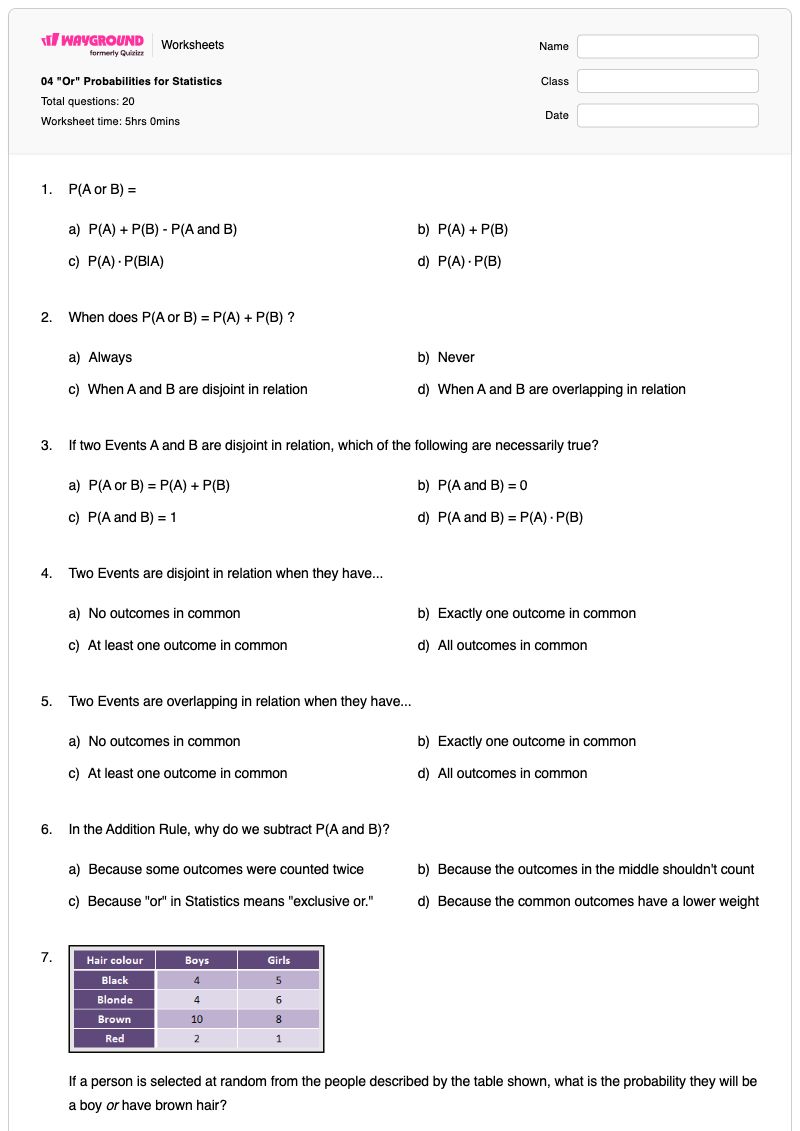
If a person is selected at random from the people described by the table shown, what is the probability they will be a boy…

If a person is selected at random from the people described by the table shown, what is the probability they will be a boy or have brown hair?

a)

70%

b)

95%

c)

25%

d)

68.5%

8.

If you roll a fair six-sided die, what is the probability of getting an odd number or a prime number?

a)

2/3

b)

1/3

c)

1/2

d)

5/6

9.
A bag contains 9 green marbles, 5 yellow marbles and 6 red marbles. You select one marble. What is the probability of…

A bag contains 9 green marbles, 5 yellow marbles and 6 red marbles. You select one marble. What is the probability of selecting a green or red marble?

a)

8/15

b)

6/11

c)

3/4

d)

2/3

10.
Consider the Venn Diagram shown. If a species is selected at random from this diagram, what is the probability it can swim…

Consider the Venn Diagram shown. If a species is selected at random from this diagram, what is the probability it can swim or breathe air?

a)

2/5

b)

14/15

c)

1/4

d)

2/3

11.

P(A or B) =

a)

1 - P(A and B)

b)

1 - P(A' and B')

c)

1 - P(A' or B')

d)

1 - P(A | B)

12.

1,500 people are attending a music festival. 200 are teenagers and 300 like electronic dance music (EDM). 100 of the teenagers like EDM.


If a person is selected at random from this festival, what is the probability they are a teenager or like EDM? If necessary, round to the nearest Percent.

a)

33%

b)

42%

c)

27%

d)

40%

13.

Integration: 58% of respondents to a survey plan to vote for the incumbent Mayor. 52% of respondents approve of the Mayor's job performance. 80% of respondents who plan to vote for the Mayor approve of her job performance.


Estimate the percentage of people in this survey's Field of Study who plan to vote for the Mayor or approve of her job performance.

a)

63.6%

b)

30%

c)

68.4%

d)

86%

14.

A bag contains 4 red, 2 blue and 3 white marbles. Two marbles are selected from this bag at random and without replacement.


What is the probability that the first marble was blue or the second marble was blue?

a)

5/12

b)

7/12

c)

32/81

d)

49/81

15.
Consider the table shown. Assume no student is enrolled in more than one of these classes. If a student is selected at…

Consider the table shown. Assume no student is enrolled in more than one of these classes. If a student is selected at random from this table, what is the probability they are enrolled in DSA or Statistics? If necessary, round to the nearest tenth of a Percent.

a)

35.7%

b)

55.6%

c)

40%

d)

0%

16.

Geraldine rolls a fair six-sided die and then flips a fair coin. What is the probability she rolls a "2" or gets a tail?

a)

7/12

b)

2/3

c)

1/12

d)

1/6

17.

A survey revealed that 34% of people are entertained by reading books, 47% are entertained by watching TV, and 19% are entertained by both books and TV. Estimate the probability that a random person in the Field of Study of this survey will be entertained by either books or TV:

a)

19%

b)

81%

c)

62%

d)

100%

18.

Five juniors and four seniors have applied for two open student council positions. School administrators have decided to pick the two new members randomly. What is the probability they are both juniors or both seniors?

a)

0.444

b)

0.395

c)

0.569

d)

0.722

19.

A trial consists of selecting a single person from a school auditorium. Which of the following pairs of Events are likely to be disjoint (mutually exclusive)?

a)

Selecting a Freshman and selecting a Senior

b)

Selecting a boy and selecting a girl

c)

Selecting a Freshman and selecting a boy

d)

Selecting a Senior and selecting a girl

20.

A trial consists of selecting a single day from last year at random. Which of the following pairs of Events are most likely to be overlapping?

a)

Selecting a sunny day and selecting a day in the summer

b)

Selecting a sunny day and selecting a day with a hurricane

c)

Selecting a snowy day and selecting a day in the summer

d)

Selecting a day in March and selecting a day in April

WaygroundAnswer Key

04 "Or" Probabilities for Statistics

Total questions: 20

1.
a)

P(A) + P(B) - P(A and B)

2.
c)

When A and B are disjoint in relation

3.
a)

P(A or B) = P(A) + P(B)

, b)

P(A and B) = 0

4.
a)

No outcomes in common

5.
c)

At least one outcome in common

6.
a)

Because some outcomes were counted twice

7.
a)

70%

8.
a)

2/3

9.
c)

3/4

10.
b)

14/15

11.
b)

1 - P(A' and B')

12.
c)

27%

13.
a)

63.6%

14.
a)

5/12

15.
a)

35.7%

16.
a)

7/12

17.
c)

62%

18.
a)

0.444

19.
a)

Selecting a Freshman and selecting a Senior

, b)

Selecting a boy and selecting a girl

20.
a)

Selecting a sunny day and selecting a day in the summer

FAQs

What does this worksheet cover, and how does it help students learn the Addition Rule for probability?

This Grade 9 worksheet focuses on finding the probability of A or B for disjoint and overlapping events. Its 18 multiple-choice and 2 multiple-select items have students use P(A or B) = P(A) + P(B) − P(A and B), identify shared outcomes, and apply the rule to Venn diagrams, tables, and real-world probability situations.

How can I use this worksheet to teach disjoint and overlapping events?

Introduce the worksheet by representing two events with a Venn diagram and asking students whether any outcomes belong to both events. Then model why the intersection is subtracted for overlapping events, compare that process with direct addition for disjoint events, and use the die, marble, and data-table questions for guided practice before assigning the remaining items independently.

What mistakes should I watch for when students complete this probability worksheet?

Students may add P(A) and P(B) without subtracting P(A and B) when the events overlap, or subtract the intersection even when the events are disjoint. Also watch for confusion between “or” and “and,” misidentifying events with no outcomes in common, and choosing only one answer on the multiple-select items when both disjoint-event statements are required.

How do I assign and grade this Addition Rule probability worksheet?

On Wayground, assign it as a digital quiz or download the printable PDF for paper-based work; both versions include a complete answer key. Printable submissions can be graded by scanning student work with the Wayground for Teachers app, while the digital quiz supports online response collection and grading.

How can I differentiate this worksheet for my students?

In the worksheet’s Advanced Settings, adjust font spacing or choose a larger font size to make the multiple-choice and multiple-select items easier to read. You can also enable a dyslexia-friendly font or translate the worksheet into another language while keeping the Addition Rule practice and event-identification tasks intact.

Where can I find more free worksheets like this on Wayground?

Wayground offers a broad collection of free printable worksheets and practice problems across subjects, with downloadable PDFs and answer keys to support essential skills and concepts. Browse more resources at https://wayground.com/en-us/worksheets.