This free printable Grade 2 English reading worksheet gives students focused practice identifying and using nonfiction text features. Across 15 multiple-choice questions, students name and interpret a table of contents, captions, bold print, labels, photographs, diagrams, maps, and a glossary. They also answer questions about where features appear in a book, how a glossary is organized in ABC order, what bold print signals, why readers read nonfiction, and how a table of contents helps locate chapter information.
Designed for second-grade readers, the worksheet builds foundational skills for navigating informational books and using visual and organizational clues to support understanding. Students select answers rather than produce extended written responses, making the activity useful for guided practice, independent work, review, or a quick comprehension check. A complete answer key is included, and the worksheet is available as a free printable PDF for classroom, intervention, or at-home practice.
Worksheet settings
Font size
S
M
L
XL
Worksheets
nonfiction text features Mrs. Hayes 2nd grade
Total questions: 15
Name
Class
Date
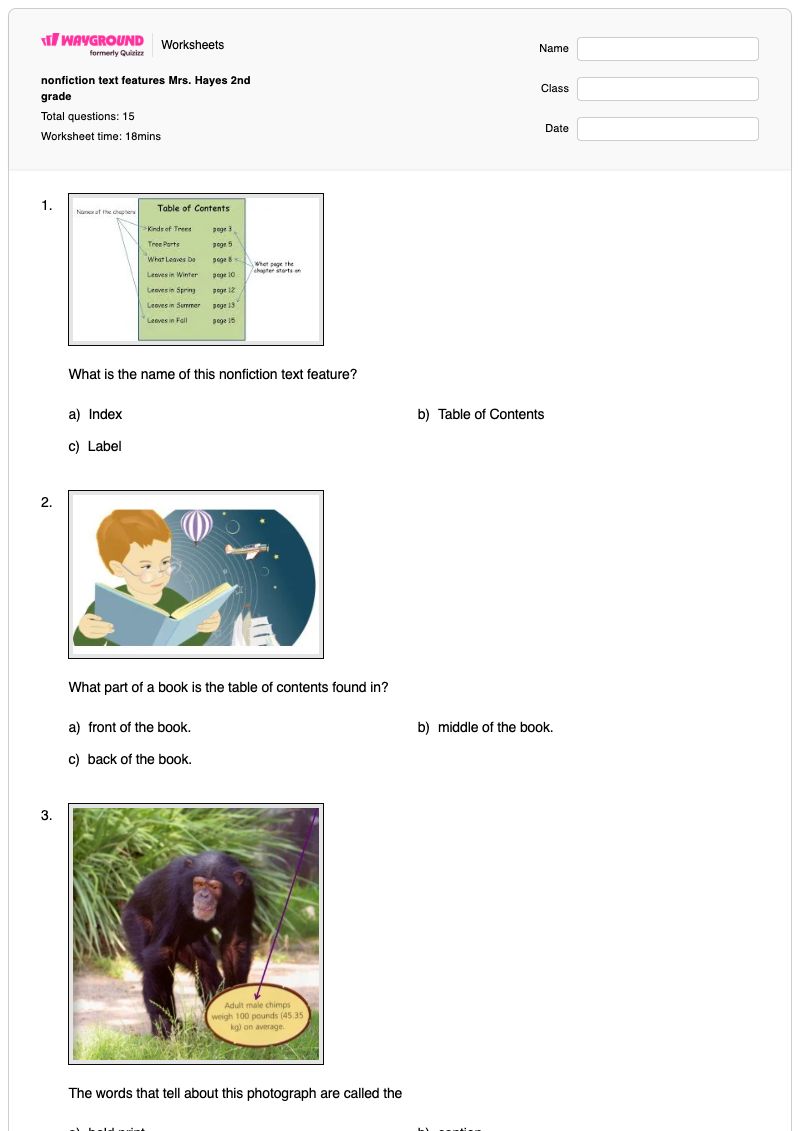
1.
What is the name of this nonfiction text feature?
a)
Index
b)
Table of Contents
c)
Label
2.
What part of a book is the table of contents found in?
a)
front of the book.
b)
middle of the book.
c)
back of the book.
3.
The words that tell about this photograph are called the
a)
bold print
b)
caption
c)
label
4.
What is the name for the dark printed words shown?
a)
bold print.
b)
labels.
c)
diagram.
5.
Where is the glossary located in a nonfiction book?
a)
front of the book.
b)
middle of the book.
c)
back of the book.
6.
Name one of the labels in this diagram
a)
hat
b)
vest
c)
scarf
7.
A reader reads nonfiction to
a)
be entertained.
b)
learn new things.
c)
meet new characters.
8.
What is the name of this nonfiction text feature?
a)
Illustration
b)
Diagram
c)
Photograph
9.
A drawing of a place is called a
a)
map
b)
globe
c)
label
10.
What does the bold print help a reader to know?
a)
The word is easy.
b)
The the words is not important.
c)
The word is important to understand.
11.
What is the name of this nonfiction text feature shown?
a)
photograph
b)
diagram
c)
caption
12.
What nonfiction text feature is shown here?
a)
Bold Words
b)
Table of Contents
c)
Index
13.
In a nonfiction book, where can you find what the bold print words mean?
a)
index
b)
glossary
c)
table of contents
14.
How is the glossary organized so that the reader can find the words easily?
a)
ABC order.
b)
number order.
c)
glossary are in size order (longest words to shortest words).
15.
What chapter is Tigers on the Prowl?
a)
Chapter 1
b)
Chapter 2
c)
Chapter 3
d)
Chapter 4
Answer Key
nonfiction text features Mrs. Hayes 2nd grade
Total questions: 15
1.
b) Table of Contents
2.
a) front of the book.
3.
b) caption
4.
a) bold print.
5.
c) back of the book.
6.
a) hat
7.
b) learn new things.
8.
c) Photograph
9.
a) map
10.
c) The word is important to understand.
11.
b) diagram
12.
a)
Bold Words
13.
b) glossary
14.
a) ABC order.
15.
c)
Chapter 3
140 %
Browse by subjects
Browse by grades
Browse by format
FAQs
What does this Grade 2 nonfiction text features worksheet cover?
This worksheet uses 15 multiple-choice questions to help students identify and interpret nonfiction features, including tables of contents, captions, bold print, labels, photographs, diagrams, maps, and glossaries. Students also practice using feature clues by identifying book locations, recognizing that bold print highlights important words, and understanding that glossary terms are arranged in ABC order.
How can I use this worksheet to teach nonfiction text features?
Introduce the worksheet by displaying examples of a table of contents, caption, bold print, label, photograph, diagram, map, and glossary, then ask students what each feature helps a reader do. Complete a few multiple-choice items together, prompting students to explain why a feature belongs in a particular book section or how it supports understanding. Students can then finish the remaining items independently and use the answer key to discuss their reasoning.
What mistakes should I watch for when students complete this worksheet?
Students may confuse a caption with a label, or a photograph with a diagram, because both can appear alongside visuals. Watch for errors when they identify the table of contents as being in the back of the book or the glossary as being in the front, and when they misunderstand bold print as decoration rather than a signal that a word is important. Students may also overlook that glossary words are organized in ABC order.
How do I assign and grade this nonfiction text features worksheet?
The worksheet is available as a printable PDF and as a digital quiz on Wayground, and it includes a complete answer key for checking the 15 multiple-choice responses. For printable submissions, you can scan student work with the Wayground for Teachers app to help grade responses efficiently.
How can I differentiate this nonfiction text features worksheet for my students?
Use the worksheet’s Advanced Settings to adjust font spacing or choose a larger font size so the multiple-choice options and feature examples are easier to read. You can also enable a dyslexia-friendly font or translate the worksheet into another language while students practice identifying features such as captions, labels, diagrams, and glossaries.
Where can I find more worksheets like this on Wayground?
Wayground offers a comprehensive collection of free printable worksheets and practice problems across all subjects, with downloadable PDFs and answer keys to support essential skills and concepts. Browse more resources at https://wayground.com/en-us/worksheets.

 Worksheets


