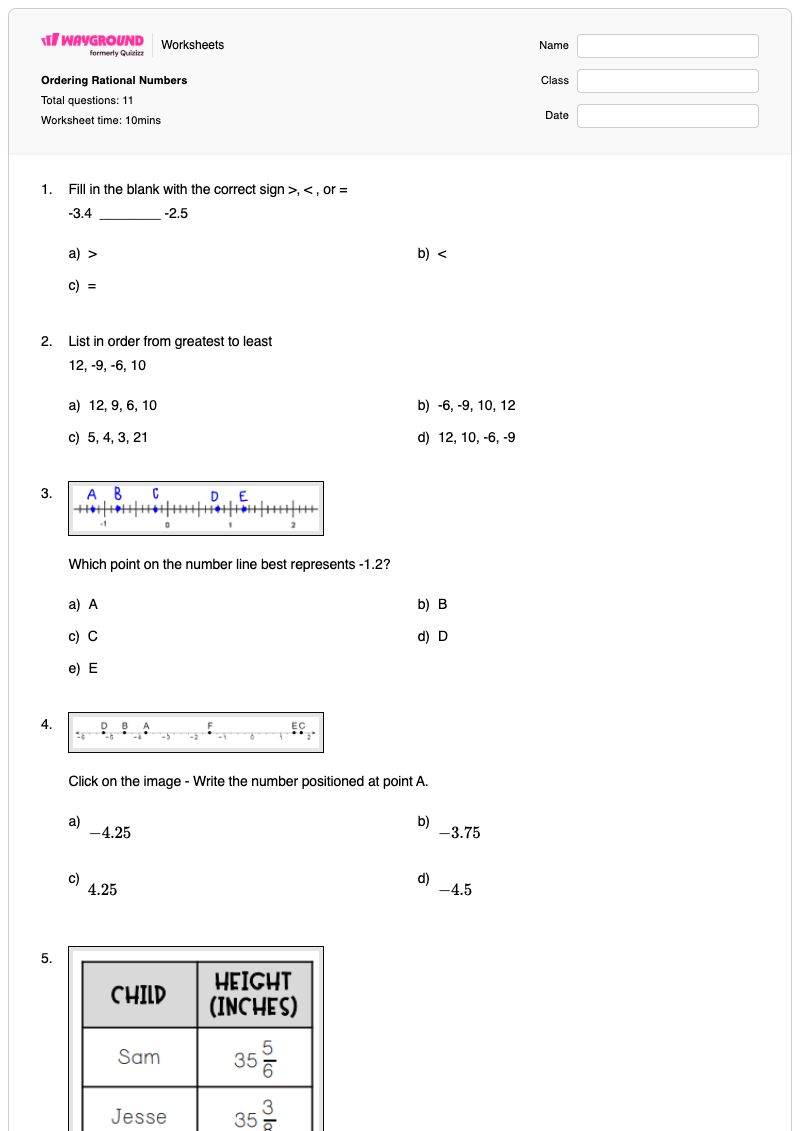
Ordering Rational Numbers is a Grade 6 mathematics worksheet that helps students compare and sequence rational numbers in different representations. Across 11 items—8 multiple-choice questions, 2 fill-in-the-blank questions, and 1 open-ended response—students use comparison signs, order positive and negative numbers from greatest to least or least to greatest, identify decimals represented on number lines, and interpret labeled number-line points. Several items require students to convert fractions to decimals before comparing values.
The open-ended question asks students to evaluate whether a proposed ordering is correct and explain their reasoning, giving you evidence of conceptual understanding rather than answer selection alone. This free printable worksheet includes a complete answer key for efficient review, independent practice, intervention, or a Grade 6 mathematics check of students’ ability to compare rational numbers, including closely spaced negative decimals.
Worksheet settings
Font size
S
M
L
XL
Worksheets
Ordering Rational Numbers
Total questions: 11
Name
Class
Date
1.
Fill in the blank with the correct sign >, < , or = -3.4 ________ -2.5
a)
>
b)
<
c)
=
2.
List in order from greatest to least 12, -9, -6, 10
a)
12, 9, 6, 10
b)
-6, -9, 10, 12
c)
5, 4, 3, 21
d)
12, 10, -6, -9
3.
Which point on the number line best represents -1.2?
a)
A
b)
B
c)
C
d)
D
e)
E
4.
Click on the image - Write the number positioned at point A.
a)
−4.25
b)
−3.75
c)
4.25
d)
−4.5
5.
Who is the tallest? (Hint: turn all fractions into decimals)
(a)
6.
Which child is shorter than Ellis? (Hint: turn all fractions into decimals)
(a)
7.
Andrew is working to place the following cards in order from least to greatest. Explain whether or not he is correct.
4 lines
8.
The following points are placed on a number line. Which number best represents point C?
a)
−332
b)
221
c)
−431
d)
431
9.
Fill in the blank with the correct sign >, < , or = -1.8_____ 0.8
a)
>
b)
<
c)
=
10.
Put the rational numbers in order from least to greatest. -1, -1.1, -1.5, -1.15, -0.5
a)
-1.5, -1.15, -1.1, -1, -0.5
b)
-1.1, -1, -1.5, -1.15, -0.5
c)
-0.5, -1.1, -1, -1.5, -1.15
11.
Fill in the blank with the correct sign >, < , or = -3.4 ________ -2.5
a)
>
b)
<
c)
=
Answer Key
Ordering Rational Numbers
Total questions: 11
1.
b) <
2.
d) 12, 10, -6, -9
3.
a)
A
4.
b)
−3.75
5.
Sam
6.
Elsa
7.
n/a
8.
a)
−332
9.
b) <
10.
a) -1.5, -1.15, -1.1, -1, -0.5
11.
b) <
140 %
Browse by subjects
Browse by grades
Browse by format
FAQs
What does the Ordering Rational Numbers worksheet cover?
This Grade 6 worksheet practises comparing and ordering rational numbers, including negative decimals, fractions converted to decimals, and values shown on number lines. Its 11 questions use comparison signs, greatest-to-least and least-to-greatest ordering, number-line identification, two fraction-to-decimal comparison items, and an open-ended explanation task. Completing these varied items helps students connect numerical value with position on a number line and justify an ordering.
How can I use this worksheet to teach students to order rational numbers?
Begin by modelling how a number’s position on a number line determines its value, then compare a few positive and negative decimals using >, <, and =. Before students complete the fraction-based items, have them convert each fraction to a decimal and explain which value is greater. Use the final open-ended item as a discussion prompt: ask students to identify whether the proposed order is correct and cite the number-line or decimal reasoning that supports their judgment.
What mistakes should I watch for on this rational numbers worksheet?
Students may reverse the order of negative numbers, treating -1.5 as greater than -1.15 because 1.5 is greater than 1.15, or they may compare digits without considering each number’s position relative to zero. Watch for incorrect comparison signs, misreading the labeled points on the number-line items, and failing to convert fractions to decimals in the height-comparison questions. In the open-ended response, check that students explain why an ordering is correct or incorrect rather than giving only a verdict.
How do I assign and grade the Ordering Rational Numbers worksheet?
You can assign this worksheet as a printable PDF or as a digital quiz on Wayground. It includes a complete answer key for the multiple-choice and fill-in-the-blank items, while the open-ended explanation can be scored for the quality of the student’s reasoning. For printable submissions, scan student work with the Wayground for Teachers app to support grading.
How can I differentiate this rational numbers worksheet for my students?
Use the worksheet’s Advanced Settings to adjust font spacing or increase the font size so the comparison signs, decimals, and number-line labels are easier to read. You can also enable a dyslexia-friendly font or translate the worksheet into another language when that supports access to the ordering and fraction-to-decimal tasks. These changes preserve the original question formats, including the open-ended explanation.
Where can I find more worksheets like this on Wayground?
Wayground offers a broad collection of free printable worksheets and practice problems across subjects, with downloadable PDFs and answer keys to help students master essential skills and concepts. Browse more resources at https://wayground.com/en-us/worksheets.

 Worksheets


