

Wayground
Go Math Grade 3 Chapter 1 - Printable Mathematics Worksheets year 3 - Wayground

Go Math Grade 3 Chapter 1

15 questions

3rd - 3rd Grade

Mathematics

Go Math Grade 3 Chapter 1 is a free printable mathematics worksheet for Grade 3 students covering foundational addition, subtraction, rounding, estimation, and number properties. Across 15 items, students identify even sums, recognize the Commutative and Associative Properties of Addition, round numbers to the nearest ten or hundred, and select sums that support a target estimate. The worksheet also applies these skills in addition and subtraction problems, including regrouping steps, table-based questions, real-world word problems, and checking subtraction with addition. Its combination of multiple-select, multiple-choice, and one fill-in-the-blank question helps teachers see whether students can recognize concepts, explain estimation choices, and calculate with three-digit numbers. This free printable worksheet includes an answer key for efficient review and grading.

Worksheet settings

Font size

S
M
L
XL
Worksheets

Go Math Grade 3 Chapter 1

Total questions: 15

Name
Class
Date
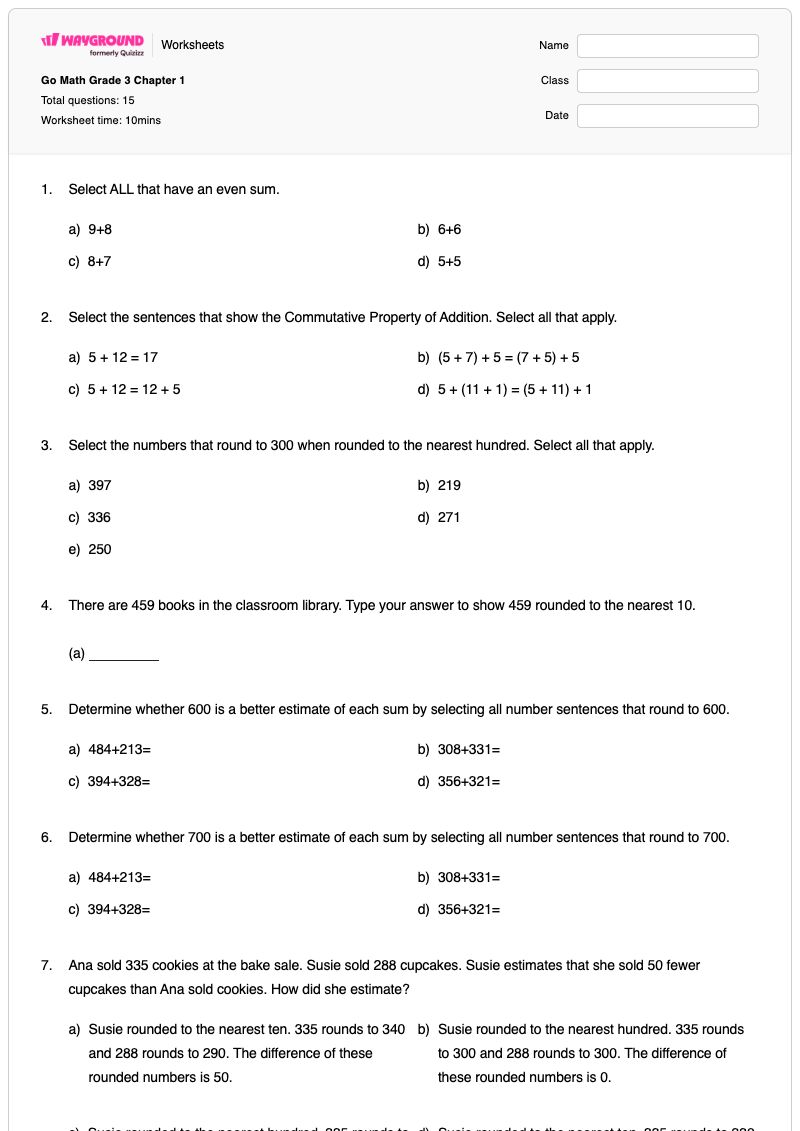
1.

Select ALL that have an even sum.

a)

9+8

b)

6+6

c)

8+7

d)

5+5

2.

Select the sentences that show the Commutative Property of Addition. Select all that apply.

a)

5 + 12 = 17

b)

(5 + 7) + 5 = (7 + 5) + 5

c)

5 + 12 = 12 + 5

d)

5 + (11 + 1) = (5 + 11) + 1

3.

Select the numbers that round to 300 when rounded to the nearest hundred. Select all that apply.

a)

397

b)

219

c)

336

d)

271

e)

250

4.

There are 459 books in the classroom library. Type your answer to show 459 rounded to the nearest 10.

(a)  

5.

Determine whether 600 is a better estimate of each sum by selecting all number sentences that round to 600.

a)

484+213=

b)

308+331=

c)

394+328=

d)

356+321=

6.

Determine whether 700 is a better estimate of each sum by selecting all number sentences that round to 700.

a)

484+213=

b)

308+331=

c)

394+328=

d)

356+321=

7.

Ana sold 335 cookies at the bake sale. Susie sold 288 cupcakes. Susie estimates that she sold 50 fewer cupcakes than Ana sold cookies. How did she estimate?

a)

Susie rounded to the nearest ten. 335 rounds to 340 and 288 rounds to 290. The difference of these rounded numbers is 50.


b)

Susie rounded to the nearest hundred. 335 rounds to 300 and 288 rounds to 300. The difference of these rounded numbers is 0.

c)

Susie rounded to the nearest hundred. 335 rounds to 300 and 288 rounds to 300. The difference of these rounded numbers is 50.

d)

Susie rounded to the nearest ten. 335 rounds to 330 and 288 rounds to 300. The difference of these rounded numbers is 30.

8.

Choose the property that makes the statement true.

The ______________ Property of Addition states that you can group addends in different ways and get the same sum.

a)

Identity

b)

Commutative

c)

Associative

d)

Patterns

9.

The table shows the number of sweaters sold online in three months.


Susie's Sweater Shop

Month Number of Sweaters

January 402

February 298

March 171


How many sweaters were sold in January and February?

a)

600

b)

696

c)

700

d)

711

10.

The table shows the number of sweaters sold online in three months.


Susie's Sweater Shop

Month Number of Sweaters

January 402

February 298

March 171


How many more sweaters were sold in January than March?

a)

573

b)

231

c)

331

d)

221

11.

The table shows the number of sweaters sold online in three months.


Susie's Sweater Shop

Month Number of Sweaters

January 402

February 298

March 171


How many more sweaters were sold in February and March than January?

a)

73

b)

69

c)

67

d)

43

12.

Help Gabrielle find the sum.

345

151

+243


Select each step Gabrielle had to do to find the sum.

a)

Regroup the ones.

b)

Add the regrouped tens.

c)

Regroup the tens.

d)

Add the regrouped hundreds.

13.

Frankie has 304 pieces in a building set. He uses 238 pieces to build a house.

How many pieces does he have left?

a)

78

b)

86

c)

76

d)

66

14.

The Shirt Store is having its annual Shop-a-thon. Shoppers have purchased 269 shirts so far. Their goal is to sell more than 400 .


What is the least number of shirts they need to sell to reach their goal?

a)

311

b)

132

c)

131

d)

669

15.

Leah used 86 + 43 = 129 to check her subtraction.

Which math problems could she be checking? Select all that apply.

a)

129 - 43 = 86

b)

129 + 43 = 86

c)

129 + 86 = 43

d)

129 - 86 = 43

Answer Key

Go Math Grade 3 Chapter 1

Total questions: 15

1.
b)

6+6

, d)

5+5

2.
c)

5 + 12 = 12 + 5

, b)

(5 + 7) + 5 = (7 + 5) + 5

3.
d)

271

, e)

250

, c)

336

4.
460
5.
b)

308+331=

6.
a)

484+213=

, d)

356+321=

, c)

394+328=

7.
a)

Susie rounded to the nearest ten. 335 rounds to 340 and 288 rounds to 290. The difference of these rounded numbers is 50.


8.
c)

Associative

9.
c)

700

10.
b)

231

11.
c)

67

12.
c)

Regroup the tens.

, d)

Add the regrouped hundreds.

13.
d)

66

14.
b)

132

15.
d)

129 - 86 = 43

, a)

129 - 43 = 86

FAQs

What does the Go Math Grade 3 Chapter 1 worksheet cover?

This 15-question worksheet practices rounding three-digit numbers to the nearest ten and hundred, estimating sums, identifying even sums, and recognizing the Commutative and Associative Properties of Addition. Students apply these ideas through multiple-select and multiple-choice items, a fill-in-the-blank rounding question, regrouping steps, table-based calculations, and addition and subtraction word problems.

How can I use this worksheet to teach rounding, estimation, and addition strategies?

Introduce the worksheet by modeling one number rounded to the nearest ten and hundred, then have students explain why the place value changes. Next, use the estimation items to discuss rounding both addends before finding an approximate sum, and finish with the regrouping and word problems so students connect the strategies to exact calculations. Ask students to justify why a selected answer fits rather than treating the multiple-select questions as guessing exercises.

What mistakes should I watch for when students complete this worksheet?

Watch for students rounding to the wrong place, especially when switching between the nearest ten and nearest hundred, or selecting only one correct option in a select-all question. Students may also confuse the Commutative Property, which changes the order of addends, with the Associative Property, which changes their grouping. In the computation items, check that students regroup the correct place value and use the inverse relationship between addition and subtraction when choosing equations that verify a difference.

How do I assign and grade this worksheet?

Go Math Grade 3 Chapter 1 is available as a printable PDF and as a digital quiz on Wayground, and it includes a complete answer key. You can grade printed student work by scanning it with the Wayground for Teachers app, or review responses from the digital version.

How can I differentiate this worksheet for my students?

Use the worksheet’s Advanced Settings to adjust font spacing and font size so the rounding, estimation, and computation items are easier to read. You can also apply a dyslexia-friendly font or translate the worksheet into another language while keeping its multiple-select, multiple-choice, and fill-in-the-blank format.

Where can I find more worksheets like this on Wayground?

Wayground offers a comprehensive collection of free printable worksheets and practice problems across all subjects, with downloadable PDFs and answer keys to support essential skills and concepts. Browse more resources at https://wayground.com/en-us/worksheets.