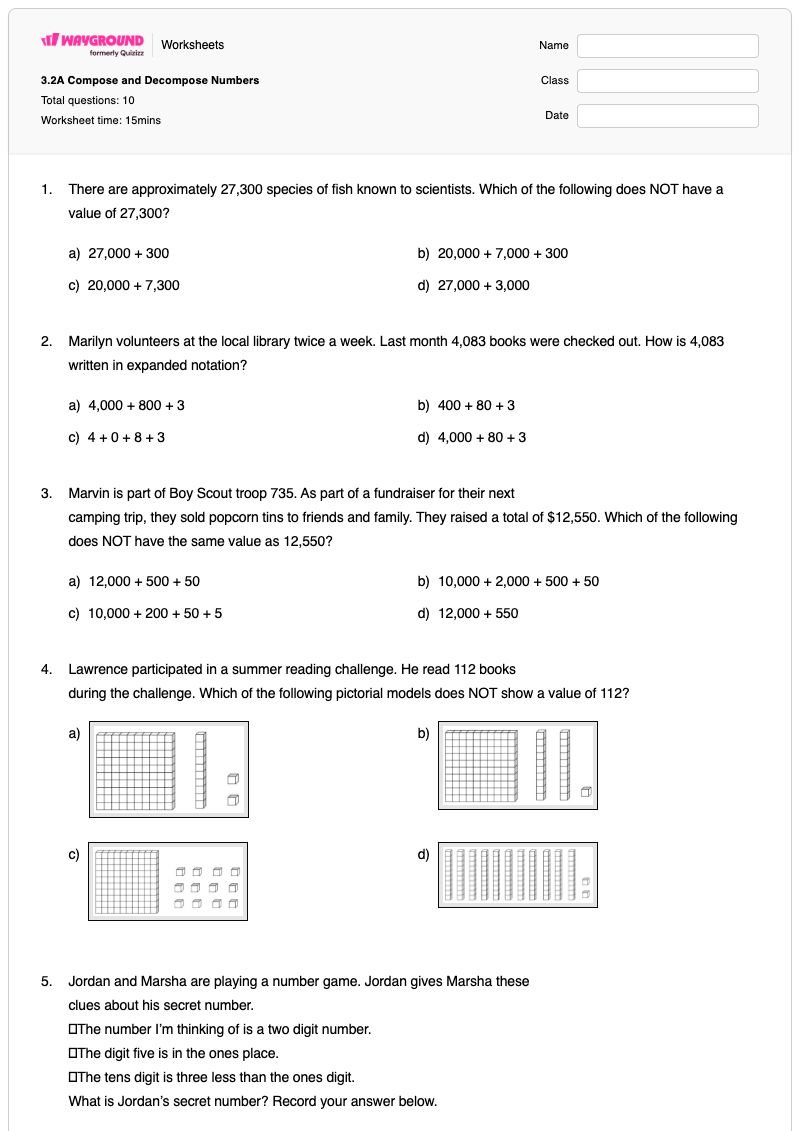
3.2A Compose and Decompose Numbers is a Grade 3 mathematics worksheet that builds place-value fluency through 10 varied items: eight multiple-choice questions, one fill-in-the-blank item, and one multiple-select question. Students represent numbers in standard, expanded, word, and pictorial forms; identify the value and spoken place of a digit; solve a two-digit number riddle from place-value clues; and determine which representations are not equivalent.
The worksheet includes examples with numbers such as 112, 832, 4,083, 12,550, and 23,067, requiring students to decompose numbers into thousands, hundreds, tens, and ones and compose equivalent forms. It is useful for independent practice, small-group review, or a quick formative assessment of Grade 3 number representation skills. This is a free printable worksheet with a complete answer key, and it is also available as a digital quiz on Wayground.
Worksheet settings
Font size
S
M
L
XL
Worksheets
3.2A Compose and Decompose Numbers
Total questions: 10
Name
Class
Date
1.
There are approximately 27,300 species of fish known to scientists. Which of the following does NOT have a value of 27,300?
a)
27,000 + 300
b)
20,000 + 7,000 + 300
c)
20,000 + 7,300
d)
27,000 + 3,000
2.
Marilyn volunteers at the local library twice a week. Last month 4,083 books were checked out. How is 4,083 written in expanded notation?
a)
4,000 + 800 + 3
b)
400 + 80 + 3
c)
4 + 0 + 8 + 3
d)
4,000 + 80 + 3
3.
Marvin is part of Boy Scout troop 735. As part of a fundraiser for their next
camping trip, they sold popcorn tins to friends and family. They raised a total of $12,550. Which of the following does NOT have the same value as 12,550?
a)
12,000 + 500 + 50
b)
10,000 + 2,000 + 500 + 50
c)
10,000 + 200 + 50 + 5
d)
12,000 + 550
4.
Lawrence participated in a summer reading challenge. He read 112 books
during the challenge. Which of the following pictorial models does NOT show a value of 112?
a)
b)
c)
d)
5.
Jordan and Marsha are playing a number game. Jordan gives Marsha these
clues about his secret number.
The number I’m thinking of is a two digit number.
The digit five is in the ones place.
The tens digit is three less than the ones digit.
What is Jordan’s secret number? Record your answer below.
(a)
6.
What is the value of the underlined digit in the numeral below?
43,642
a)
6
b)
600
c)
60
d)
6,000
7.
In which of the numerals below is the digit 2 NOT pronounced ‘twenty’?
a)
20,479
b)
23,487
c)
19,427
d)
19,278
8.
Which of the following does NOT have a value of 832?
a)
Eight hundreds + three tens + two ones
b)
Eight hundreds + thirty-two tens
c)
Eight hundreds + thirty-two ones
d)
Seven hundreds + thirteen tens + two ones
9.
Mrs. Blackwell’s class is playing a number game. When it was Ted’s turn, he drew the following card.
In order to stay in the game, he must determine the value of the pictorial model shown on the card. What is the value of the pictorial model?
a)
334
b)
444
c)
344
d)
434
10.
Which of the following has the same value as 20,000 + 3,000 + 60 + 7?
Select all that apply.
a)
23,670
b)
23, 067
c)
Twenty-three thousand, sixty-seven
d)
(2 x 10,000) + (3 x 1,00) + (6 x 10) + (7 x 1)
Answer Key
3.2A Compose and Decompose Numbers
Total questions: 10
1.
d)
27,000 + 3,000
2.
d)
4,000 + 80 + 3
3.
c)
10,000 + 200 + 50 + 5
4.
b)
5.
25
6.
b)
600
7.
d)
19,278
8.
b)
Eight hundreds + thirty-two tens
9.
c)
344
10.
b)
23, 067
, c)
Twenty-three thousand, sixty-seven
, d)
(2 x 10,000) + (3 x 1,00) + (6 x 10) + (7 x 1)
140 %
Browse by subjects
Browse by grades
Browse by format
FAQs
What does the 3.2A Compose and Decompose Numbers worksheet cover?
This Grade 3 worksheet practices composing and decomposing whole numbers through expanded notation, word form, standard form, pictorial models, and place-value expressions. Its 10 items—eight multiple choice, one fill-in-the-blank number riddle, and one multiple-select question—ask students to identify equivalent and non-equivalent representations, determine a digit’s value, and use tens and ones clues to find a number.
How can I use this worksheet to teach composing and decomposing numbers?
Introduce one number at a time by having students build it with place-value blocks, write its standard and expanded forms, and explain why the forms are equivalent. Then use the worksheet’s “does not have the same value” items and pictorial-model questions for guided discussion, asking students to locate the place value that makes an option incorrect. Finish with the secret-number fill-in item and the multiple-select question so students apply the same reasoning independently.
What mistakes should I watch for on this place-value worksheet?
Students may confuse a digit with its value, such as choosing 6 instead of 600 when the digit 6 is in the hundreds place. They may also treat a non-equivalent decomposition as correct, misread pictorial hundreds, tens, and ones, or select only one answer in the multiple-select item. In the number riddle, check that students use both clues—5 in the ones place and a tens digit three less—to form 25.
How do I assign and grade the 3.2A Compose and Decompose Numbers worksheet?
On Wayground, you can assign this worksheet as a printable PDF or as a digital quiz, with a complete answer key included for all 10 items. Printable submissions can be graded by scanning student work with the Wayground for Teachers app. The PDF option also supports schools that want to reduce screen time while students practice place-value representations.
How can I differentiate this number-composition worksheet for my students?
Use the worksheet’s Advanced Settings to adjust font spacing and font size so the place-value expressions, answer choices, and pictorial-model items are easier to read. You can also apply a dyslexia-friendly font or translate the worksheet into another language when appropriate. These file-level options preserve the worksheet’s focus on composing and decomposing whole numbers while changing its presentation.
Where can I find more worksheets like this on Wayground?
Wayground offers a broad collection of free printable worksheets and practice problems across subjects, with downloadable PDFs and answer keys to support essential skills and concepts. Teachers can browse more resources at https://wayground.com/en-us/worksheets.

 Worksheets


