

Wayground
Observations and Inferences - Printable Science Worksheets year 4 - Wayground

Observations and Inferences

15 questions

3rd - 5th Grade

Science

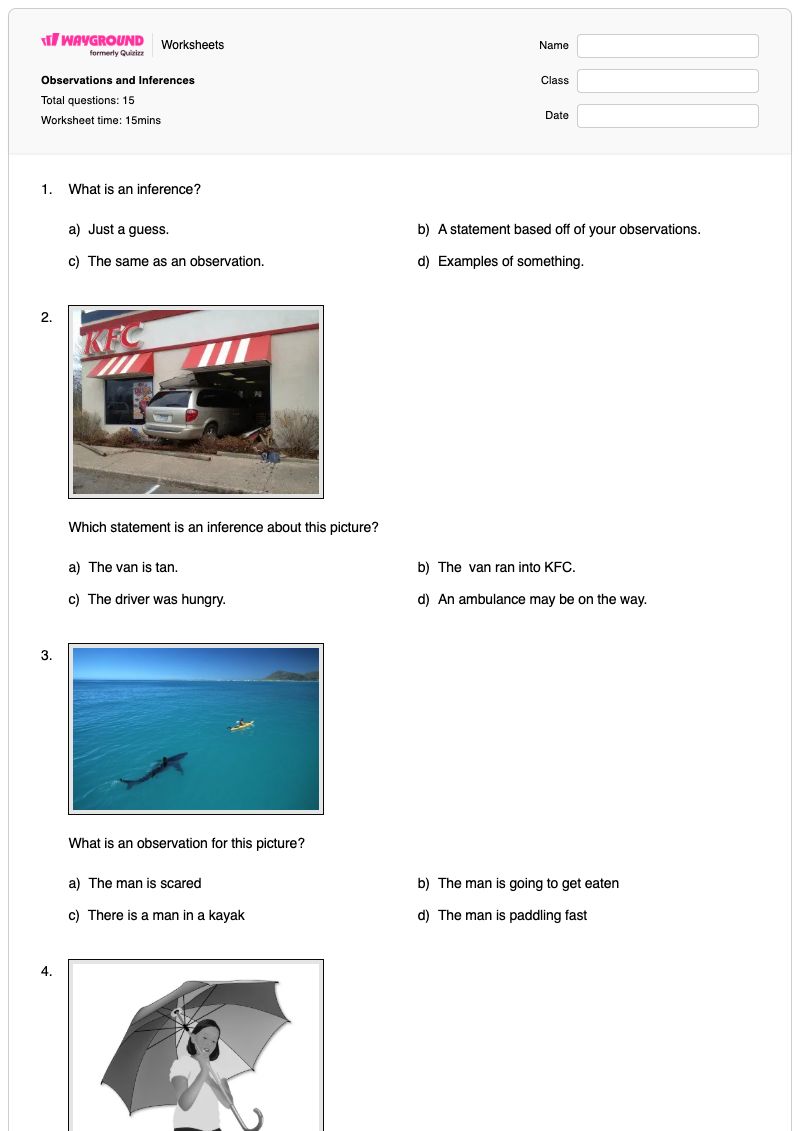
Observations and Inferences is a free printable science worksheet for students in Grades 3–5. It builds the foundational skill of distinguishing information gathered through the five senses from inferences—statements formed from observations. Across 15 multiple-choice questions, students identify definitions, classify statements as observations or inferences, and interpret picture-based scenarios. The worksheet gives students repeated practice separating visible or directly described details from conclusions about what may have happened, what someone may feel, or what may happen next. Examples include identifying a person in a kayak as an observation, recognizing that a girl broke a vase as an inference, and deciding whether statements about clothing, weather, or behavior are observations or inferences. A complete answer key is included for efficient review, reteaching, or independent practice.

Worksheet settings

Font size

S
M
L
XL
Worksheets

Observations and Inferences

Total questions: 15

Name
Class
Date
1.
What is an inference? 
a)
Just a guess.
b)
A statement based off of your observations. 
c)
The same as an observation. 
d)
Examples of something. 
2.
Which statement is an inference about this picture?
a)
The van is tan.
b)
The  van ran into KFC. 
c)
The driver was hungry. 
d)
An ambulance may be on the way. 
3.
What is an observation for this picture?
a)
The man is scared
b)
The man is going to get eaten
c)
There is a man in a kayak
d)
The man is paddling fast
4.
She is holding an umbrella
a)
observation
b)
inference
5.
It is raining outside
a)
observation
b)
inference
6.
Which of the following is NOT an inference about the man in this picture:
a)
The man hates his purple shirt.
b)
The man has a purple shirt.
c)
The man is having a bad day.
d)
This man is upset because he's hungry
7.
The boy has a green blanket
a)
observation
b)
inference
8.
The boy is not going to school today
a)
observation
b)
inference
9.
Which of the following statements is an inference about the picture
a)
The vase is broken.
b)
The girls' bow is blue and purple.
c)
The girl broke the vase.
d)
The girl has blonde hair.
10.

Information gathered using your 5 senses is called an

a)

Observation

b)

Inference

11.
Which of the following is an observation about this picture?
a)
The boy has fallen off his bike.
b)
The boy is in a lot of pain.
c)
The boy has injuries to his knees
d)
The boy learned his lesson about wheelies
12.
The girl is folding her arms.
a)
Observation
b)
Inference
13.

It's December.

a)

Observation

b)

Inference

14.
The 2 men are wearing black.
a)
Observation
b)
Inference
15.
The girl does not want to eat her vegetables.
a)
Observation
b)
Inference
Answer Key

Observations and Inferences

Total questions: 15

1.
b) A statement based off of your observations. 
2.
c) The driver was hungry. 
3.
c) There is a man in a kayak
4.
a) observation
5.
b) inference
6.
b) The man has a purple shirt.
7.
a) observation
8.
b) inference
9.
c) The girl broke the vase.
10.
a)

Observation

11.
c) The boy has injuries to his knees
12.
a) Observation
13.
b)

Inference

14.
a) Observation
15.
b) Inference

FAQs

What does the Observations and Inferences worksheet cover?

This Grade 3–5 science worksheet covers the difference between observations and inferences through 15 multiple-choice questions. Students define each term, identify information gathered through the five senses, classify statements, and use picture-based scenarios to separate directly described details from conclusions drawn from them.

How can I use this worksheet to teach observations and inferences?

Introduce the distinction by asking students to describe only what they can directly notice in a picture, then discuss what they might conclude from those details. Use the worksheet’s picture-based multiple-choice items to have students explain why statements such as a person’s clothing are observations while claims about feelings, causes, or plans are inferences. Review the answers by asking students to identify the observation that supports each inference.

What mistakes should I watch for when students complete this worksheet?

Students may label a conclusion as an observation because it seems obvious, such as deciding that someone is hungry, upset, or having a bad day. They may also confuse a visible detail with an explanation of what happened, as in the broken-vase and bicycle-picture questions. Pay special attention to the NOT an inference item, where students must select the directly observable detail rather than one of the picture-based assumptions.

How do I assign and grade the Observations and Inferences worksheet?

You can assign this worksheet as a printable PDF or as a digital quiz on Wayground. It includes a complete answer key, and printable submissions can be graded by scanning student work with the Wayground for Teachers app. The PDF option also supports classrooms that are reducing screen time.

How can I differentiate this observations and inferences worksheet for my students?

In the worksheet’s Advanced Settings, adjust font spacing or choose a larger font size to make the 15 multiple-choice items easier to read. You can also apply a dyslexia-friendly font or translate the worksheet into another language. These options can support access to the picture-based classification questions without changing the observation-and-inference skill being assessed.

Where can I find more worksheets like this on Wayground?

Wayground offers a broad collection of free printable worksheets and practice problems across subjects, with downloadable PDFs and answer keys to support essential skills and concepts. Browse more resources at https://wayground.com/en-us/worksheets.