

Wayground
Osmosis diffusion  - Printable Science Worksheets year 10 - Wayground

Osmosis diffusion

20 questions

10th - 10th Grade

Science

This Grade 10 science worksheet builds understanding of osmosis, diffusion, and cell membrane transport through 20 questions: one fill-in-the-blank item and 19 multiple-choice questions. Students identify the levels of biological organization, define diffusion as movement from high to low concentration without ATP, distinguish passive and active transport, and determine how molecules move across a selectively permeable membrane. The worksheet also uses state-lab scenarios and test results to connect concepts to evidence. Students interpret starch and glucose indicator tests, identify substances that can cross a membrane, recognize equilibrium, explain why starch is too large to pass through the membrane, and distinguish organic molecules from water. It is a free printable worksheet with an answer key for Grade 10 science instruction, review, or assessment.

Worksheet settings

Font size

S
M
L
XL
Worksheets

Osmosis diffusion

Total questions: 20

Name
Class
Date
1.

Organelle, cell, (a)   , organ, organ system, organism

2.

Diffusion is the movement of molecules from an area of

a)

high to low concentration; no energy used.

b)

low to high concentration; no energy used.

c)

low to high concentration; ATP energy used

d)

high to low concentration; ATP energy used

3.

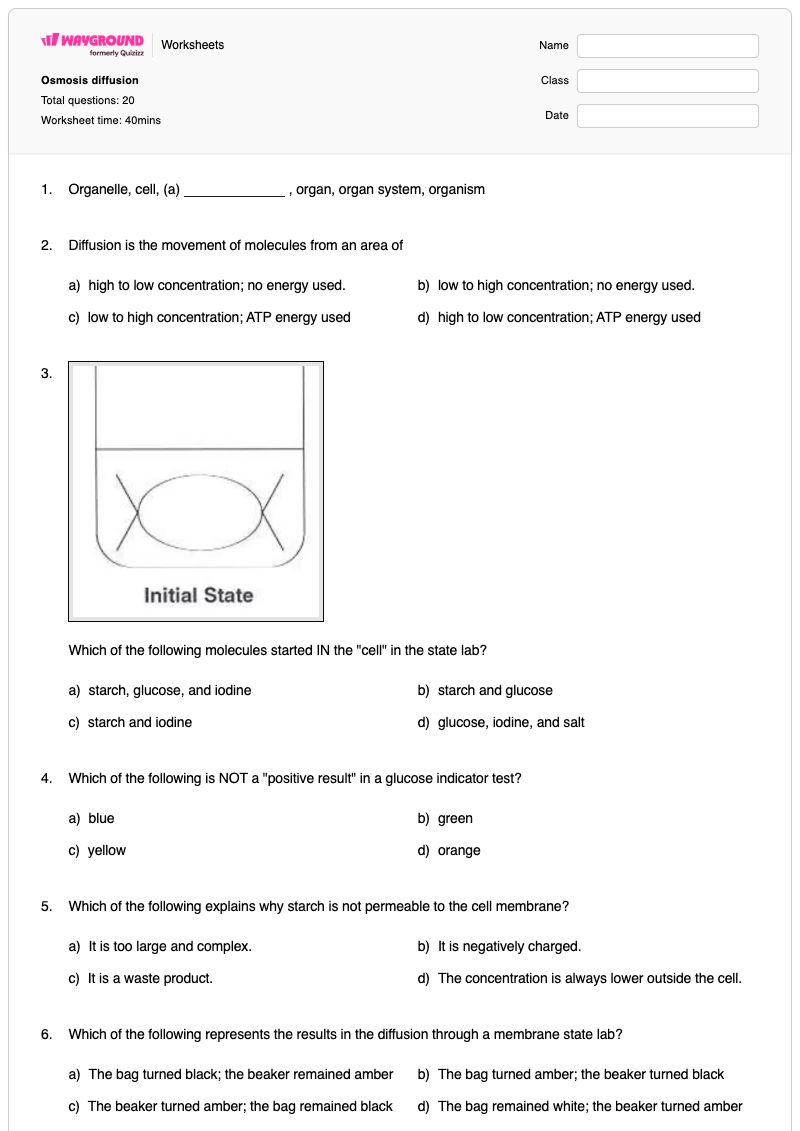
Which of the following molecules started IN the "cell" in the state lab?

a)

starch, glucose, and iodine

b)

starch and glucose

c)

starch and iodine

d)

glucose, iodine, and salt

4.

Which of the following is NOT a "positive result" in a glucose indicator test?

a)

blue

b)

green

c)

yellow

d)

orange

5.

Which of the following explains why starch is not permeable to the cell membrane?

a)

It is too large and complex.

b)

It is negatively charged.

c)

It is a waste product.

d)

The concentration is always lower outside the cell.

6.

Which of the following represents the results in the diffusion through a membrane state lab?

a)

The bag turned black; the beaker remained amber

b)

The bag turned amber; the beaker turned black

c)

The beaker turned amber; the bag remained black

d)

The bag remained white; the beaker turned amber

7.

Identify the SUBSTANCE and the PROCESS that caused the change shown

a)

ATP; Active Transport

b)

Salt water; Omsosis

c)

Distilled water; Osmosis

d)

ATP; Passive Transport

8.

Which of the following could be represented by X?

a)

Transports molecules across the membrane

b)

Requires the use of ATP energy

c)

Movement from high to low concentration

d)

Movement from low to high concentration

9.

Which molecule is in equilibrium (equally concentrated inside and outside of the cell)?

a)

A

b)

B

c)

C

10.

Where is B most likely to diffuse and why?

a)

Out of the cell, b/c there is a higher conc. inside.

b)

Into the the cell, b/c there is a higher conc. inside.

c)

Into the the cell, b/c there is a lower conc. outside.

d)

Out of the cell, b/c there is a lower conc. inside.

11.

Active transport would be required to transport molecule B

a)

Into the cell

b)

Out of the cell

12.

When is active transport used by a cell?

a)

When the cell wants to maintain a high or low concentration.

b)

When the cell becomes highly concentrated with water

c)

In a salt water environment

d)

In a distilled water environment

13.

Which of the following does NOT describe the cell membrane?

a)

It is selectively permeable

b)

It is responsible for waste removal

c)

Gases are exchanged here

d)

It contains receptor molecules to receive messages

e)

It is only found in plant cells

14.

In a positive test for starch, iodine reacts and turns

a)

Black

b)

Light blue

c)

Amber

d)

Greene

15.

Which of the following is NOT an organic molecule?

a)

Starch

b)

DNA

c)

Glucose

d)

Water

16.

Which of the following is LEAST likely to be permeable to the cell membrane?

a)

Water

b)

Oxygen

c)

Carbon dioxide

d)

Glucose

e)

Protein

17.

Which of the following molecules is able to diffuse through the cell membrane?

a)

Carbon dioxide

b)

Protein

c)

Starch

d)

Polymers

18.

Which organelle is NOT correctly paired with its function?

a)

Vacuole- storage

b)

Cell membrane- waste removal

c)

Ribosome- protein synthesis

d)

Cytoplasm- Photosynthesis

e)

Mitochondria- energy production

19.

Which of the following explains why plant cells are less likely to burst in distilled water?

a)

Plant contain a cell wall for support and structure

b)

Plant cells are unable to perform osmosis.

c)

Plant cells contain vacuoles and chloroplasts

d)

Plant cells have a rigid cell membrane and a square shape.

20.

Explain why the bag shriveled in the beaker with 80% water and 20% starch.

a)

Water moved from high to low concentration.

b)

Water moved from low to high concentration.

c)

Starch moved from high to low concentration.

d)

Starch moved from low to high concentration.

Answer Key

Osmosis diffusion

Total questions: 20

1.
tissue
2.
a)

high to low concentration; no energy used.

3.
b)

starch and glucose

4.
a)

blue

5.
a)

It is too large and complex.

6.
a)

The bag turned black; the beaker remained amber

7.
b)

Salt water; Omsosis

8.
a)

Transports molecules across the membrane

9.
a)

A

10.
a)

Out of the cell, b/c there is a higher conc. inside.

11.
a)

Into the cell

12.
a)

When the cell wants to maintain a high or low concentration.

13.
e)

It is only found in plant cells

14.
a)

Black

15.
d)

Water

16.
e)

Protein

17.
a)

Carbon dioxide

18.
d)

Cytoplasm- Photosynthesis

19.
a)

Plant contain a cell wall for support and structure

20.
a)

Water moved from high to low concentration.

FAQs

What does the Osmosis diffusion worksheet cover?

This Grade 10 worksheet covers diffusion, osmosis, passive transport, active transport, equilibrium, and selective membrane permeability. Its one fill-in-the-blank item and 19 multiple-choice questions ask students to apply concentration-gradient rules, interpret cell and membrane scenarios, and use starch and glucose indicator-test results from a state lab.

How can I use this worksheet to teach osmosis and diffusion?

Introduce diffusion as movement from high to low concentration without ATP, then contrast it with active transport, which uses energy to move substances against a concentration gradient. Use the worksheet’s state-lab questions to have students predict which substances cross the membrane and compare those predictions with the bag, beaker, starch, iodine, and glucose test results before assigning the full set.

What mistakes should I watch for when students complete this osmosis and diffusion worksheet?

Watch for students reversing the direction of diffusion or treating all membrane transport as active transport. They may also confuse equilibrium with the absence of molecules, assume starch can cross because it is present in the lab, or misread indicator results by selecting blue for a positive glucose test or amber for a positive starch test instead of using the worksheet’s established results.

How do I assign and grade this osmosis and diffusion worksheet?

On Wayground, assign it as a digital quiz or download the printable PDF for students to complete on paper. The worksheet includes a complete answer key, and printable submissions can be graded by scanning student work with the Wayground for Teachers app.

How can I differentiate this osmosis and diffusion worksheet for my students?

Use the worksheet’s Advanced Settings to adjust font spacing or font size so the concentration scenarios, lab-result choices, and fill-in-the-blank sequence are easier to read. You can also enable a dyslexia-friendly font or translate the worksheet into another language when those options better support access to the membrane-transport content.

Where can I find more worksheets like this on Wayground?

Wayground offers a comprehensive collection of free printable worksheets and practice problems across subjects, with downloadable PDFs and answer keys to help students master essential skills and concepts. Browse more resources at https://wayground.com/en-us/worksheets.