

Wayground
2.1 Osmosis Video - Printable Science Worksheets year 8 - Wayground

2.1 Osmosis Video

19 questions

8th - 8th Grade

Science

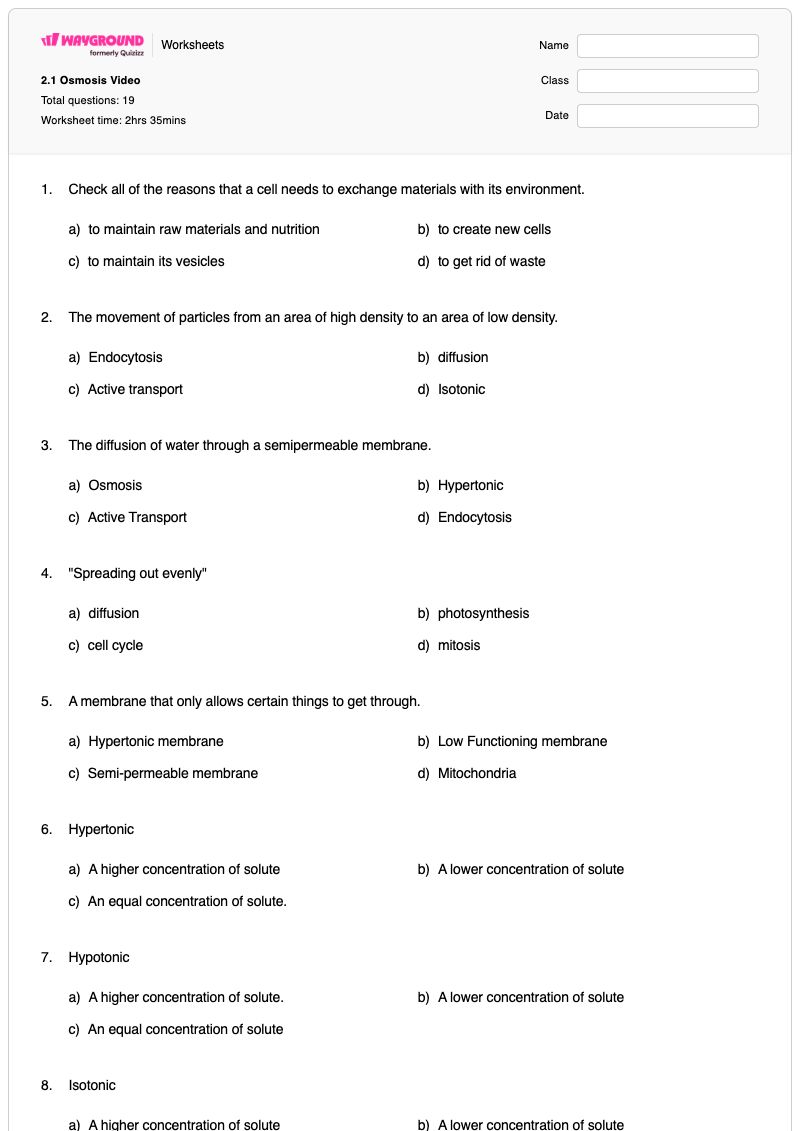
2.1 Osmosis Video is a free printable Grade 8 science worksheet that reviews how cells exchange materials with their environment. Its 19 questions include 4 multiple-select items and 15 multiple-choice items covering why cells exchange materials, diffusion, osmosis, semipermeable membranes, hypertonic, hypotonic, and isotonic conditions, active and passive transport, endocytosis, exocytosis, and the meanings of endo, exo, and cyto. Students identify definitions and distinguish related cell-transport processes, including whether movement requires energy and whether a cell brings material in or pushes it out. This worksheet is suitable for introducing or reinforcing cell transport vocabulary, checking students’ understanding after instruction, or reviewing key terms before a larger assessment. It includes a complete answer key for efficient review and grading.

Worksheet settings

Font size

S
M
L
XL
Worksheets

2.1 Osmosis Video

Total questions: 19

Name
Class
Date
1.

Check all of the reasons that a cell needs to exchange materials with its environment.

a)

to maintain raw materials and nutrition

b)

to create new cells

c)

to maintain its vesicles

d)

to get rid of waste

2.

The movement of particles from an area of high density to an area of low density.

a)

Endocytosis

b)

diffusion

c)

Active transport

d)

Isotonic

3.

The diffusion of water through a semipermeable membrane.

a)

Osmosis

b)

Hypertonic

c)

Active Transport

d)

Endocytosis

4.

"Spreading out evenly"

a)

diffusion

b)

photosynthesis

c)

cell cycle

d)

mitosis

5.

A membrane that only allows certain things to get through.

a)

Hypertonic membrane

b)

Low Functioning membrane

c)

Semi-permeable membrane

d)

Mitochondria

6.

Hypertonic

a)

A higher concentration of solute

b)

A lower concentration of solute

c)

An equal concentration of solute.

7.

Hypotonic

a)

A higher concentration of solute.

b)

A lower concentration of solute

c)

An equal concentration of solute

8.

Isotonic

a)

A higher concentration of solute

b)

A lower concentration of solute

c)

An equal concentration of solute

9.

The material passes through the cell membrane and the cell uses energy.

a)

Active Transport

b)

Passive Transport

c)

Endocytosis

10.

The material passes through the cell membrane without using energy.

a)

Active Transport

b)

Passive Transport

c)

Endocytosis

11.

The cell surrounds and brings an item in.

a)

passive transport

b)

exocytosis

c)

Endocytosis

d)

active transport

12.

A cell pushes an item out.

a)

exocytosis

b)

endocytosis

c)

active transport

d)

passive transport

13.

Which means "in" or "inside"

a)

endo

b)

exo

c)

cyto

14.

Which means "out" or "outside"

a)

endo

b)

exo

c)

cyto

15.

Which means "cell"

a)

endo

b)

exo

c)

cyto

16.

Check all that apply to Endocytosis

a)

First the cell membrane wraps around the particle.

b)

Second the cell forms a vesicle around the particle.

c)

Third the cell brings the particle into itself.

d)

Fourth, the cell bakes a cake.

17.

Choose all of the steps of Exocytosis.

a)

Step #1 Waste is packed in a vesicle.

b)

Step #2 The vesicle moves to the cell membrane and fuses with it.

c)

Step #3 The cell membrane opens and releases the waste.

d)

Step #4. The cell trash truck comes and picks it up every Friday at 7 am.

18.

What is a channel in a cell membrane?

a)

A hole in the cell membrane made by a protein.

b)

A protein in the cell membrane made by a hole.

19.

What are the objectives for this section?

a)

Explain the process of diffusion.

b)

Describe how osmosis occurs.

c)

Comparing passive transport with active transport

d)

Explain how large particles get into and out of cells.

Answer Key

2.1 Osmosis Video

Total questions: 19

1.
a)

to maintain raw materials and nutrition

, d)

to get rid of waste

2.
b)

diffusion

3.
a)

Osmosis

4.
a)

diffusion

5.
c)

Semi-permeable membrane

6.
a)

A higher concentration of solute

7.
b)

A lower concentration of solute

8.
c)

An equal concentration of solute

9.
a)

Active Transport

10.
b)

Passive Transport

11.
c)

Endocytosis

12.
a)

exocytosis

13.
a)

endo

14.
b)

exo

15.
c)

cyto

16.
a)

First the cell membrane wraps around the particle.

, b)

Second the cell forms a vesicle around the particle.

, c)

Third the cell brings the particle into itself.

17.
a)

Step #1 Waste is packed in a vesicle.

, b)

Step #2 The vesicle moves to the cell membrane and fuses with it.

, c)

Step #3 The cell membrane opens and releases the waste.

18.
a)

A hole in the cell membrane made by a protein.

19.
a)

Explain the process of diffusion.

, b)

Describe how osmosis occurs.

, c)

Comparing passive transport with active transport

, d)

Explain how large particles get into and out of cells.

FAQs

What does the 2.1 Osmosis Video worksheet cover?

This Grade 8 science worksheet builds understanding of how cells exchange materials by using 4 multiple-select and 15 multiple-choice questions. Students distinguish diffusion from osmosis, identify semipermeable membranes and hypertonic, hypotonic, and isotonic conditions, classify transport as active or passive, and differentiate endocytosis from exocytosis.

How can I use this worksheet to teach cell transport?

Introduce the worksheet by reviewing why cells exchange materials and then have students define diffusion, osmosis, and semipermeable membranes. Use the tonicity questions to compare higher, lower, and equal solute concentrations before students apply the active-versus-passive transport and endocytosis-versus-exocytosis distinctions. Ask students to explain why each selected term fits the definition, especially on the multiple-select item about a cell’s material-exchange needs.

What mistakes should I watch for when students complete this osmosis worksheet?

Students may select creating new cells or maintaining vesicles instead of identifying obtaining raw materials and nutrition and removing waste as reasons cells exchange materials. They may also confuse diffusion with osmosis, treat all membrane transport as energy-dependent, or reverse endocytosis and exocytosis. Watch for confusion among hypertonic, hypotonic, and isotonic, which the worksheet distinguishes by higher, lower, and equal solute concentration.

How do I assign and grade this cell transport worksheet?

The worksheet is available as a printable PDF and as a digital quiz on Wayground, and it includes a complete answer key for all 19 questions. For printable submissions, you can scan student work with the Wayground for Teachers app to support grading.

How can I differentiate this worksheet for my students?

Use the worksheet’s Advanced Settings to adjust font spacing or choose a larger font size so the diffusion, osmosis, and transport definitions are easier to read. You can also apply a dyslexia-friendly font or translate the worksheet into another language while preserving its multiple-choice and multiple-select format.

Where can I find more worksheets like this on Wayground?

Wayground offers a broad collection of free printable worksheets and practice problems across subjects, with downloadable PDFs and answer keys to help students master essential skills and concepts. Browse more resources at https://wayground.com/en-us/worksheets.