Partitioning Shapes is a free printable Grade 1 mathematics worksheet with an answer key that helps students recognize and describe equal parts of shapes. Through 14 items—12 multiple-choice questions and 2 fill-in-the-blank prompts—students identify halves and fourths, determine how many equal parts form a whole, and decide whether circles and rectangles are partitioned correctly. A pizza context connects fractional parts to everyday sharing.
The worksheet also reinforces related early math skills by asking students to identify a defining shape attribute, combine numbers in 5 + 5 + 3, and write the number fifteen. The visual yes-or-no questions give students practice connecting fraction language to pictured partitions, while the final item checks their understanding that equal parts are the same size. It is suitable for Grade 1 practice, independent review, small-group instruction, or a quick assessment of foundational partitioning skills.
Worksheet settings
Font size
S
M
L
XL
Worksheets
Partitioning Shapes
Total questions: 14
Name
Class
Date
1.
If a shape is divided into two equal parts, it is divided into ______
a)
quarters
b)
fourths
c)
halves
2.
If a shape is divided into fourths, it has ___________ equal parts.
a)
3
b)
2
c)
4
d)
5
3.
If a pizza is cut into two equal parts and you eat one part, what part have you eaten?
a)
one half
b)
one whole
c)
one fourth
4.
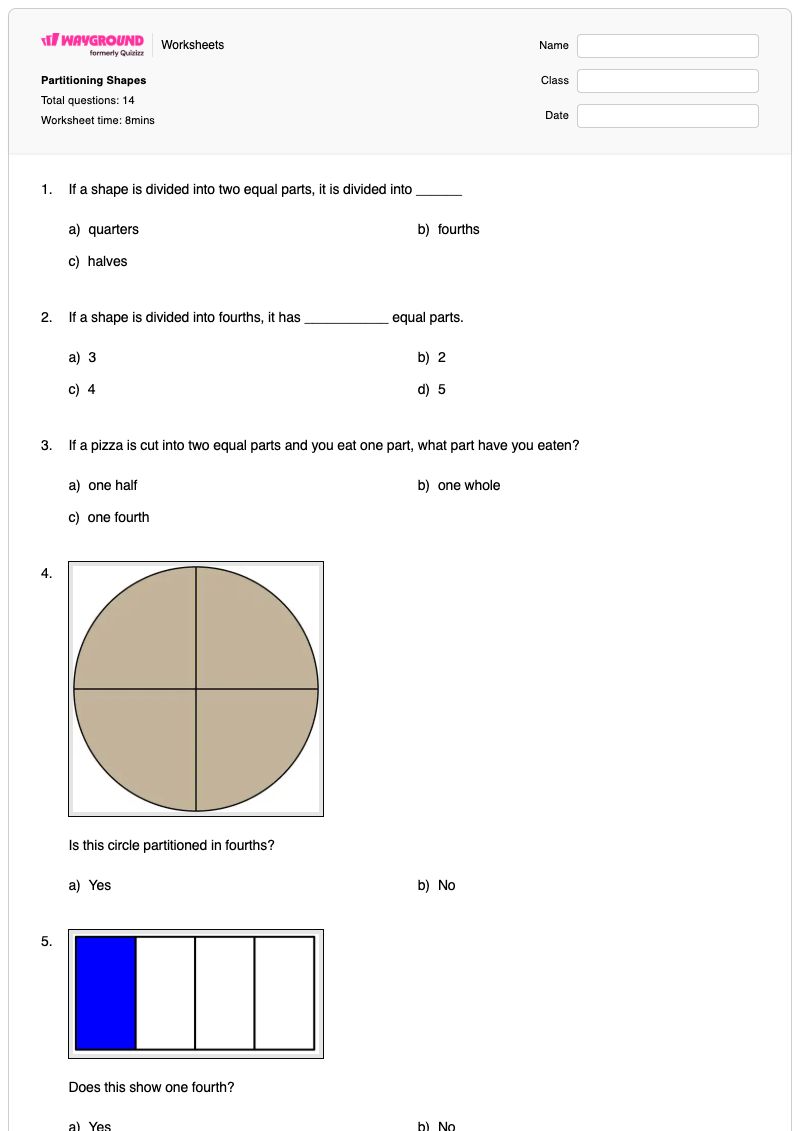
Is this circle partitioned in fourths?
a)
Yes
b)
No
5.
Does this show one fourth?
a)
Yes
b)
No
6.
Does this show one half?
a)
No
b)
Yes
7.
If a rectangle is divided into halves, it takes _____ equal pieces to make the whole.
a)
3
b)
4
c)
2
8.
If a circle is divided into fourths, it takes _____ equal parts to make the whole.
a)
4
b)
3
c)
2
d)
1
9.
Is this partitioned into halves?
a)
no
b)
yes
10.
Which is a defining attribute?
a)
color
b)
size
c)
number of sides
11.
What shape can you make with 3 triangles?
a)
b)
c)
12.
Solve. 5+5+3= _
(a)
13.
Type the number fifteen.
(a)
14.
Equal Parts are parts that are ___________
a)
The Same
b)
Different
Answer Key
Partitioning Shapes
Total questions: 14
1.
c)
halves
2.
c)
4
3.
a)
one half
4.
a)
Yes
5.
a)
Yes
6.
b)
Yes
7.
c)
2
8.
a)
4
9.
a)
no
10.
c)
number of sides
11.
c)
12.
13
13.
15
14.
a)
The Same
140 %
Browse by subjects
Browse by grades
Browse by format
FAQs
What does the Partitioning Shapes worksheet cover?
This Grade 1 worksheet practices identifying equal halves and fourths in circles, rectangles, and other shape representations. Its 12 multiple-choice items and 2 fill-in-the-blank items ask students to name the number of equal parts, recognize pictured partitions, connect one eaten part to one half, and apply related early shape and number skills.
How can I use this worksheet to teach students about halves and fourths?
Introduce the worksheet by folding or drawing shapes into two and four equal parts, then have students explain how the number of parts determines whether a shape shows halves or fourths. As students work through the visual yes-or-no items, ask them to justify whether the parts are equal before choosing an answer. Use the pizza question to connect partitioning to sharing a whole.
What mistakes should I watch for when students complete this Partitioning Shapes worksheet?
Students may confuse the words halves and fourths, or count the parts without checking that they are equal. They may also misread the pictured yes-or-no questions by focusing on the shape’s appearance rather than the number and equality of its parts. Review the distinction between a defining attribute such as number of sides and non-defining features such as color or size, and check that students write 13 for 5 + 5 + 3 and 15 for the numeral prompt.
How do I assign and grade the Partitioning Shapes worksheet?
The worksheet is available as a printable PDF and as a digital quiz on Wayground, and it includes a complete answer key. For printable submissions, scan student work with the Wayground for Teachers app to help grade responses. The printable format can also support schools that are reducing screen time.
How can I differentiate the Partitioning Shapes worksheet for my students?
In the worksheet’s Advanced Settings, adjust font spacing and font size to make the shape-identification questions and fill-in-the-blank prompts easier to read. You can also enable a dyslexia-friendly font or translate the worksheet into another language while keeping the halves-and-fourths practice intact.
Where can I find more worksheets like this on Wayground?
Wayground offers a comprehensive collection of free printable worksheets and practice problems across all subjects, with downloadable PDFs and answer keys to support essential skills and concepts. Browse more resources at https://wayground.com/en-us/worksheets.

 Worksheets


