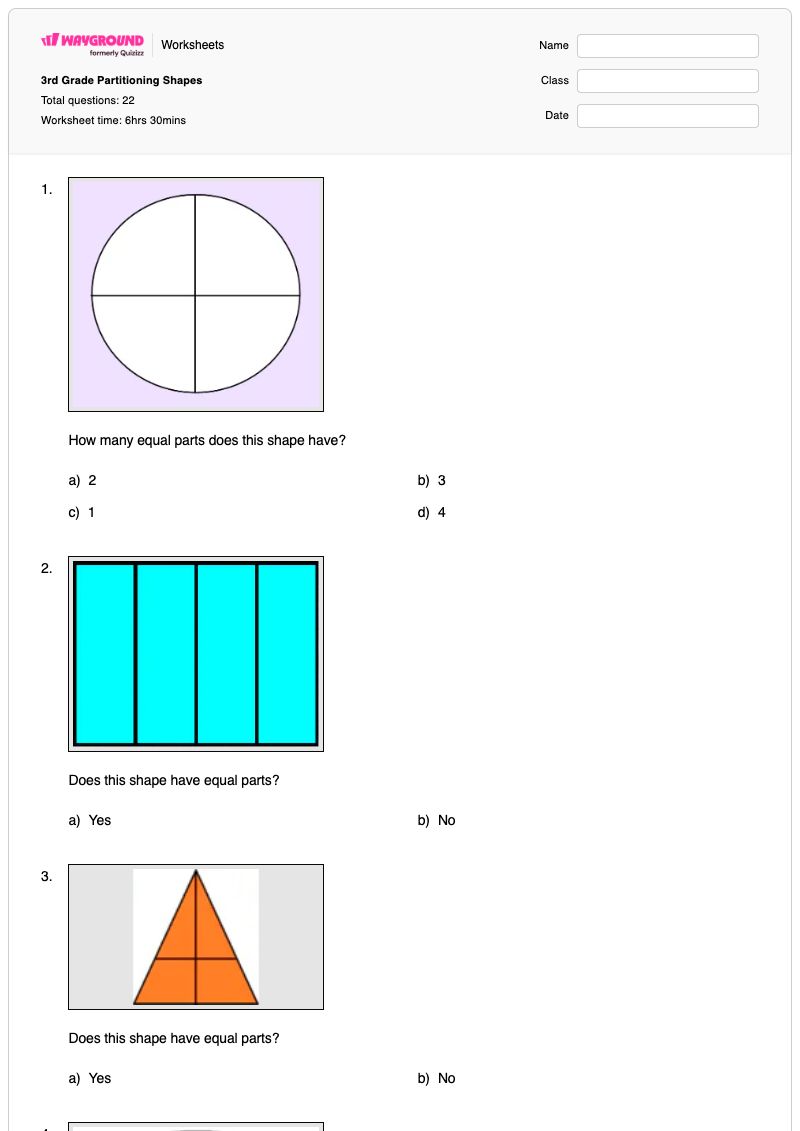
This free printable Grade 3 mathematics worksheet builds understanding of partitioning shapes into equal parts. Across 22 questions—19 multiple-choice and 3 multiple-select—students identify whether shapes are divided equally, determine the number of parts, interpret the meaning of partition, and recognize halves, thirds, and fourths. They also connect shaded regions and unit fractions such as 1/4 to matching visual models.
The worksheet gives students repeated practice analyzing visual fraction models rather than only reading fraction notation. Students select shapes partitioned into thirds, halves, or fourths, decide whether a shape represents a named fraction, and distinguish equal parts from unequal parts. It is suitable for Grade 3 math instruction, independent practice, review, or a quick formative check. The printable PDF is free and includes a complete answer key for efficient checking and feedback.
Worksheet settings
Font size
S
M
L
XL
Worksheets
3rd Grade Partitioning Shapes
Total questions: 22
Name
Class
Date
1.
How many equal parts does this shape have?
a)
2
b)
3
c)
1
d)
4
2.
Does this shape have equal parts?
a)
Yes
b)
No
3.
Does this shape have equal parts?
a)
Yes
b)
No
4.
Does this shape have equal parts?
a)
No
b)
Yes
5.
What fraction is shaded green?
a)
one-third
b)
one-half
c)
one-fourth
6.
Which shows a circle divided into fourths?
a)
b)
c)
7.
Which shows one half?
a)
b)
c)
8.
Is this square partitioned into thirds?
a)
Yes
b)
No
9.
Is the shape partitioned into fourths?
a)
Yes
b)
No
10.
What does "partition" mean?
a)
Split into equal parts
b)
One part of the whole
11.
Select the partitioned shape that matches the unit fraction.
1/4
a)
b)
c)
d)
12.
Select the shapes partitioned into thirds
a)
b)
c)
d)
e)
13.
Select the shapes partitioned into halves
a)
b)
c)
d)
e)
14.
Select the shapes partitioned into fourths.
a)
b)
c)
d)
e)
15.
Are these parts equal or not equal?
a)
unequal
b)
equal
16.
A unit fraction has _____ in the numerator.
a)
2
b)
5
c)
1
d)
3
17.
A ______ is a part of a whole.
a)
fraction
b)
area
c)
unit
18.
If Mrs. Scott wants to share her cake with Ms. Templeton and Mrs. Nichols, she would cut her cake into _____. They would each get 1 piece.
a)
fourths
b)
thirds
c)
halves
19.
What does it mean to partition?
a)
add
b)
to divide into smaller or equal parts
c)
subtract
20.
What terms could NOT be used to describe the polygon?
a)
quadrilateral
b)
square
c)
rhombus
d)
parallelogram
21.
The spinner is divided into equal parts. What unit fraction is the yellow?
a)
1/3
b)
1/5
c)
2/5
22.
Label the circle with the correct unit fraction.
a)
1/2
b)
1/3
c)
1/5
Answer Key
3rd Grade Partitioning Shapes
Total questions: 22
1.
d) 4
2.
a) Yes
3.
b) No
4.
b) Yes
5.
c)
one-fourth
6.
b)
7.
a)
8.
b)
No
9.
b)
No
10.
a)
Split into equal parts
11.
c)
12.
e) , b)
13.
c) , d) , e)
14.
a) , c) , d)
15.
a)
unequal
16.
c) 1
17.
a) fraction
18.
b) thirds
19.
b) to divide into smaller or equal parts
20.
b) square
21.
b) 1/5
22.
b) 1/3
140 %
Browse by subjects
Browse by grades
Browse by format
FAQs
What does the 3rd Grade Partitioning Shapes worksheet cover?
This worksheet practices partitioning shapes into equal parts and identifying visual models of halves, thirds, and fourths. Its 22 questions use multiple-choice and multiple-select formats to ask students to count equal parts, judge whether parts are equal, match unit fractions to shapes, identify shaded fractions, and select shapes partitioned into a specific number of parts.
How can I use this worksheet to teach partitioning shapes?
First model how to check whether a shape has equal parts, then connect the number of parts to the words half, third, and fourth. Use the worksheet’s yes-or-no items and definition question to establish that partition means splitting a whole into equal parts before students complete the shaded-fraction, matching, and multiple-select shape questions. Ask students to explain how they know a model shows 1/2, 1/3, or 1/4.
What mistakes should I watch for on this partitioning shapes worksheet?
Students may count the regions without checking that the parts are equal, or call a shape partitioned even when its regions are unequal. They may also confuse the denominator with the shaded amount—for example, choosing fourths because a shape has four visible regions without verifying the shaded fraction—or select only one correct shape on the multiple-select items for thirds, halves, or fourths.
How do I assign and grade this partitioning shapes worksheet?
The worksheet is available as a printable PDF and as a digital quiz on Wayground, and it includes a complete answer key. You can assign the digital version for online responses or print it for students; printable submissions can be graded by scanning student work with the Wayground for Teachers app.
How can I differentiate this shapes and fractions worksheet for my students?
Use the worksheet’s Advanced Settings to adjust font spacing or increase the font size so the shape diagrams, fraction choices, and equal-part questions are easier to read. You can also enable a dyslexia-friendly font or translate the worksheet into another language when those options support access to the directions and vocabulary.
Where can I find more worksheets like this on Wayground?
Wayground offers a broad collection of free printable worksheets and practice problems across subjects, with downloadable PDFs and answer keys to support essential skills and concepts. Browse more resources at https://wayground.com/en-us/worksheets.

 Worksheets


