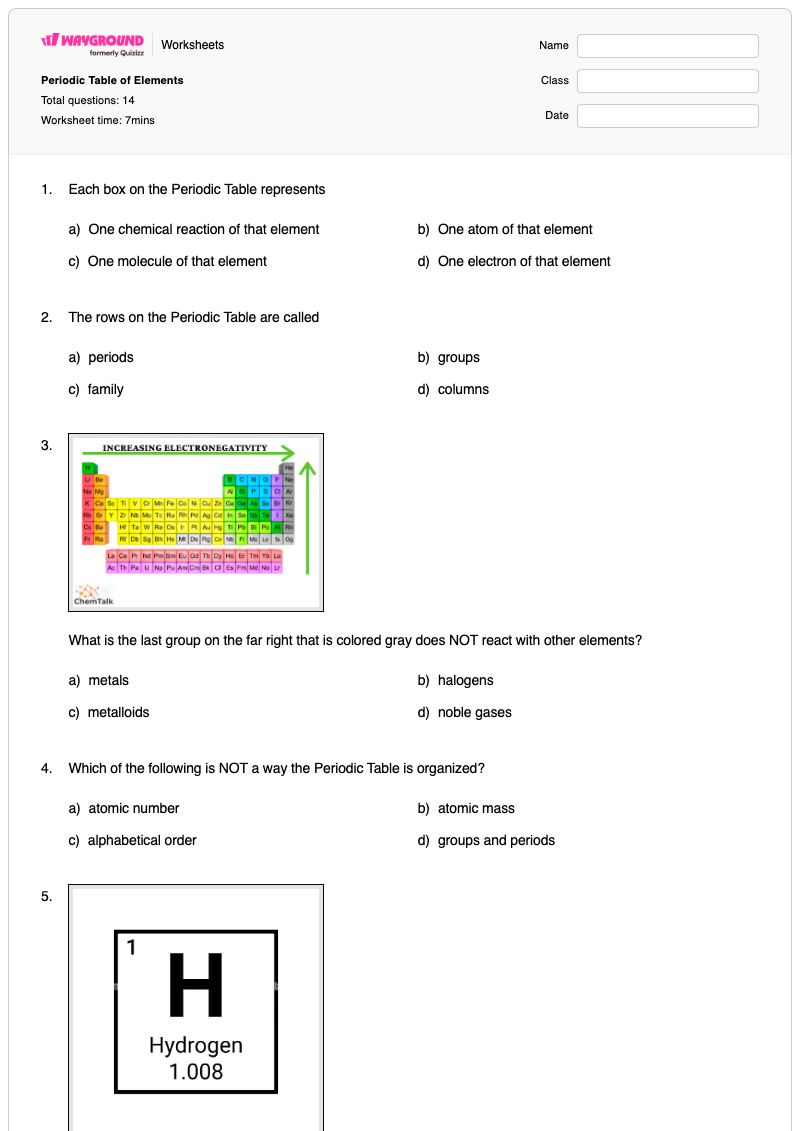
This free printable Grade 6 science worksheet helps students build foundational knowledge of the Periodic Table of Elements through 14 multiple-choice questions. Students identify what each element box represents, distinguish periods from groups, recognize how the table is organized, and interpret atomic number, atomic mass, chemical symbols, and element classifications such as metals, metalloids, and noble gases.
The worksheet also connects Periodic Table information to atomic structure and chemical formulas. Students identify protons, neutrons, and electrons, explain the role of subscripts, count total atoms in a formula, and determine how many different elements make up a molecule. An answer key is included, making this free printable worksheet useful for independent practice, review, or a quick Grade 6 science check for understanding.
Worksheet settings
Font size
S
M
L
XL
Worksheets
Periodic Table of Elements
Total questions: 14
Name
Class
Date
1.
Each box on the Periodic Table represents
a)
One chemical reaction of that element
b)
One atom of that element
c)
One molecule of that element
d)
One electron of that element
2.
The rows on the Periodic Table are called
a)
periods
b)
groups
c)
family
d)
columns
3.
What is the last group on the far right that is colored gray does NOT react with other elements?
a)
metals
b)
halogens
c)
metalloids
d)
noble gases
4.
Which of the following is NOT a way the Periodic Table is organized?
a)
atomic number
b)
atomic mass
c)
alphabetical order
d)
groups and periods
5.
The number 1.008 on this square is the
a)
atomic number
b)
atomic mass
c)
chemical symbol
d)
how many electrons it has
6.
In a chemical formula, the small number underneath the element is called the .
a)
symbol
b)
semimetal
c)
subscript
7.
How many total atoms make up this formula?
a)
11
b)
12
c)
38
d)
3
8.
The atomic number of the element is the same as the the number of ____.
a)
molecules
b)
neutrons
c)
protons
9.
How many different elements make up this molecule?
a)
2
b)
3
c)
1
d)
4
10.
What particle in the atom has a negative charge to cancel out the proton's positive charge and circle around in its "shell"?
a)
electron
b)
neutron
c)
atomic number
d)
proton
11.
Elements that act like both a metal and a nonmetal are called ______.
a)
reactors
b)
families
c)
metalloids
d)
subscripts
12.
Properties of metals include all of the following except
a)
magnetic
b)
dull
c)
conductive
d)
malleable
13.
Most of an atoms mass is made up in the nucleus from which two particles
a)
protons and electrons
b)
neutrons and electrons
c)
neutrons and protons
14.
Metals make up ________ of the Periodic Table.
a)
one period
b)
most
c)
5 elements
d)
the right side
Answer Key
Periodic Table of Elements
Total questions: 14
1.
b)
One atom of that element
2.
a)
periods
3.
d)
noble gases
4.
c)
alphabetical order
5.
b)
atomic mass
6.
c)
subscript
7.
b)
12
8.
c)
protons
9.
a)
2
10.
a)
electron
11.
c)
metalloids
12.
b)
dull
13.
c)
neutrons and protons
14.
b)
most
140 %
Browse by subjects
Browse by grades
Browse by format
FAQs
What does this Periodic Table of Elements worksheet cover?
This Grade 6 science worksheet uses 14 multiple-choice questions to assess how students interpret Periodic Table information and connect it to atomic structure. Students identify periods and groups, distinguish atomic number from atomic mass, classify metals, metalloids, and noble gases, and use subscripts to count atoms and identify the elements in a molecule.
How can I use this worksheet to teach Periodic Table organization and atomic structure?
Introduce the worksheet by reviewing one element box and having students locate its atomic number, atomic mass, and chemical symbol. Then use the questions in sequence to connect table organization—periods, groups, and element classifications—to protons, neutrons, electrons, and chemical-formula subscripts. Ask students to explain why counting total atoms in a formula is different from counting the different elements present.
What mistakes should I watch for when students complete this worksheet?
Students may confuse periods with groups, or mistake atomic mass for atomic number when reading an element square. In the formula questions, watch for students who count only the element symbols instead of using subscripts to find the total number of atoms, or who confuse the number of different elements with the total atoms in a molecule. Students may also mix up electrons, protons, and neutrons when identifying particle charges and locations.
How do I assign and grade this Periodic Table worksheet?
Wayground provides this worksheet as both a printable PDF and a digital quiz, with a complete answer key for all 14 multiple-choice questions. You can print it for paper-based practice or assign the digital version online; printable submissions can be graded by scanning student work with the Wayground for Teachers app. The printable option can also support schools that are reducing screen time.
How can I differentiate this Periodic Table worksheet for my students?
Use the worksheet’s Advanced Settings to adjust font spacing and font size so students can read the element terminology and multiple-choice options more comfortably. You can also enable a dyslexia-friendly font or translate the worksheet into another language, helping students access questions about periods, atomic structure, and chemical formulas.
Where can I find more worksheets like this on Wayground?
Wayground offers a broad collection of free printable worksheets and practice problems across subjects, with downloadable PDFs and answer keys to help students master essential skills and concepts. Browse more resources at https://wayground.com/en-us/worksheets.

 Worksheets


