
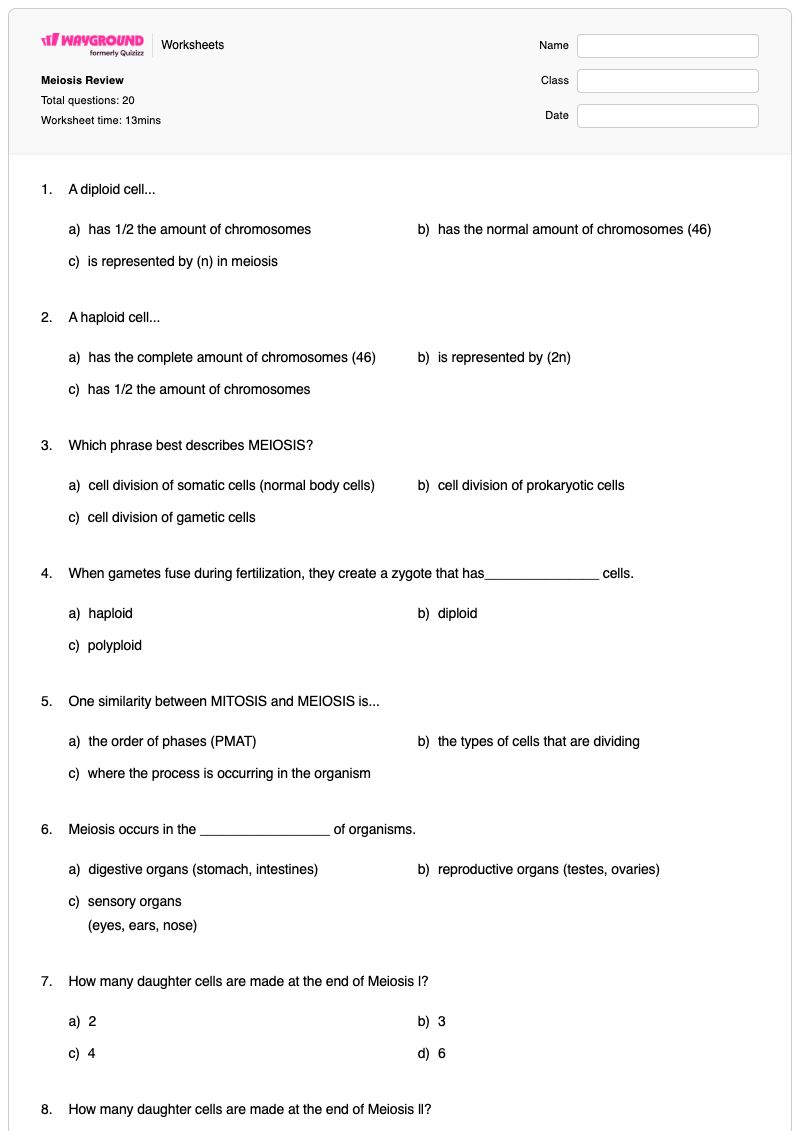

Meiosis Review is a Grade 9 science worksheet that checks students’ understanding of how meiosis produces gametes. Across 20 questions—14 multiple-choice items and 6 fill-in-the-blank prompts—students distinguish diploid and haploid cells, identify meiosis as gamete-producing cell division, and connect fertilization with the formation of a diploid zygote. They also review where meiosis occurs, the number of daughter cells produced after Meiosis I and II, and how meiosis differs from or resembles mitosis.
The worksheet also asks students to identify the PMAT phase sequence, recognize crossing over during Prophase I, and explain that meiotic daughter cells are non-identical. Questions about sexual reproduction and genetic variation help students connect the process of meiosis to survival and inheritance. This free printable worksheet with an answer key is designed for Grade 9 science review, formative assessment, independent practice, or preparation for instruction on heredity and cell division.
Worksheet settings
Font size
S
M
L
XL
Worksheets
Meiosis Review
Total questions: 20
Name
Class
Date
1.
A diploid cell...
a)
has 1/2 the amount of chromosomes
b)
has the normal amount of chromosomes (46)
c)
is represented by (n) in meiosis
2.
A haploid cell...
a)
has the complete amount of chromosomes (46)
b)
is represented by (2n)
c)
has 1/2 the amount of chromosomes
3.
Which phrase best describes MEIOSIS?
a)
cell division of somatic cells (normal body cells)
b)
cell division of prokaryotic cells
c)
cell division of gametic cells
4.
When gametes fuse during fertilization, they create a zygote that has_______________ cells.
a)
haploid
b)
diploid
c)
polyploid
5.
One similarity between MITOSIS and MEIOSIS is...
a)
the order of phases (PMAT)
b)
the types of cells that are dividing
c)
where the process is occurring in the organism
6.
Meiosis occurs in the _________________ of organisms.
a)
digestive organs (stomach, intestines)
b)
reproductive organs (testes, ovaries)
c)
sensory organs
(eyes, ears, nose)
7.
How many daughter cells are made at the end of Meiosis l?
a)
2
b)
3
c)
4
d)
6
8.
How many daughter cells are made at the end of Meiosis ll?
a)
2
b)
4
c)
6
d)
8
9.
The daughter cells created in Meiosis are _____________.
a)
identical
b)
non-identical
10.
Crossing over is the process of...
a)
chromosomes separating during Anaphase
b)
tiny pieces being exchanged on two sister chromatids
c)
chromatids lining up in the middle of the cell during Metaphase
11.
During Prophase l of MEISOSI...
a)
the cell is split in two
b)
chromosomes line up in the middle of the cell
c)
crossing over occurs between two chromosomes
12.
If there is a lot of genetic variation in a population,
then there is a greater chance of survival.
a)
TRUE
b)
FALSE
13.
Which is NOT true about sexual reproduction?
a)
only one organism is required to pass on traits
b)
sperm and egg are required for a zygote to form
c)
both parents pass on traits to offspring
14.
(a) is the type of cell division that makes gametes.
15.
Meiosis creates four ___-________ cells, meaning that each have their own individual DNA.
(a)
16.
The acronym used to remember the order of phases in cell division is (a) .
17.
Which phase in cell division comes before Anaphase?
(a)
18.
Which phase in cell division comes before Telophase?
(a)
19.
Which phase in cell division comes before Metphase?
(a)
20.
On a scale from 1-5, how confident do you feel about the topic of Meiosis?
(1 is least confident, 5 is most confident)
a)
1
b)
2
c)
3
d)
4
e)
5
Answer Key
Meiosis Review
Total questions: 20
1.
b)
has the normal amount of chromosomes (46)
2.
c)
has 1/2 the amount of chromosomes
3.
c)
cell division of gametic cells
4.
b)
diploid
5.
a)
the order of phases (PMAT)
6.
b)
reproductive organs (testes, ovaries)
7.
a)
2
8.
b)
4
9.
b)
non-identical
10.
b)
tiny pieces being exchanged on two sister chromatids
11.
c)
crossing over occurs between two chromosomes
12.
a)
TRUE
13.
a)
only one organism is required to pass on traits
14.
Meiosis, meiosis
15.
non-identical
16.
PMAT, pmat
17.
metaphase, Metaphase
18.
anaphase, Anaphase
19.
prophase, Prophase
20.
n/a
140 %
Browse by subjects
Browse by grades
Browse by format
FAQs
What does the Meiosis Review worksheet cover?
This Grade 9 science worksheet uses 14 multiple-choice questions and 6 fill-in-the-blank prompts to review meiosis foundations. Students identify diploid and haploid chromosome amounts, locate meiosis in reproductive organs, track the two daughter cells after Meiosis I and four after Meiosis II, and recognize crossing over during Prophase I. The items also connect meiosis with non-identical gametes, fertilization, sexual reproduction, and genetic variation.
How can I use this worksheet to teach the stages and outcomes of meiosis?
Introduce the worksheet after students have learned the PMAT sequence, then have them use the multiple-choice items to explain why meiosis produces gametes rather than somatic cells. Pause at the questions about Meiosis I and II so students can model the change from one starting cell to two and then four non-identical daughter cells. Use the Prophase I and crossing-over items as a discussion prompt about how meiosis contributes to genetic variation before students complete the fill-in-the-blank review.
What mistakes should I watch for when students complete this meiosis worksheet?
Watch for students reversing diploid and haploid, or confusing the chromosome amount of a diploid cell with the amount in a haploid cell. Students may also select two daughter cells as the final outcome of meiosis instead of distinguishing two after Meiosis I from four after Meiosis II. Other common errors include placing crossing over in the wrong phase, treating meiotic daughter cells as identical, and choosing the false idea that only one organism is required for sexual reproduction.
How do I assign and grade this Meiosis Review worksheet?
The worksheet is available as a printable PDF and as a digital quiz on Wayground, so you can assign the format that fits your Grade 9 science lesson. It includes a complete answer key for the multiple-choice and fill-in-the-blank items. Printable submissions can be graded by scanning student work with the Wayground for Teachers app.
How does this worksheet connect meiosis to genetic variation and sexual reproduction?
The worksheet moves beyond naming meiosis by asking students to connect crossing over and non-identical daughter cells with genetic variation. Its questions also require students to identify sperm and egg as the gametes involved in forming a diploid zygote and to recognize why greater variation can improve a population’s chance of survival. This makes the review useful for checking whether students can connect cell division details to the broader purpose of sexual reproduction.
Where can I find more worksheets like this on Wayground?
Wayground offers a broad collection of free printable worksheets and practice problems across subjects, with downloadable PDFs and answer keys to support essential skills and concepts. Browse more resources at https://wayground.com/en-us/worksheets.