

Wayground
Bioenergetics: Photosynthesis & Cellular Respiration - Printable Biology Worksheets - Wayground

Bioenergetics: Photosynthesis & Cellular Respiration

10 questions

10th - 10th Grade

Biology

Bioenergetics: Photosynthesis & Cellular Respiration is a Grade 10 biology worksheet with 10 multiple-choice questions focused on how cells capture, transfer, and use energy. Students identify ATP’s role in transferring energy, connect ATP to cilia movement, protein synthesis, and active transport, and interpret what changes in ATP suggest about energy input or output. The worksheet also asks students to compare photosynthesis and cellular respiration, including how the products of photosynthesis support cellular respiration and how the two processes involve different energy conversions. Several questions use a drawing, list, diagram, or chart, giving students practice applying bioenergetics concepts to visual and contextual information rather than recalling isolated definitions. This free printable worksheet includes a complete answer key and is designed for Grade 10 biology practice, review, or formative assessment.

Worksheet settings

Font size

S
M
L
XL
Worksheets

Bioenergetics: Photosynthesis & Cellular Respiration

Total questions: 10

Name
Class
Date
1.

Which statement best describes the role of ATP in a living system?

a)

ATP senses and adjusts the pH in the cellular environment.

b)

ATP identifies and repairs weak components of cells and tissues.

c)

ATP measures and provides heat to increase reaction rates in cells.

d)

ATP captures and transfers energy released by the breakdown of glucose.

2.

An organism carries out both photosynthesis and cellular respiration. Which statement describes a difference between these two processes?

a)

Only cellular respiration creates chemical energy.

b)

The processes occur in different types of animal cells.

c)

Only photosynthesis changes light energy into chemical energy.

d)

The processes occur at different times during the animal’s life cycle.

3.

A scientist observed that during the course of a chemical reaction the number of ATP molecules was reduced. What did the scientist most likely learn from the observation?

a)

The reaction produced water.

b)

The reaction consumed water.

c)

The reaction caused an output of energy.

d)

The reaction required an input of energy.

4.

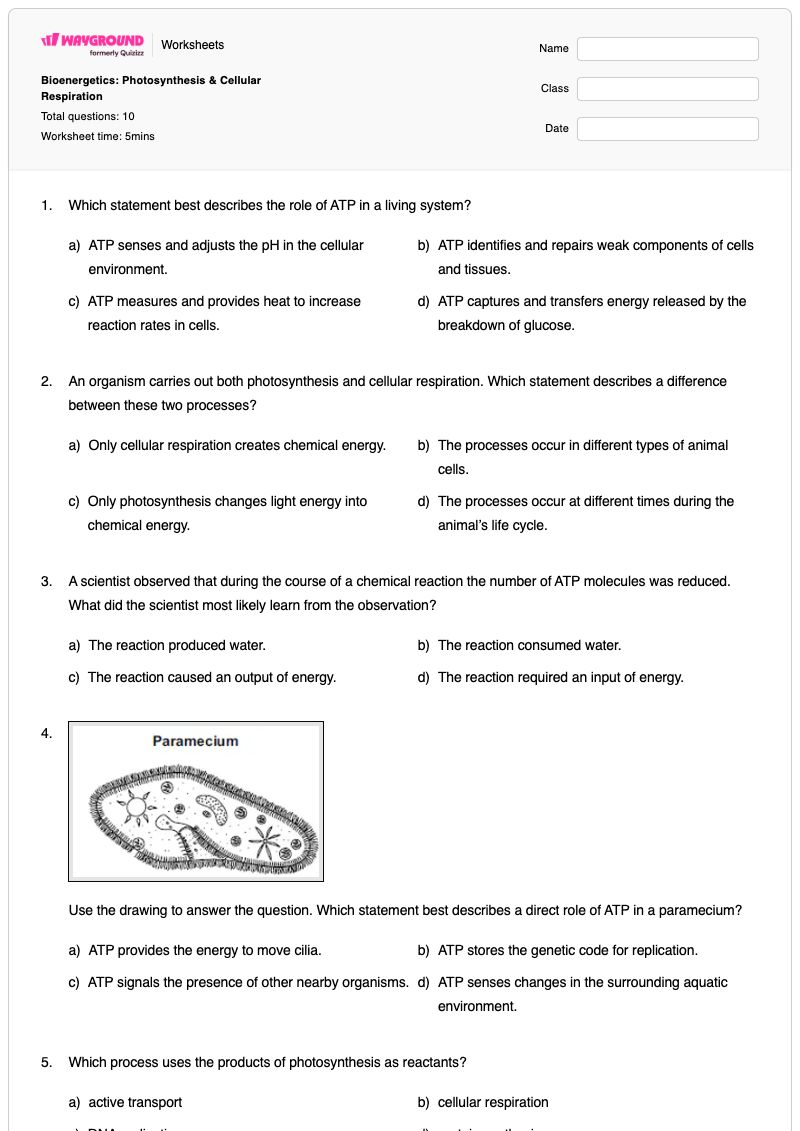
Use the drawing to answer the question. Which statement best describes a direct role of ATP in a paramecium?

a)

ATP provides the energy to move cilia.

b)

ATP stores the genetic code for replication.

c)

ATP signals the presence of other nearby organisms.

d)

ATP senses changes in the surrounding aquatic environment.

5.

Which process uses the products of photosynthesis as reactants?

a)

active transport

b)

cellular respiration

c)

DNA replication

d)

protein synthesis

6.

Which statement best explains why cellular respiration in plants and other organisms is dependent on photosynthesis?

a)

Photosynthesis is one of the final steps in cellular respiration.

b)

Photosynthesis provides the materials that fuel cellular respiration.

c)

Photosynthesis absorbs excess energy produced by cellular respiration.

d)

Photosynthesis absorbs materials that are catalyzed during cellular respiration.

7.

Use the list to answer the question. A plant cell uses the molecules in the list to synthesize a protein. What role do the ATP molecules play in the protein synthesis process?

a)

They provide energy.

b)

They increase activation energy.

c)

They convert energy into hereditary information.

d)

They absorb excess energy to prevent overheating.

8.

Which two statements correctly describe one similarity and one difference between cellular respiration and photosynthesis?

1. Cellular respiration and photosynthesis both involve water.

2.Cellular respiration uses sugar, and photosynthesis produces sugar.

  1. 3. Cellular respiration and photosynthesis both use light to produce energy.

  2. 4. Cellular respiration requires light energy, and photosynthesis requires chemical energy.

a)

statements 1 and 2

b)

statements 1 and 4

c)

statements 2 and 3

d)

statements 3 and 4

9.

Use the diagram to answer the following question. The diagram shows the movement of ions against a concentration gradient to an area of higher concentration. Which molecule provides the energy needed for this movement to occur in a cell?

a)

ATP

b)

mRNA

c)

protein

d)

lipid

10.

Use the chart to answer the question.

Four students classified the main energy conversions that occur during photosynthesis and cellular respiration. Which student best classified the energy conversion that occur in the two processes?

a)

student 1

b)

student 2

c)

student 3

d)

student 4

Answer Key

Bioenergetics: Photosynthesis & Cellular Respiration

Total questions: 10

1.
d)

ATP captures and transfers energy released by the breakdown of glucose.

2.
c)

Only photosynthesis changes light energy into chemical energy.

3.
d)

The reaction required an input of energy.

4.
a)

ATP provides the energy to move cilia.

5.
b)

cellular respiration

6.
b)

Photosynthesis provides the materials that fuel cellular respiration.

7.
a)

They provide energy.

8.
a)

statements 1 and 2

9.
a)

ATP

10.
d)

student 4

FAQs

What does this photosynthesis and cellular respiration worksheet help students learn?

This Grade 10 biology worksheet uses 10 multiple-choice questions to assess ATP’s role in capturing and transferring energy, including its use in cilia movement, protein synthesis, and active transport. Students also compare photosynthesis with cellular respiration by identifying their energy conversions and explaining how photosynthesis provides materials that fuel cellular respiration.

How can I use this worksheet to teach ATP and the relationship between photosynthesis and cellular respiration?

Introduce ATP as an energy-transfer molecule, then have students trace how its role appears in the worksheet’s examples: moving cilia, synthesizing protein, and moving ions against a concentration gradient. After students complete the comparison questions, ask them to explain why photosynthesis and cellular respiration are connected and how the products of one process can support the other.

What mistakes should I watch for when students complete this bioenergetics worksheet?

Students may confuse ATP with molecules that store genetic information, increase activation energy, or sense environmental changes instead of recognizing its role in energy transfer. They may also reverse the relationship between photosynthesis and cellular respiration, overlook that a reduction in ATP can indicate an energy input, or misread the diagram showing ion movement against a concentration gradient.

How do I assign and grade this photosynthesis and cellular respiration worksheet?

Wayground provides this worksheet as a printable PDF and as a digital quiz, with a complete answer key for all 10 multiple-choice questions. You can grade printable submissions by scanning student work with the Wayground for Teachers app, or review responses through the digital quiz.

How can I differentiate this ATP and photosynthesis worksheet for my students?

Use the worksheet’s Advanced Settings to adjust font spacing and font size around the multiple-choice options, diagrams, and chart. You can also apply a dyslexia-friendly font or translate the worksheet into another language while keeping the ATP and energy-conversion questions intact.

Where can I find more worksheets like this on Wayground?

Wayground offers a broad collection of free printable worksheets and practice problems across subjects, with downloadable PDFs and answer keys to support mastery of essential skills and concepts. Browse more resources at https://wayground.com/en-us/worksheets.