

Wayground
Cellular Respiration and Photosynthesis Review  - Printable Science Worksheets - Wayground

Cellular Respiration and Photosynthesis Review

38 questions

8th - 8th Grade

Science

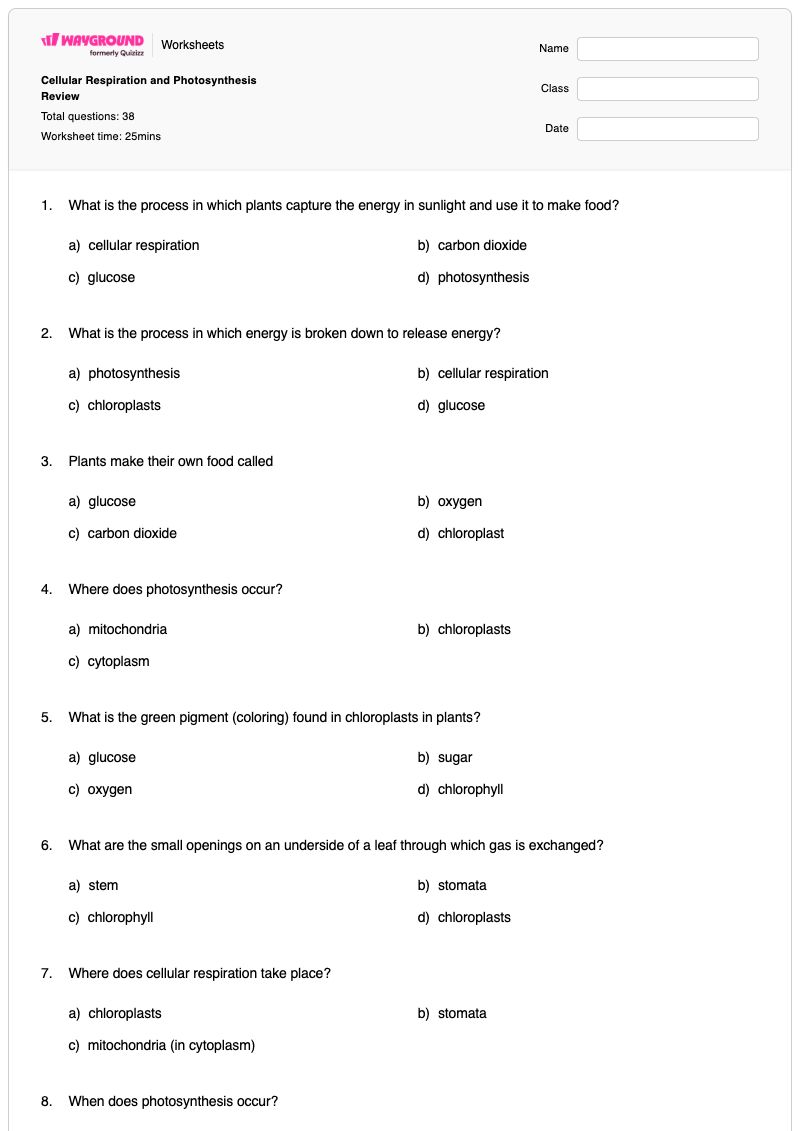
Cellular Respiration and Photosynthesis Review is a Grade 8 science worksheet that helps students distinguish the two processes plants use to make and release energy. Across 38 questions—33 multiple choice and 5 multiple select—students identify key terms, locations, timing, reactants, products, and the equations associated with photosynthesis and cellular respiration. They also connect structures such as chloroplasts, mitochondria, stomata, and chlorophyll to their roles in plant processes. This free printable worksheet is useful for review, independent practice, or a formative assessment after instruction. The multiple-select items require students to identify all applicable inputs and outputs rather than choosing a single response, while the equation-identification questions reinforce recognition of each process. An answer key is included so teachers can quickly check understanding and address confusion between the two processes, their organelles, and their reactants and products.

Worksheet settings

Font size

S
M
L
XL
Worksheets

Cellular Respiration and Photosynthesis Review

Total questions: 38

Name
Class
Date
1.

What is the process in which plants capture the energy in sunlight and use it to make food?

a)

cellular respiration

b)

carbon dioxide

c)

glucose

d)

photosynthesis

2.

What is the process in which energy is broken down to release energy?

a)

photosynthesis

b)

cellular respiration

c)

chloroplasts

d)

glucose

3.

Plants make their own food called

a)

glucose

b)

oxygen

c)

carbon dioxide

d)

chloroplast

4.

Where does photosynthesis occur?

a)

mitochondria

b)

chloroplasts

c)

cytoplasm

5.

What is the green pigment (coloring) found in chloroplasts in plants?

a)

glucose

b)

sugar

c)

oxygen

d)

chlorophyll

6.

What are the small openings on an underside of a leaf through which gas is exchanged?

a)

stem

b)

stomata

c)

chlorophyll

d)

chloroplasts

7.

Where does cellular respiration take place?

a)

chloroplasts

b)

stomata

c)

mitochondria (in cytoplasm)

8.

When does photosynthesis occur?

a)

With sunlight

b)

At night

c)

All the time

9.

When does cellular respiration occur?

a)

With sunlight

b)

At night

c)

All the time

10.

In photosynthesis, what are the reactants (the input, what the plant takes in)?

a)

water

b)

oxygen

c)

glucose

d)

carbon dioxide

e)

milk

11.

In photosynthesis, what are the products (output, what is released or made)?

a)

oxygen

b)

water

c)

glucose

d)

carbon dioxide

12.

In cellular respiration, what are the reactants (input)?

a)

oxygen

b)

water

c)

glucose

d)

carbon dioxide

13.

In cellular respiration, what are the products (the output)?

a)

water

b)

carbon dioxide

c)

energy

d)

glucose

14.

What equation is this?

a)

Photosynthesis

b)

Cellular Respiration

15.

What equation is this?

a)

Photosynthesis

b)

Cellular Respiration

16.

Photosynthesis and cellular respiration can be thought of as _________ processes

a)

similar

b)

opposite

17.

Photosynthesis occurs in what type of cells?

a)

Plants

b)

All

c)

Algae

18.

Cellular respiration occurs in mostly all cells/organisms

a)

True

b)

False

19.

Photosynthesis is a biological process that occurs in autotrophs. Which of the following is produced as a result of photosynthesis?

a)

Water and light

b)

Glucose and chlorophyll

c)

Glucose and oxygen

d)

Carbon dioxide and water

20.

The organic molecule that is the cell's primary form of energy?

a)

Glucose

b)

ATP

c)

ADP

d)

GMP

21.

Where do the reactions of photosynthesis take place in autotrophs?

a)

Chloroplast

b)

Mitochondria

c)

Cell Walls

d)

Cytoplasm

22.

Where does the energy for plants to perform photosynthesis come from?

a)

Breaking down ATP

b)

sunlight

c)

glucose metabolism

d)

None of the Above

23.

What is the chemical equation for photosynthesis? Choose the BEST answer

a)

C6H12O6 + O2 -> CO2 + H2O

b)

CO2 + H2O --> C6H12O6 + O2

c)

6 CO2 + 6 H2O --> C6H12O6 + 6 O2

d)

C6H12O6 + 6 O2 -> 6 CO2 + 6 H2O

24.

What is the pigment responsible for absorbing light energy in chloroplasts during photosynthesis?

a)

None of the Above

b)

Carotenoids

c)

Xenophylls

d)

Chlorophyll

25.

Cellular Respiration involves the chemical breakdown of _____ to form ATP Energy

a)

Fats

b)

Fructose

c)

Glucose

d)

Proteins

26.

Which of the following chemical equations properly demonstrates Cellular Respiration? Choose the BEST answer.

a)

C6H12O6 + O2 --> H2O + CO2

b)

H2O + CO2 -> C6H12O6 + O2

c)

C6H12O6 + 6 O2 -> 6 H2O + 6 CO2

d)

6 H2O + 6 CO2 -> C6H12O6 + 6 O2

27.

Where do the reactions of Aerobic respiration take place? (Krebs Cycle & Electron Transport Chain)

a)

Cytoplasm

b)

Mitochondria

c)

Chloroplasts

d)

Cell Wall

28.

True of False, Plants can perform Cellular Respiration and Photosynthesis

a)

False

b)

True

29.
What are the two products that are formed in photosynthesis?
a)
Oxygen and carbon dioxide
b)
Water and oxygen
c)
Oxygen and glucose
d)
Water and glucose
30.

Photosynthesis is ...

a)

The process in which organisms convert/transfer energy from glucose to ATP.

b)

The process in which organisms exchange carbon dioxide and oxygen in their lungs.

c)

The process of taking a picture.

d)

The process of plants converting/transferring solar energy to chemical energy to make their food.

31.
What are the reactants (what's needed) for photosynthesis?
a)
glucose and oxygen
b)
light, water, and carbon dioxide
c)

oxygen and carbon dioxide

d)

light and water

32.

Which process does heterotrophs and autotrophs undergo in order to convert glucose into ATP?

a)

cellular respiration

b)

osmosis

c)

photosynthesis

d)

transcription

33.

In what organelle does cellular respiration take place?

a)

mitochondria

b)

chromosomes

c)

lysosomes

d)

nucleus

34.

Cellular respiration is a chemical reaction that converts chemical energy stored in glucose into which large molecule?

a)

carbohydrate

b)

citric acid

c)

pyruvate

d)

ATP

35.

What is one of the reactants (raw materials) going into cellular respiration?

a)

Energy

b)

Sugar (Glucose)

c)

Carbon dioxide

d)

Water

36.

Which statement about photosynthesis is correct?

a)

Plants get the energy they need for photosynthesis from water.

b)

Plants get the energy they need for photosynthesis from soil.

c)

Plants get the energy they need for photosynthesis from sunlight.

d)

Plants do not require energy to perform photosynthesis.

37.

Which organism(s) go through cellular respiration?

a)

animals only

b)

plants only

c)

both animals and plants

d)

decomposers

38.

What is the main purpose of photosynthesis?

a)

To make food

b)

To create energy

c)

To release oxygen

d)

To absorb sunlight

Answer Key

Cellular Respiration and Photosynthesis Review

Total questions: 38

1.
d)

photosynthesis

2.
b)

cellular respiration

3.
a)

glucose

4.
b)

chloroplasts

5.
d)

chlorophyll

6.
b)

stomata

7.
c)

mitochondria (in cytoplasm)

8.
a)

With sunlight

9.
c)

All the time

10.
a)

water

, d)

carbon dioxide

11.
a)

oxygen

, c)

glucose

12.
a)

oxygen

, b)

water

13.
a)

water

, b)

carbon dioxide

, c)

energy

14.
a)

Photosynthesis

15.
b)

Cellular Respiration

16.
b)

opposite

17.
a)

Plants

, c)

Algae

18.
a)

True

19.
c)

Glucose and oxygen

20.
b)

ATP

21.
a)

Chloroplast

22.
b)

sunlight

23.
c)

6 CO2 + 6 H2O --> C6H12O6 + 6 O2

24.
d)

Chlorophyll

25.
c)

Glucose

26.
c)

C6H12O6 + 6 O2 -> 6 H2O + 6 CO2

27.
b)

Mitochondria

28.
b)

True

29.
c) Oxygen and glucose
30.
d)

The process of plants converting/transferring solar energy to chemical energy to make their food.

31.
b) light, water, and carbon dioxide
32.
a)

cellular respiration

33.
a)

mitochondria

34.
d)

ATP

35.
b)

Sugar (Glucose)

36.
c)

Plants get the energy they need for photosynthesis from sunlight.

37.
c)

both animals and plants

38.
a)

To make food

FAQs

What does the Cellular Respiration and Photosynthesis Review worksheet cover?

This Grade 8 science worksheet uses 33 multiple-choice and 5 multiple-select questions to compare photosynthesis with cellular respiration. Students identify where each process occurs, when it occurs, the roles of chloroplasts, mitochondria, stomata, and chlorophyll, and the reactants and products involved. Equation-identification items further reinforce how to distinguish the two processes.

How can I use this worksheet to teach photosynthesis and cellular respiration?

Use the worksheet after introducing the two processes to organize a compare-and-contrast review. Ask students to explain why water and carbon dioxide belong in the photosynthesis reactants item, then have them use the products and equation questions to justify their choices. Discuss the multiple-select items as a class so students explain every option they select rather than guessing from a single answer.

What mistakes should I watch for when students complete this worksheet?

Students may reverse photosynthesis and cellular respiration, confuse chloroplasts with mitochondria, or mistake chlorophyll for the organelle where photosynthesis occurs. Watch for students selecting only one option on the multiple-select questions, especially when identifying several reactants or products. They may also confuse photosynthesis occurring with sunlight with cellular respiration occurring all the time, or misidentify the equations.

How do I assign and grade this worksheet?

The worksheet is available as a printable PDF and as a digital quiz on Wayground, and it includes a complete answer key. For printable submissions, you can grade student work by scanning it with the Wayground for Teachers app. The PDF option can also support classrooms or schools that are reducing screen time.

How can I differentiate this photosynthesis and cellular respiration worksheet for my students?

In the worksheet’s Advanced Settings, adjust font spacing or font size to make the 38 multiple-choice and multiple-select items easier to read. You can also apply a dyslexia-friendly font or translate the worksheet into another language, helping students access the process comparisons, reactant-and-product questions, and equation items.

Where can I find more worksheets like this on Wayground?

Wayground offers a comprehensive collection of free printable worksheets and practice problems across all subjects, with downloadable PDFs and answer keys to help students master essential skills and concepts. Browse more resources at https://wayground.com/en-us/worksheets.