

Wayground
KE REVIEW ~ UNIT 3 - Printable Biology Worksheets - Wayground

KE REVIEW ~ UNIT 3

20 questions

9th - 12th Grade

Biology

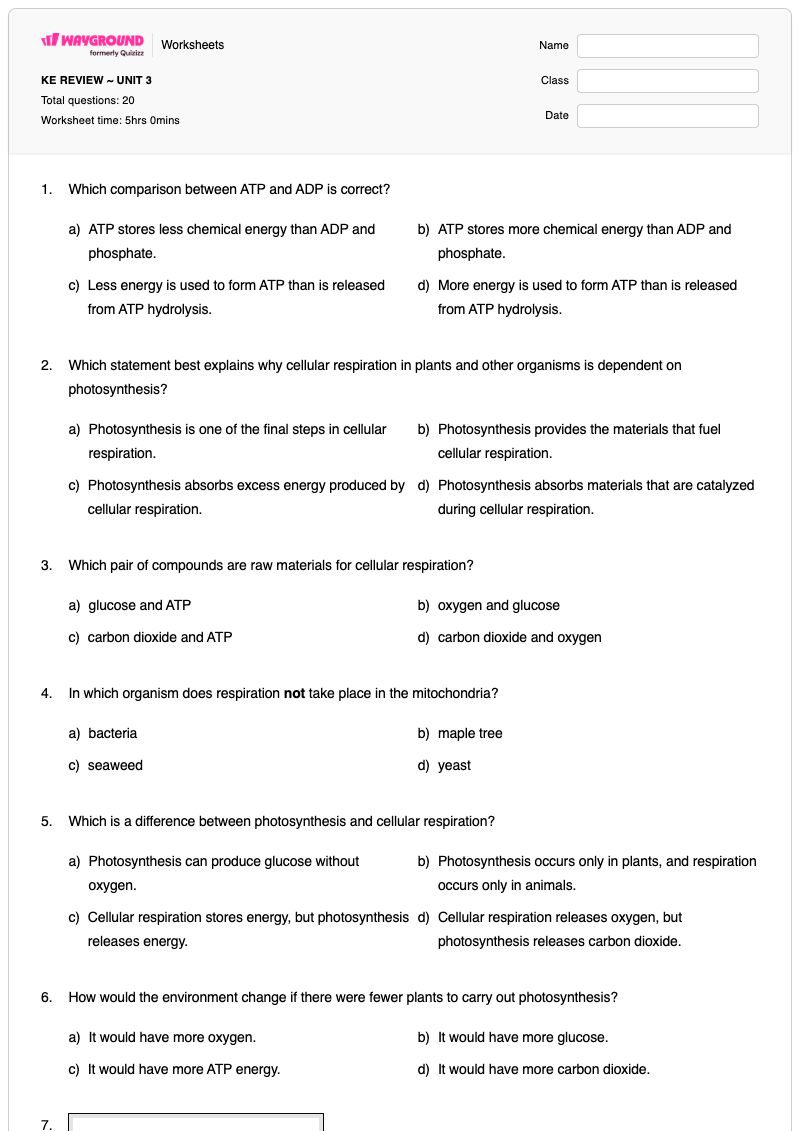
KE REVIEW ~ UNIT 3 is a Grade 9–12 Biology worksheet that reviews how ATP, photosynthesis, and cellular respiration manage and transform energy in cells. Students answer multiple-choice questions about ATP and ADP energy storage, the reactants and products of photosynthesis and respiration, the relationship between the two processes, and the roles of chloroplasts and mitochondria. The worksheet also connects ATP to cellular work, including cilia movement and active transport against a concentration gradient. This free printable worksheet includes 20 multiple-choice questions designed to check understanding and help students distinguish related biological processes, energy conversions, organelle functions, and environmental effects such as changes in oxygen and carbon dioxide. It works well as a unit review, formative assessment, independent practice, or test-preparation activity for secondary Biology students. A complete answer key is included so teachers can quickly check responses and identify concepts that need further instruction.

Worksheet settings

Font size

S
M
L
XL
Worksheets

KE REVIEW ~ UNIT 3

Total questions: 20

Name
Class
Date
1.

Which comparison between ATP and ADP is correct?

a)

ATP stores less chemical energy than ADP and phosphate.

b)

ATP stores more chemical energy than ADP and phosphate.

c)

Less energy is used to form ATP than is released from ATP hydrolysis.

d)

More energy is used to form ATP than is released from ATP hydrolysis.

2.

Which statement best explains why cellular respiration in plants and other organisms is dependent on photosynthesis?

a)

Photosynthesis is one of the final steps in cellular respiration.

b)

Photosynthesis provides the materials that fuel cellular respiration.

c)

Photosynthesis absorbs excess energy produced by cellular respiration.

d)

Photosynthesis absorbs materials that are catalyzed during cellular respiration.

3.

Which pair of compounds are raw materials for cellular respiration?

a)

glucose and ATP

b)

oxygen and glucose

c)

carbon dioxide and ATP

d)

carbon dioxide and oxygen

4.

In which organism does respiration not take place in the mitochondria?

a)

bacteria

b)

maple tree

c)

seaweed

d)

yeast

5.

Which is a difference between photosynthesis and cellular respiration?

a)

Photosynthesis can produce glucose without oxygen.

b)

Photosynthesis occurs only in plants, and respiration occurs only in animals.

c)

Cellular respiration stores energy, but photosynthesis releases energy.

d)

Cellular respiration releases oxygen, but photosynthesis releases carbon dioxide.

6.

How would the environment change if there were fewer plants to carry out photosynthesis?

a)

It would have more oxygen.

b)

It would have more glucose.

c)

It would have more ATP energy.

d)

It would have more carbon dioxide.

7.

Which statement best describes a direct role of ATP in a paramecium?

a)

ATP provides the energy to move cilia.

b)

ATP stores the genetic code for replication.

c)

ATP signals the presence of other nearby organisms.

d)

ATP senses changes in the surrounding aquatic environment.

8.

Which process uses the products of photosynthesis as reactants?

a)

active transport

b)

cellular respiration

c)

DNA replication

d)

protein synthesis

9.

Which of the following are the reactants in photosynthesis?

a)

oxygen (O2) and water (H2O)

b)

water (H2O) and glucose (C6H12O6)

c)

carbon dioxide (CO2) and water (H2O)

d)

glucose (C6H12O6) and carbon dioxide (CO2)

10.

A scientist observed that during the course of a chemical reaction the number of ATP molecules was reduced. What did the scientist most likely learn from the observation?

a)

The reaction produced water

b)

The reaction consumed water.

c)

The reaction caused an output of energy.

d)

The reaction required an input of energy.

11.

Four students classified the main energy conversions that occur during photosynthesis and cellular respiration. Which student best classified the energy conversions that occur in the two processes?

a)

student 1

b)

student 2

c)

student 3

d)

student 4

12.

Which statement best compares the energy transformations of photosynthesis and cellular respiration?

a)

Only photosynthesis uses oxygen to create energy.

b)

Only photosynthesis causes an increase in kinetic energy.

c)

Photosynthesis and cellular respiration both store energy in chemical bonds.

d)

Photosynthesis and cellular respiration both require chemical energy to make food.

13.

Use the diagram to answer the question. The diagram shows the movement of ions against a concentration gradient to an area of higher concentration. Which molecule provides the energy needed for this movement to occur in a cell?

a)

ATP

b)

mRNA

c)

protein

d)

lipid

14.

Use the diagram to answer the question. The diagram shows an energy transformation that typically occurs in plant cell plastids. Which statement best describes this role of plastids in the plant cell?

a)

Chloroplasts transform light energy into chemical energy.

b)

Mitochondria transform light energy into chemical energy.

c)

Chloroplasts transform chemical energy into electromagnetic energy.

d)

Mitochondria transform chemical energy into electromagnetic energy.

15.

Use the list to answer the question. Which two statements correctly describe one similarity and one difference between cellular respiration and photosynthesis?

a)

statements 1 and 2

b)

statements 1 and 4

c)

statements 2 and 3

d)

statements 3 and 4

16.

Plant cells use sunlight to make their own food. Which structure allows plant cells to perform this function?

a)

nucleus

b)

vacuole

c)

chloroplast

d)

mitochondrion

17.

Use the list to answer the question. A plant cell uses the molecules in the list to synthesize a protein. What role do the ATP molecules play in the protein synthesis process?

a)

They provide energy.

b)

They increase activation energy.

c)

They convert energy into hereditary information.

d)

They absorb excess energy to prevent overheating.

18.

Which statement best describes a relationship between mitochondria and chloroplasts?

a)

Mitochondria release chemical energy from molecules and store it in chloroplasts.

b)

Chloroplasts release chemical energy from molecules and store it in mitochondria.

c)

Mitochondria convert chemical energy into light energy that can be used by chloroplasts.

d)

Chloroplasts convert light energy into chemical energy that can be used by mitochondria.

19.

Use the lists below to answer the question. A student made lists of structures observed in cells from two different organisms. Which statement describes the most likely difference in the way that organism 1 and organism 2 obtain energy?

a)

Only organism 1 uses solar energy to make energy-rich compounds.

b)

Only organism 1 stores solar energy until it is needed for its life processes.

c)

Only organism 2 produces molecules for long-term energy storage.

d)

Only organism 2 transforms food energy into ATP during cellular respiration.

20.

A cell in the leaf of a green plant performs both photosynthesis and cellular respiration, often at the same time. Which statement best describes how these processes are related to each other?

a)

Both processes produce carbon dioxide.

b)

Both processes require energy directly from the Sun.

c)

Products of one process are used as some of the reactants for the other process.

d)

Thermal energy from one process is used as the energy source for the other process.

Answer Key

KE REVIEW ~ UNIT 3

Total questions: 20

1.
b)

ATP stores more chemical energy than ADP and phosphate.

2.
b)

Photosynthesis provides the materials that fuel cellular respiration.

3.
b)

oxygen and glucose

4.
a)

bacteria

5.
a)

Photosynthesis can produce glucose without oxygen.

6.
d)

It would have more carbon dioxide.

7.
a)

ATP provides the energy to move cilia.

8.
b)

cellular respiration

9.
c)

carbon dioxide (CO2) and water (H2O)

10.
d)

The reaction required an input of energy.

11.
d)

student 4

12.
c)

Photosynthesis and cellular respiration both store energy in chemical bonds.

13.
a)

ATP

14.
a)

Chloroplasts transform light energy into chemical energy.

15.
a)

statements 1 and 2

16.
c)

chloroplast

17.
a)

They provide energy.

18.
d)

Chloroplasts convert light energy into chemical energy that can be used by mitochondria.

19.
a)

Only organism 1 uses solar energy to make energy-rich compounds.

20.
c)

Products of one process are used as some of the reactants for the other process.

FAQs

What does the KE REVIEW ~ UNIT 3 worksheet cover?

This 20-question multiple-choice Biology review covers how ATP and ADP relate to cellular energy, how photosynthesis and cellular respiration use and produce materials, and how energy moves through these processes. Students also apply the concepts to organelles, ATP-powered cilia movement and active transport, chloroplast function, and changes in environmental oxygen and carbon dioxide.

How can I use this worksheet to teach ATP, photosynthesis, and cellular respiration?

Introduce the review by having students compare the reactants, products, and energy transformations of photosynthesis and cellular respiration. Then use the multiple-choice items to prompt explanations: ask students why ATP is needed for active transport or cilia movement, why bacteria do not use mitochondria for respiration, and how fewer plants would affect atmospheric gases. Review the answer choices afterward to address reasoning, not just letter selection.

What mistakes should I watch for when students complete this worksheet?

Students may confuse the reactants and products of photosynthesis and cellular respiration, especially carbon dioxide, oxygen, water, and glucose. They may also reverse the energy relationship between ATP and ADP, treat mitochondria as the site of respiration in bacteria, or confuse chloroplasts with mitochondria when identifying energy transformations. In diagram-based questions, check that students recognize ATP as the energy source for movement against a concentration gradient.

How do I assign and grade this worksheet?

The KE REVIEW ~ UNIT 3 worksheet is available as a printable PDF and as a digital quiz on Wayground, and it includes a complete answer key. You can grade printable submissions by scanning student work with the Wayground for Teachers app, or review responses from the digital quiz. The printable format can also support schools that are reducing screen time.

How can I differentiate this ATP and cellular respiration review worksheet?

Use the worksheet’s Advanced Settings to adjust font spacing and font size so the 20 multiple-choice questions are easier to read. You can also apply a dyslexia-friendly font or translate the worksheet into another language, while keeping the ATP, photosynthesis, cellular respiration, and energy-transformation content intact.

Where can I find more worksheets like this on Wayground?

Wayground offers a broad collection of free printable worksheets and practice problems across subjects, with downloadable PDFs and answer keys to help students build essential skills and concepts. Browse more resources at https://wayground.com/en-us/worksheets.