

Wayground
photosynthesis/cellular respiration - Printable Science Worksheets - Wayground

photosynthesis/cellular respiration

14 questions

7th - 7th Grade

Science

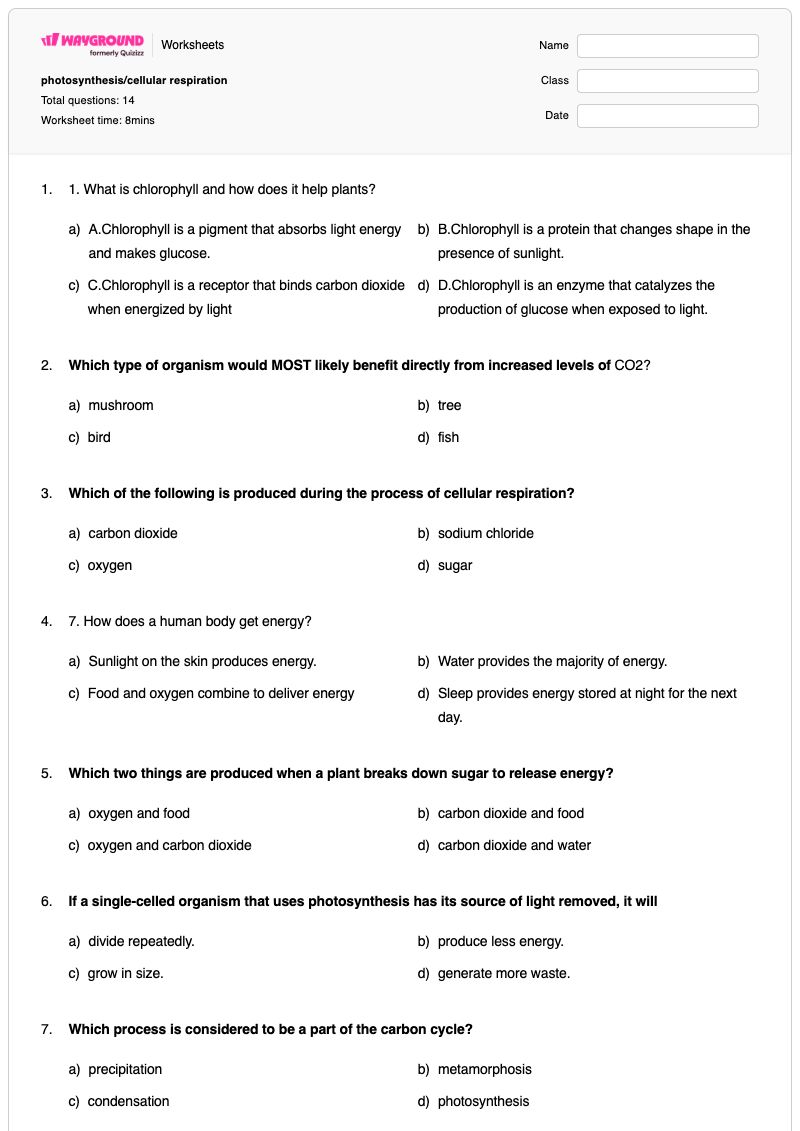
This Grade 7 science worksheet helps students distinguish photosynthesis from cellular respiration through 14 multiple-choice questions. Students identify chlorophyll’s role in absorbing light energy, recognize the reactants and products in each process, interpret the photosynthesis equation, and trace how solar energy is stored in sugars and released by mitochondria. The questions also connect plant and animal gas exchange to the carbon cycle, including how carbon dioxide supports photosynthesis, how respiration produces carbon dioxide and water, and how deforestation can affect atmospheric carbon dioxide. Additional items address reduced light, bark photosynthesis, and why most organisms cannot use atmospheric nitrogen directly. This free printable worksheet includes a complete answer key for Grade 7 science instruction, review, or assessment.

Worksheet settings

Font size

S
M
L
XL
Worksheets

photosynthesis/cellular respiration

Total questions: 14

Name
Class
Date
1.

1. What is chlorophyll and how does it help plants?

a)

A.Chlorophyll is a pigment that absorbs light energy and makes glucose.

b)

B.Chlorophyll is a protein that changes shape in the presence of sunlight.

c)

C.Chlorophyll is a receptor that binds carbon dioxide when energized by light

d)

D.Chlorophyll is an enzyme that catalyzes the production of glucose when exposed to light.

2.

Which type of organism would MOST likely benefit directly from increased levels of CO2?

a)

mushroom

b)

tree

c)

bird

d)

fish

3.

Which of the following is produced during the process of cellular respiration?

a)

carbon dioxide

b)

sodium chloride

c)

oxygen

d)

sugar

4.

7. How does a human body get energy?

a)

Sunlight on the skin produces energy.

b)

Water provides the majority of energy.

c)

Food and oxygen combine to deliver energy

d)

Sleep provides energy stored at night for the next day.

5.

Which two things are produced when a plant breaks down sugar to release energy?

a)

oxygen and food

b)

carbon dioxide and food

c)

oxygen and carbon dioxide

d)

carbon dioxide and water

6.

If a single-celled organism that uses photosynthesis has its source of light removed, it will

a)

divide repeatedly.

b)

produce less energy.

c)

grow in size.

d)

generate more waste.

7.

Which process is considered to be a part of the carbon cycle?

a)

precipitation

b)

metamorphosis

c)

condensation

d)

photosynthesis

8.

How will clear-cutting of forests affect the level of carbon dioxide in the atmosphere?

a)

It will decrease because of increased respiration.

b)

It will increase because of decreased photosynthesis.

c)

It will decrease because of decreased photosynthesis.

d)

It will remain constant as respiring animals remove the carbon dioxide.

9.

Which statement accurately describes an interaction between plants and animals?

a)

Animals release CO2, required for photosynthesis.

b)

Animals release O2, required for plant survival.

c)

Plants provide humans with atmospheric nitrogen.

d)

Plants provide humans with CO2 for respiration.

10.

6. Which of the following represents the process of photosynthesis?

a)

C6H12O6+6O2→6CO2+6H2O

b)

6CO2+6H2O→C6H12O6+6O2

c)

2H2O→2H2+O2

d)

2H2+O2→2H2O

11.

Beneath the outer layer of tree bark is a layer of live tissue. The cells of this live tissue contain chloroplasts. The bark also contains structures that allow gas exchange with the environment. These characteristics allow the tree bark to perform photosynthesis. Tree bark photosynthesis occurs mostly in early spring and late fall, or in times of drought or disease. What is the MOST likely reason bark photosynthesis is higher during these conditions?

a)

Photosynthesis keeps the bark from freezing.

b)

The bark produces a different type of sugar.

c)

The angle of light is different.

d)

The tree has fewer leaves.

12.

Which of the following BEST describes the flow of energy in a cabbage plant?

a)

Chemical energy is absorbed by mitochondria, stored in sugars, and released in chloroplasts.

b)

Chemical energy is absorbed by chloroplasts, stored in sugars, and released in mitochondria.

c)

Solar energy is absorbed by chloroplasts, converted and stored in sugars, and released in mitochondria.

d)

Solar energy is absorbed by mitochondria, converted and stored in sugars, and released in chloroplasts.

13.

People take in and release gases from the air when they breathe. Which exhaled gas is a waste product of respiration?

a)

helium

b)

oxygen

c)

carbon dioxide

d)

hydrogen

14.

Nitrogen makes up 78% of Earth’s atmosphere. Which statement BEST describes the importance of the nitrogen cycle?

a)

People need nitrogen to breathe.

b)

Nitrogen gas cannot be used directly by most organisms.

c)

Nitrogen needs to combine with oxygen to make water.

d)

Plants need nitrogen for photosynthesis.

Answer Key

photosynthesis/cellular respiration

Total questions: 14

1.
a)

A.Chlorophyll is a pigment that absorbs light energy and makes glucose.

2.
b)

tree

3.
a)

carbon dioxide

4.
c)

Food and oxygen combine to deliver energy

5.
d)

carbon dioxide and water

6.
b)

produce less energy.

7.
d)

photosynthesis

8.
b)

It will increase because of decreased photosynthesis.

9.
a)

Animals release CO2, required for photosynthesis.

10.
b)

6CO2+6H2O→C6H12O6+6O2

11.
d)

The tree has fewer leaves.

12.
c)

Solar energy is absorbed by chloroplasts, converted and stored in sugars, and released in mitochondria.

13.
c)

carbon dioxide

14.
b)

Nitrogen gas cannot be used directly by most organisms.

FAQs

What does this photosynthesis and cellular respiration worksheet cover?

This Grade 7 science worksheet uses 14 multiple-choice questions to assess how students distinguish photosynthesis from cellular respiration. Students identify chlorophyll’s function, select the correct equation for photosynthesis, trace energy from chloroplasts to sugars to mitochondria, and identify gases and products involved in respiration. Several questions apply these ideas to carbon cycling, reduced light, bark photosynthesis, and forest clearing.

How can I use this worksheet to teach photosynthesis and cellular respiration?

Introduce the worksheet by having students compare the two processes: photosynthesis uses light energy to form glucose, while cellular respiration breaks down sugar to release energy. Before students answer, ask them to annotate the photosynthesis equation and identify where chloroplasts and mitochondria fit in the energy flow. Use the questions about exhaled carbon dioxide, plant-animal gas exchange, and clear-cutting to discuss how the processes connect within the carbon cycle.

What mistakes should I watch for when students complete this worksheet?

Students may reverse the photosynthesis equation with the cellular respiration equation or confuse chloroplasts, where light energy is captured, with mitochondria, where energy is released from sugars. They may also select oxygen instead of carbon dioxide as a product of respiration, or overlook that removing light reduces energy production in a photosynthetic organism. Watch for confusion about cause and effect in the clear-cutting question: fewer trees performing photosynthesis lead to more atmospheric carbon dioxide.

How do I assign and grade this worksheet?

You can assign this worksheet as a printable PDF or as a digital quiz on Wayground. It includes a complete answer key, and printable submissions can be graded by scanning student work with the Wayground for Teachers app. The printable format can also support schools that are reducing screen time.

How can I differentiate this worksheet for my students?

In the worksheet’s Advanced Settings, adjust font spacing or choose a larger font size to make the 14 multiple-choice items easier to read. You can also apply a dyslexia-friendly font for the questions about equations, energy flow, and gas exchange, or translate the worksheet into another language while preserving its original question format.

Where can I find more worksheets like this on Wayground?

Wayground offers a comprehensive collection of free printable worksheets and practice problems across all subjects, with downloadable PDFs and answer keys to help students master essential skills and concepts. Browse more resources at https://wayground.com/en-us/worksheets.