
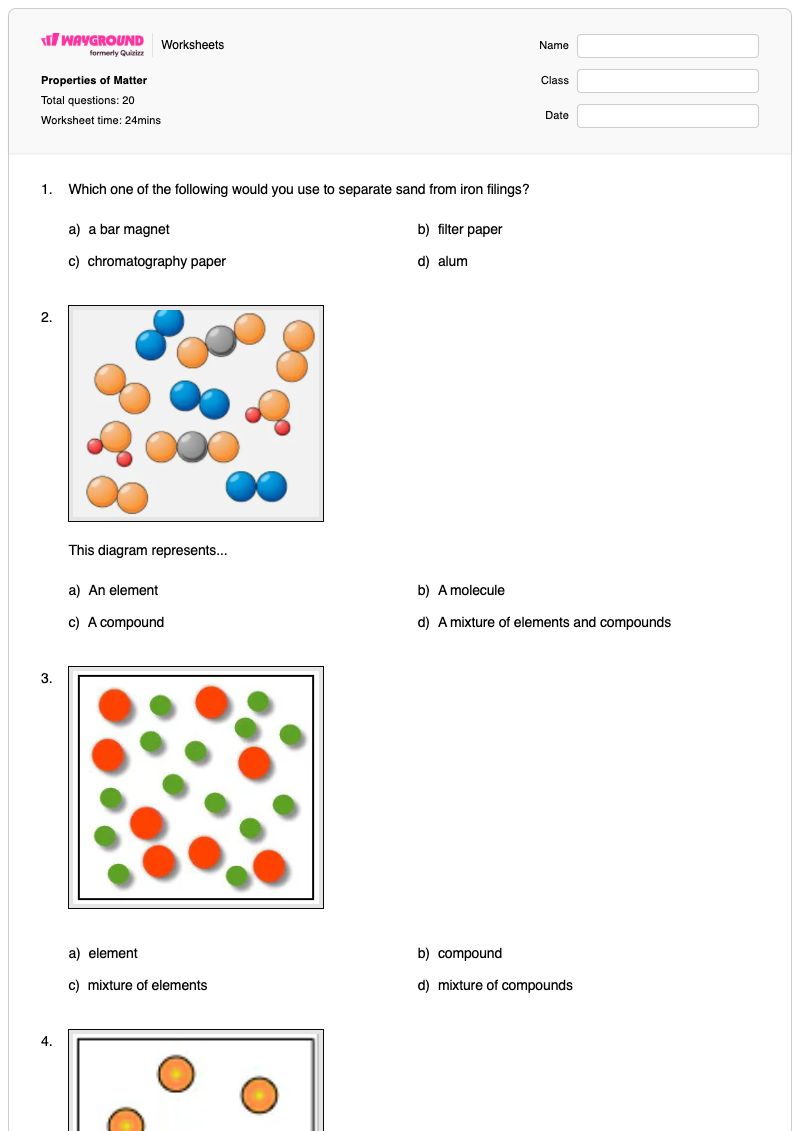

This Grade 9 science worksheet helps students classify matter and distinguish among elements, compounds, homogeneous mixtures, heterogeneous mixtures, solutions, colloids, and suspensions. Across 20 multiple-choice questions, students interpret a particle diagram, identify mixture types, compare how suspension and colloid particles behave, recognize the Tyndall effect, and select appropriate separation methods such as using a magnet to remove iron filings from sand.
The worksheet also reinforces the definition of matter and the difference between physical and chemical properties. Students classify examples such as state of matter, boiling, flammability, and the ability to rust, applying these distinctions in a focused question-and-answer format. Designed for Grade 9 science instruction, review, or assessment, this free printable worksheet includes a complete answer key for efficient checking and feedback.
Worksheet settings
Font size
S
M
L
XL
Worksheets
Properties of Matter
Total questions: 20
Name
Class
Date
1.
Which one of the following would you use to separate sand from iron filings?
a)
a bar magnet
b)
filter paper
c)
chromatography paper
d)
alum
2.
This diagram represents...
a)
An element
b)
A molecule
c)
A compound
d)
A mixture of elements and compounds
3.
a)
element
b)
compound
c)
mixture of elements
d)
mixture of compounds
4.
a)
element
b)
compound
c)
mixture of elements
d)
mixture of compounds
5.
What is a mixture?
a)
elements chemically combined
b)
a combination of different things
c)
it is found on the Periodic Table
d)
it is made of chemical
6.
What type of mixture is this?
a)
heterogeneous
b)
homogeneous
7.
Sand floating in water, but most of the sand is settled at the bottom this an example of which type of mixture?
a)
A solution
b)
A colloid
c)
A suspension
d)
A compound
8.
Which statement below does NOT describe a colloid?
a)
A colloid is a type of heterogeneous mixture
b)
A colloid is a type of solution.
c)
The particles in a colloid do not settle like they do in a suspension.
d)
The particles in a colloid do not dissolve – they are just too small to be seen.
9.
How are suspensions and colloids different?
a)
Suspensions settle out and colloids do not settle.
b)
Colloids settle out and suspensions do not settle.
c)
Suspensions dissolve and colloids do not.
d)
Colloids dissolve and suspensions do not.
10.
The scattering of light by colloids is called ____.
a)
homogeneous
b)
suspension
c)
air pollution
d)
The Tyndall effect
11.
A substance that contains only one type of atom is a(n)
a)
compound
b)
element
c)
heterogeneous mixture
d)
homogeneous mixture
12.
The particles in both a solution and a colloid can
a)
A. scatter light.
b)
B. settle out.
c)
D. pass through a fine filter.
13.
What is matter?
a)
a pure substance
b)
anything that occupies space and possesses mass
c)
an element
d)
a compound
14.
Which of the following is not a chemical property?
a)
rusting
b)
boiling
c)
rotting
d)
burning
15.
Which one of these is a chemical property?
a)
melting point
b)
boiling point
c)
color
d)
flammability
16.
Ability to rust is this type of property:
a)
Physical property
b)
Chemical property
17.
Which is an example of a physical property?
a)
ability to react with acid
b)
state of matter
c)
flammability
d)
ability to react with oxygen
18.
What kind of properties can only be observed when a substance changes into a different substance?
a)
physical properties
b)
chemical properties
c)
liquid properties
d)
real properties
19.
Properties that can be observed without trying to change the identity of the substance.
a)
Physical
b)
Chemical
20.
Which of the following is a chemical change?
a)
human digestion
b)
cutting a tree down
c)
melting a chocolate bar
d)
Has a density of 1 gm/mL
Answer Key
Properties of Matter
Total questions: 20
1.
a) a bar magnet
2.
d)
A mixture of elements and compounds
3.
c) mixture of elements
4.
a) element
5.
b) a combination of different things
6.
a) heterogeneous
7.
c) A suspension
8.
b)
A colloid is a type of solution.
9.
a)
Suspensions settle out and colloids do not settle.
10.
d) The Tyndall effect
11.
b) element
12.
c)
D. pass through a fine filter.
13.
b) anything that occupies space and possesses mass
14.
b) boiling
15.
d) flammability
16.
b) Chemical property
17.
b) state of matter
18.
b) chemical properties
19.
a) Physical
20.
a) human digestion
140 %
Browse by subjects
Browse by grades
Browse by format
FAQs
What does the Properties of Matter worksheet cover?
This Grade 9 worksheet uses 20 multiple-choice questions to assess how students classify matter as elements, compounds, or mixtures and distinguish homogeneous mixtures, heterogeneous mixtures, solutions, colloids, and suspensions. It also asks students to apply separation methods, identify the Tyndall effect, and differentiate physical properties from chemical properties using examples such as boiling, flammability, and rusting.
How can I use this worksheet to teach properties of matter?
Introduce the worksheet by having students sort examples into pure substances and mixtures, then model how particle behavior distinguishes solutions, colloids, and suspensions. Use the separation-method and diagram questions for guided discussion, and finish by asking students to justify why boiling and state of matter are physical properties while flammability and rusting describe chemical properties.
What mistakes should I watch for when students complete this worksheet?
Students may confuse a compound with a mixture, or classify every mixture as homogeneous without considering whether its composition is uniform. They may also reverse the key distinction between colloids and suspensions—suspension particles settle, while colloid particles do not—and confuse physical properties such as boiling with chemical properties such as flammability or the ability to rust.
How do I assign and grade this Properties of Matter worksheet?
The worksheet is available as a printable PDF and as a digital quiz on Wayground, and it includes a complete answer key for all 20 multiple-choice questions. For printable submissions, scan student work with the Wayground for Teachers app to support grading and review.
How can I differentiate this Properties of Matter worksheet for my students?
Use the worksheet’s Advanced Settings to adjust font spacing and font size so the 20 multiple-choice items are easier to read. You can also enable a dyslexia-friendly font or translate the worksheet into another language, while keeping the matter-classification and physical-versus-chemical-property questions intact.
Where can I find more worksheets like this on Wayground?
Wayground offers a broad collection of free printable worksheets and practice problems across subjects, with downloadable PDFs and answer keys to help students build essential skills and concepts. Browse more resources at https://wayground.com/en-us/worksheets.