

This Grade 8 science worksheet, titled الخصائص والتغيرات الفيزيائية والكيميائية, helps students distinguish physical changes from chemical changes in matter. Across 15 multiple-choice questions, students classify examples such as cutting, dissolving, melting, freezing, boiling, burning, rusting, and candle burning, and determine whether a new substance has formed.
The worksheet also reinforces the difference between physical and chemical properties. Students identify flammability as a chemical property and recognize evidence of chemical change, including light release, temperature change, color change, formation of a solid, and gas production. This free printable worksheet includes a complete answer key and is designed for Grade 8 science practice, review, or formative assessment.
Worksheet settings
Font size
S
M
L
XL
Worksheets
الخصائص والتغيرات الفيزيائية والكيميائية
Total questions: 15
Name
Class
Date
1.
What kind of change occurs if matter changes in amount, size, or shape?
a)
substance change
b)
chemical change
c)
physical change
d)
elemental change
2.
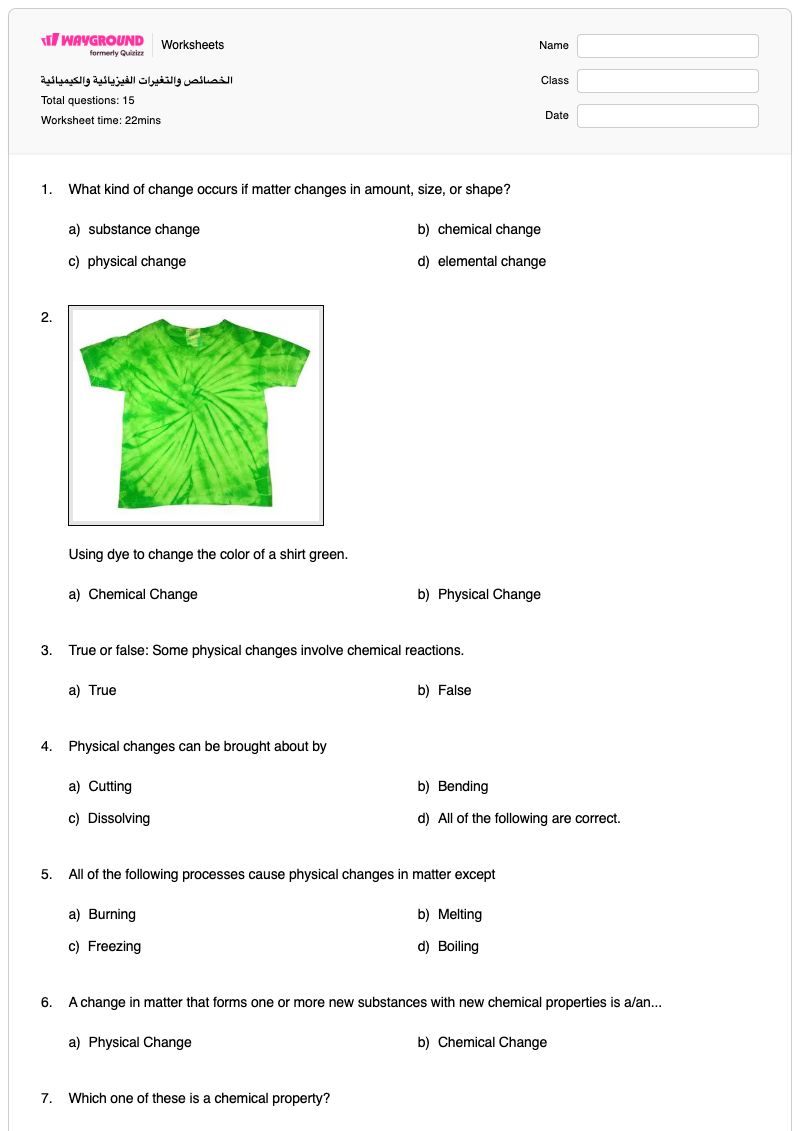
Using dye to change the color of a shirt green.
a)
Chemical Change
b)
Physical Change
3.
True or false: Some physical changes involve chemical reactions.
a)
True
b)
False
4.
Physical changes can be brought about by
a)
Cutting
b)
Bending
c)
Dissolving
d)
All of the following are correct.
5.
All of the following processes cause physical changes in matter except
a)
Burning
b)
Melting
c)
Freezing
d)
Boiling
6.
A change in matter that forms one or more new substances with new chemical properties is a/an...
a)
Physical Change
b)
Chemical Change
7.
Which one of these is a chemical property?
a)
melting point
b)
boiling point
c)
color
d)
flammability
8.
What is a chemical change?
a)
Forming a new substance
b)
When two or more substances combine to make a greater one
c)
When two or more substances combine to make a new chemical substance
d)
Combing substances
9.
Students observed a piece of iron change from shiny to rusty. What caused this change?
a)
a chemical reaction
b)
a heat reaction
c)
a cold reaction
d)
a physical reaction
10.
Which is the best example of a new substance forming?
a)
lighting a match
b)
cutting a piece of paper
c)
popping a balloon
d)
hitting a nail with a hammer
11.
Which is an example of a different substance being formed?
a)
glass breaking
b)
metal melting
c)
water freezing
d)
candle burning
12.
Properties that can only be observed or measured by changing the chemical identity of a substance.
a)
Physical Properties
b)
Combustible Properties
c)
Chemical Properties
d)
Changeable Properties
13.
Release of light, temperature change, sudden color change, sudden appearance of a solid, and gas given off are all evidence of what?
a)
chemical change
b)
physical change
c)
matter disappearing
d)
physical and chemical changes occurring
14.
Cutting, crushing, melting, and boiling are all examples of what?
a)
physical changes
b)
chemical changes
c)
messes
d)
Law of Conservation of Particles
15.
A change is a substance that affects its chemical properties thus a chemical reaction happens and a new substance is formed.
a)
physical change
b)
physical properties
c)
chemical change
d)
chemical properties
Answer Key
الخصائص والتغيرات الفيزيائية والكيميائية
Total questions: 15
1.
c)
physical change
2.
b) Physical Change
3.
b) False
4.
d) All of the following are correct.
5.
a) Burning
6.
b) Chemical Change
7.
d) flammability
8.
c)
When two or more substances combine to make a new chemical substance
9.
a)
a chemical reaction
10.
a)
lighting a match
11.
d)
candle burning
12.
c)
Chemical Properties
13.
a)
chemical change
14.
a)
physical changes
15.
c)
chemical change
140 %
Browse by subjects
Browse by grades
Browse by format
FAQs
What does this worksheet cover, and how does it help students learn about physical and chemical changes?
This Grade 8 worksheet uses 15 multiple-choice questions to help students classify changes in matter as physical or chemical. Students apply the distinction to examples such as cutting, dissolving, melting, rusting, burning, and freezing, while identifying when a new substance with new chemical properties forms.
How can I use this worksheet to teach physical and chemical changes?
Introduce the lesson by contrasting a change in size or shape, such as cutting, with a change that produces a new substance, such as burning. Then have students explain the reasoning behind the worksheet’s examples, including why rusting and candle burning are chemical changes and why melting and boiling are physical changes. Use the multiple-choice responses to prompt discussion before reviewing the answer key.
What mistakes should I watch for when students complete this physical and chemical changes worksheet?
Students may confuse any visible change with a chemical change, even though changes such as cutting, melting, freezing, and boiling are classified here as physical changes. Watch for students who select color or melting point as chemical properties instead of flammability, or who overlook that rusting, burning, light, gas, and sudden temperature or color changes indicate chemical change.
How do I assign and grade this physical and chemical changes worksheet?
The worksheet is available as a printable PDF and as a digital quiz on Wayground, and it includes a complete answer key for all 15 multiple-choice questions. Printable submissions can be graded by scanning student work with the Wayground for Teachers app.
How does this worksheet help students identify evidence of chemical change?
Several questions ask students to connect chemical change with evidence such as light release, temperature change, sudden color change, formation of a solid, or gas production. Students also apply these indicators to examples such as a match lighting, a candle burning, and iron changing from shiny to rusty.
Where can I find more worksheets like this on Wayground?
Wayground offers a comprehensive collection of free printable worksheets and practice problems across all subjects, with downloadable PDFs and answer keys to help students master essential skills and concepts. Browse more resources at https://wayground.com/en-us/worksheets.