Scientific Method is a free printable science worksheet for students in Grades 6–8. It includes 10 questions—9 multiple-choice and 1 multiple-select—that build understanding of core scientific method vocabulary and experimental design. Students identify independent and controlled variables in a plant-growth investigation, define a hypothesis, recognize the scientific method as an organized process, select the metric system, and choose an appropriate tool for measuring the volume of rocks.
The worksheet helps students connect definitions to applied examples instead of memorizing terms in isolation. The repeated plant investigation asks them to distinguish the variable changed by the scientist from conditions kept the same, while the hypothesis questions reinforce the idea of a research-based, untested explanation. Use it for guided practice, independent review, or a quick formative assessment. A complete answer key is included, and the worksheet is available as a free printable PDF.
Worksheet settings
Font size
S
M
L
XL
Worksheets
Scientific Method
Total questions: 10
Name
Class
Date
1.
This variable in an experiment is the one being changed by the scientist.
a)
dependent variable
b)
independent variable
c)
data
d)
control group
2.
What is a hypothesis?
a)
A hypothesis is the right answer to an experiment.
b)
A hypothesis is the wrong answer to an experiment.
c)
A hypothesis is an educated guess.
d)
I don't know.
3.
An experiment is performed on plants to see how different liquids affect plant growth. Each plant in the experiment is given a different liquid; water, apple juice, or milk. Each plant has the same amount of soil, sunlight, and listens to the same music. In this investigation, the independent variable is ...
a)
The type of plant
b)
The amount of sunlight
c)
The type of music
d)
The type of liquid
4.
A possible explanation to a problem that has not yet been tested.
a)
data
b)
theory
c)
hypothesis
d)
fact
5.
An experiment is performed on plants to see how different liquids affect plant growth. Each plant in the experiment is given a different liquid; water, apple juice, or milk. Each plant has the same amount of soil, sunlight, and listens to the same music. In this investigation, what are the controlled variables?
a)
Type of plant, amount of music, and sunlight
b)
Water, apple juice, milk
c)
Plant growth
6.
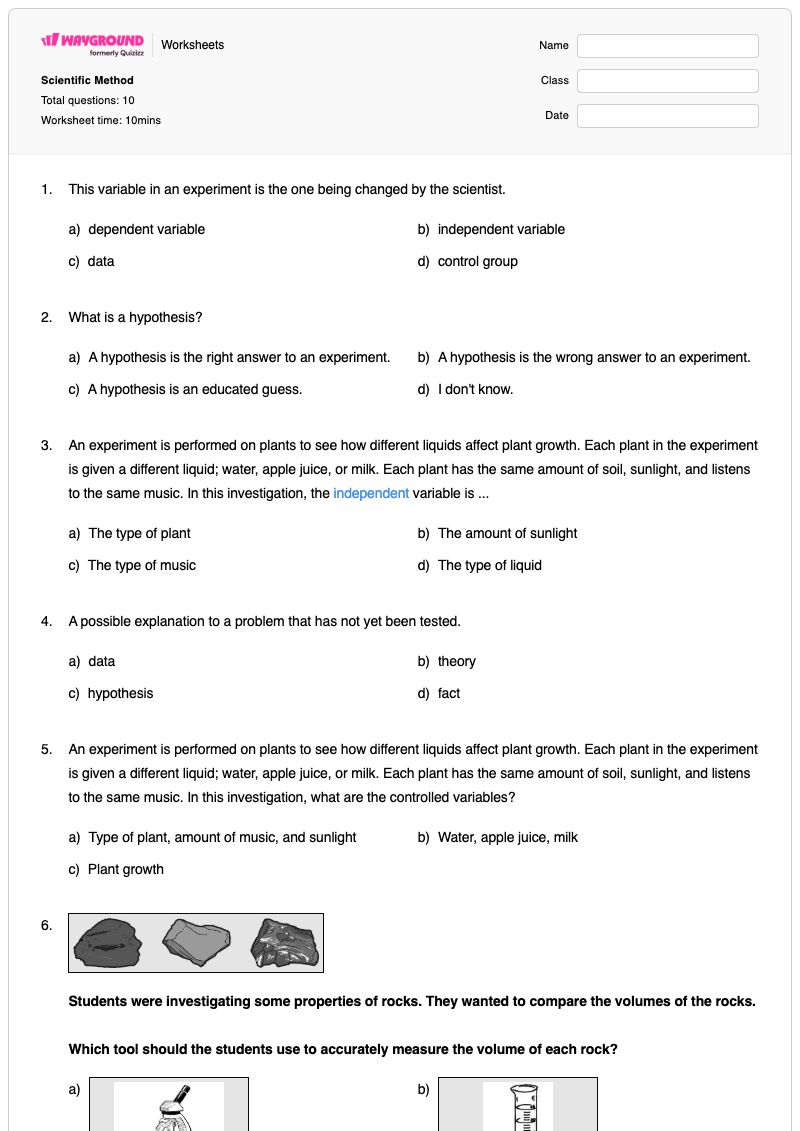
Students were investigating some properties of rocks. They wanted to compare the volumes of the rocks.
Which tool should the students use to accurately measure the volume of each rock?
a)
b)
c)
d)
7.
Which measurement system do we like to use in science?
a)
Metric
b)
SAE
c)
Inches
d)
eye ball it
8.
The scientific method is
a)
Confusing
b)
Too long
c)
An organized way of finding answers
d)
Something only Science teachers use
9.
What is a Hypothesis?
a)
A best guess after research
b)
A bad movie
c)
Your results after an experiment
d)
An untested theory
10.
The Scientific Method is an organized way to solve a problem or answer a question.
a)
True
b)
False
c)
Squirrel!
Answer Key
Scientific Method
Total questions: 10
1.
b) independent variable
2.
c) A hypothesis is an educated guess.
3.
d) The type of liquid
4.
c) hypothesis
5.
a) Type of plant, amount of music, and sunlight
6.
b)
7.
a)
Metric
8.
c)
An organized way of finding answers
9.
a)
A best guess after research
, d)
An untested theory
10.
a)
True
140 %
Browse by subjects
Browse by grades
Browse by format
FAQs
What does this Scientific Method worksheet cover?
This Grade 6–8 science worksheet uses 9 multiple-choice questions and 1 multiple-select question to assess scientific method vocabulary and experimental design. Students identify independent and controlled variables in a plant-growth investigation, recognize a hypothesis as an educated or untested explanation, identify the metric system, select a tool for measuring rock volume, and explain the scientific method as an organized way to answer questions.
How can I use this worksheet to teach independent variables, controlled variables, and hypotheses?
Introduce the plant-growth scenario before assigning the worksheet, and ask students what changes between plants and what remains the same. Have them justify why the type of liquid is the independent variable and why conditions such as soil, sunlight, and music are controlled variables. Then use the hypothesis items to discuss why a proposed explanation must be formed before testing rather than treated as a proven result.
What mistakes should I watch for when students complete this Scientific Method worksheet?
Students may confuse the independent variable with a controlled variable by selecting a condition kept the same instead of the type of liquid that changes. They may also treat a hypothesis as a correct answer or an experiment result rather than an educated, untested explanation. On the multiple-select item, check that students select both applicable descriptions instead of choosing only one.
How do I assign and grade this Scientific Method worksheet?
The worksheet is available as a printable PDF and as a digital quiz on Wayground, with a complete answer key for all 10 items. You can grade printable submissions by scanning student work with the Wayground for Teachers app. The printable format also gives schools an option for reducing screen time while students review variables, hypotheses, measurement, and the scientific method.
How can I differentiate this Scientific Method worksheet for my students?
In the worksheet’s Advanced Settings, adjust font spacing and font size to make the scientific method definitions and plant-investigation scenarios easier to read. You can also enable a dyslexia-friendly font or translate the worksheet into another language when those options better support access to the vocabulary-heavy multiple-choice and multiple-select items.
Where can I find more worksheets like this on Wayground?
Wayground offers a comprehensive collection of free printable worksheets and practice problems across all subjects. Teachers can browse downloadable PDFs with answer keys at https://wayground.com/en-us/worksheets to find additional practice for essential skills and concepts.

 Worksheets


