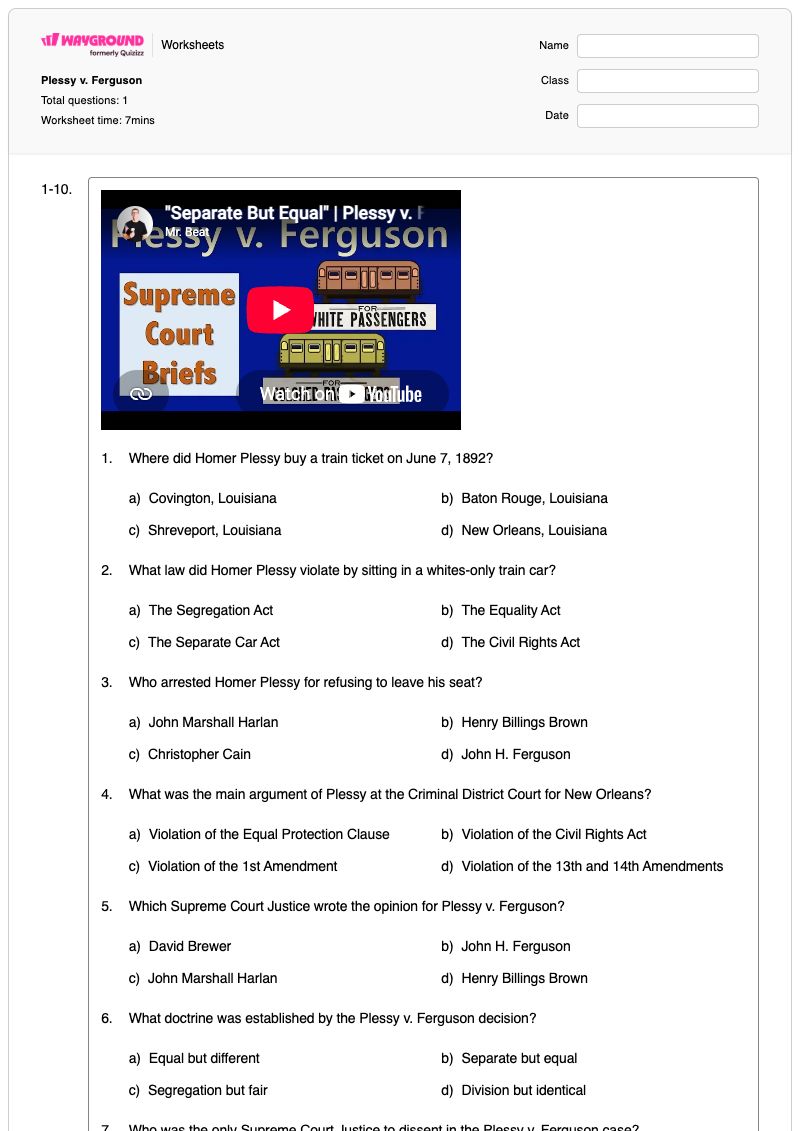
Plessy v. Ferguson is a free printable Grade 7 Social Studies worksheet that helps students review the people, events, legal arguments, and lasting impact connected to this landmark Supreme Court case. It includes 11 questions: one comprehension item and ten multiple-choice questions covering Homer Plessy’s arrest, the Separate Car Act, the arguments involving the 13th and 14th Amendments, the Court’s “separate but equal” doctrine, John Marshall Harlan’s dissent, and the later decision in Brown v. Board of Education.
Students use recall and comprehension skills to connect key figures, court decisions, constitutional arguments, and historical consequences. The focused question set supports instruction or review of how Plessy v. Ferguson was established, challenged, and later overturned. This worksheet is designed for Grade 7 learners and includes a complete answer key for efficient checking and discussion.
Worksheet settings
Font size
S
M
L
XL
Worksheets
Plessy v. Ferguson
Total questions: 1
Name
Class
Date
1-10.
1.
Where did Homer Plessy buy a train ticket on June 7, 1892?
a)
Covington, Louisiana
b)
Baton Rouge, Louisiana
c)
Shreveport, Louisiana
d)
New Orleans, Louisiana
2.
What law did Homer Plessy violate by sitting in a whites-only train car?
a)
The Segregation Act
b)
The Equality Act
c)
The Separate Car Act
d)
The Civil Rights Act
3.
Who arrested Homer Plessy for refusing to leave his seat?
a)
John Marshall Harlan
b)
Henry Billings Brown
c)
Christopher Cain
d)
John H. Ferguson
4.
What was the main argument of Plessy at the Criminal District Court for New Orleans?
a)
Violation of the Equal Protection Clause
b)
Violation of the Civil Rights Act
c)
Violation of the 1st Amendment
d)
Violation of the 13th and 14th Amendments
5.
Which Supreme Court Justice wrote the opinion for Plessy v. Ferguson?
a)
David Brewer
b)
John H. Ferguson
c)
John Marshall Harlan
d)
Henry Billings Brown
6.
What doctrine was established by the Plessy v. Ferguson decision?
a)
Equal but different
b)
Separate but equal
c)
Segregation but fair
d)
Division but identical
7.
Who was the only Supreme Court Justice to dissent in the Plessy v. Ferguson case?
a)
Henry Billings Brown
b)
John H. Ferguson
c)
David Brewer
d)
John Marshall Harlan
8.
What did John Marshall Harlan predict about the Plessy v. Ferguson decision?
a)
It would be overturned in a few years
b)
It would be celebrated
c)
It would be upheld forever
d)
It would be seen as one of the worst decisions
9.
Which case overturned Plessy v. Ferguson?
a)
Roe v. Wade
b)
Miranda v. Arizona
c)
Marbury v. Madison
d)
Brown v. Board of Education
10.
What is the mission of the Plessy and Ferguson Foundation for Education and Reconciliation?
a)
To promote racial segregation
b)
To teach the history of Plessy v. Ferguson
c)
To advocate for the Separate Car Act
d)
To support the Supreme Court's decisions
Answer Key
Plessy v. Ferguson
Total questions: 1
1-10.
1.
d)
New Orleans, Louisiana
2.
c)
The Separate Car Act
3.
c)
Christopher Cain
4.
d)
Violation of the 13th and 14th Amendments
5.
d)
Henry Billings Brown
6.
b)
Separate but equal
7.
d)
John Marshall Harlan
8.
d)
It would be seen as one of the worst decisions
9.
d)
Brown v. Board of Education
10.
b)
To teach the history of Plessy v. Ferguson
140 %
Browse by subjects
Browse by grades
Browse by format
FAQs
What does the Plessy v. Ferguson worksheet cover?
This Grade 7 Social Studies worksheet uses one comprehension question and ten multiple-choice questions to review the central events and legal significance of Plessy v. Ferguson. Students identify details about Homer Plessy’s arrest, the Separate Car Act, the 13th and 14th Amendments, the “separate but equal” doctrine, John Marshall Harlan’s dissent, and Brown v. Board of Education.
How can I use this worksheet to teach Plessy v. Ferguson?
Introduce the case by having students identify the people, law, and location involved in Homer Plessy’s arrest, then use the multiple-choice items to build toward the Supreme Court’s ruling and its “separate but equal” doctrine. After students complete the comprehension and recall questions, discuss why Harlan’s dissent and Brown v. Board of Education are important to understanding the case’s later impact.
What mistakes should I watch for when students complete this worksheet?
Students may confuse New Orleans with another Louisiana location, the Separate Car Act with a different civil rights law, or Christopher Cain with one of the judges or justices named in the questions. Watch for confusion between Henry Billings Brown, who wrote the majority opinion, and John Marshall Harlan, who dissented, as well as between the Plessy ruling and Brown v. Board of Education, which overturned it.
How do I assign and grade this Plessy v. Ferguson worksheet?
On Wayground, you can assign the worksheet as a printable PDF or as a digital quiz, and it includes a complete answer key for grading the comprehension and multiple-choice responses. Printable submissions can also be graded by scanning student work with the Wayground for Teachers app. The PDF option can support schools that are reducing screen time.
How can I differentiate this Plessy v. Ferguson worksheet for my students?
Use the worksheet’s Advanced Settings to adjust font spacing and font size so the comprehension and multiple-choice items are easier to read. You can also select a dyslexia-friendly font or translate the worksheet into another language when that better supports students working with the historical and legal vocabulary.
Where can I find more worksheets like this on Wayground?
Wayground offers a broad collection of free printable worksheets and practice problems across subjects, with downloadable PDFs and answer keys to help students build essential skills and concepts. Browse more resources at https://wayground.com/en-us/worksheets.


 Worksheets