

Wayground
"Those Winter Sundays" by Robert Hayden - Printable ELA Worksheets year 10 - Wayground

"Those Winter Sundays" by Robert Hayden

Alesha Cary

Created by Alesha Cary

23 questions

10th Grade

ELA

Updated Aug 2026

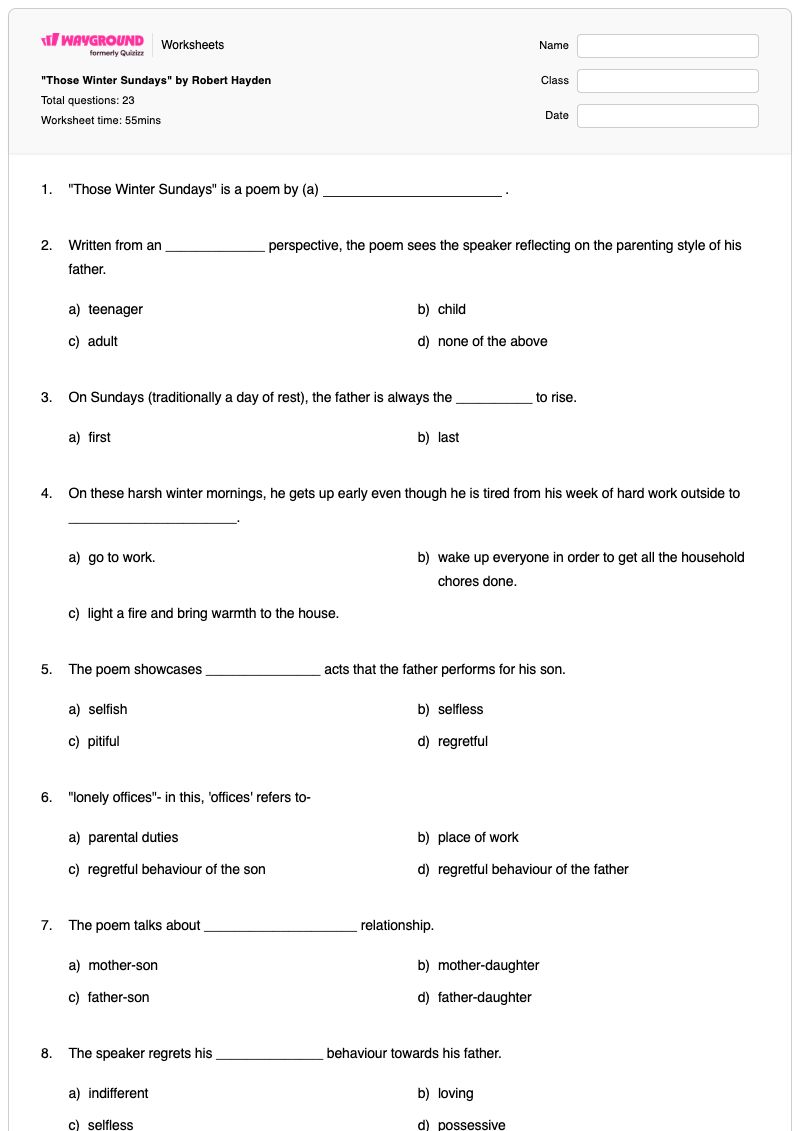
This free printable Grade 10 English worksheet explores Robert Hayden’s “Those Winter Sundays” through 23 questions: one fill-in-the-blank item, 20 multiple-choice questions, and two multiple-select questions. Students identify the poem’s speaker and father-son relationship, interpret phrases such as “blueblack cold” and “lonely offices,” and examine the father’s selfless acts, physical labor, and parental duties. The questions build close-reading skills by asking students to infer the poem’s adult perspective, apprehensive and regretful tones, themes of love and belated gratitude, and the speaker’s changed understanding of his father’s sacrifices. Students must distinguish directly supported statements from unsupported interpretations and use contextual clues to interpret figurative or descriptive language. The worksheet is suitable for Grade 10 literature practice, comprehension checks, independent work, or assessment, and includes a complete answer key for efficient review.

Worksheet settings

Font size

S
M
L
XL
WaygroundWorksheets

"Those Winter Sundays" by Robert Hayden

Total questions: 23

Name
Class
Date
1.

"Those Winter Sundays" is a poem by (a)   .

2.

Written from an _____________ perspective, the poem sees the speaker reflecting on the parenting style of his father.

a)

teenager

b)

child

c)

adult

d)

none of the above

3.

On Sundays (traditionally a day of rest), the father is always the __________ to rise.

a)

first

b)

last

4.

On these harsh winter mornings, he gets up early even though he is tired from his week of hard work outside to ______________________.

a)

go to work.

b)

wake up everyone in order to get all the household chores done.

c)

light a fire and bring warmth to the house.

5.

The poem showcases _______________ acts that the father performs for his son.

a)

selfish

b)

selfless

c)

pitiful

d)

regretful

6.

"lonely offices"- in this, 'offices' refers to-

a)

parental duties

b)

place of work

c)

regretful behaviour of the son

d)

regretful behaviour of the father

7.

The poem talks about ____________________ relationship.

a)

mother-son

b)

mother-daughter

c)

father-son

d)

father-daughter

8.

The speaker regrets his ______________ behaviour towards his father.

a)

indifferent

b)

loving

c)

selfless

d)

possessive

9.

"blueblack cold" is trying to convey that-

a)

his skin was blue in colour.

b)

it was extremely cold.

c)

his father used to beat him up.

d)

the sky is blueblack in colour.

10.
In line 5, the sentence " No one ever thanked him", suggests the poem explores the theme of
a)
uninformed judgement
b)
domestic problems
c)
suppressed excitement
d)
belated gratitude
11.

Of the following words, which is the best choice for the poem's tone?

a)

carefree

b)

optimistic

c)

self righteous

d)

regretful

12.

I'd wake and hear the cold splintering, breaking.

When the rooms were warm, he'd call

and slowly I would rise and dress

fearing the chronic angers of that house

What is the tone of the lines?

a)

Happy

b)

Warm

c)

Apprehensive

d)

Angry

13.

Which of the following would be MOST LIKELY to be PART of the theme of this poem?

a)

Friendship

b)

Love and regret

c)

Death

d)

Architecture

14.

Based upon what you can infer from the poem, what was the father’s occupation?

a)

Business Professional

b)

Medical Doctor

c)

Physical Laborer

d)

Prisoner in Jail

15.

Choose the correct statement. (Only one of these is directly supported by the poem.)

a)

The weather was quite warm outside the house.

b)

There were many children in the family.

c)

The poet acknowledged the sacrifices of his father when he, himself , grew up.

d)

The poem was given as a birthday gift to the poet's father.

16.

What was the poet’s attitude towards his father in his childhood?

a)

Thankfulness

b)

Indifference

c)

Fearfulness

d)

Sympathy

17.

What does the line ‘chronic angers of the house’ suggest?

a)

The house was on fire.

b)

No one ever got angry with anyone else.

c)

Occasionally, the family members got angry at each other, but they worked it out.

d)

The people in the house fought constantly.

18.

How does the father show his love?

a)

In an extravagant manner

b)

In a simple way, mostly through little actions

19.

Which pairs of words describe the sounds of the fire?

a)

blanked/blaze

b)

splintering/breaking

c)

blueblack/cold

d)

Sundays/shoes

e)

austere/lonely

20.

The phrase "lonely offices," as it is used in line 14, means

a)

unappreciated duties

b)

dreaded chores

c)

silent rooms

d)

empty hearts

e)

unloved parent

21.

The poet's diction in the last two lines of the poem identifies the father as one who

a)

was cruel and detached

b)

performs his responsibilities with love

c)

is unaware of the pain he is causing

d)

looks toward future rewards

e)

is frivolous and elusive

22.

When you consider the poem as a whole, an idea that emerges is

a)

understanding where there was indifference

b)

fear where there was love

c)

resentment where there was embracing

d)

pity where there was appreciation

e)

contempt where there was respect

23.

The diction in the closing two lines of the poem suggests that the speaker

a)

knows his mother was unhappy

b)

realizes that he was right to resent his father

c)

has a belated feeling of acknowledging his father's love

d)

resents everything his father did for him when the speaker was a child

e)

was aware of his father's feelings toward him

WaygroundAnswer Key

"Those Winter Sundays" by Robert Hayden

Total questions: 23

1.
Robert Hayden, robert hayden
2.
c)

adult

3.
a)

first

4.
c)

light a fire and bring warmth to the house.

5.
b)

selfless

6.
a)

parental duties

7.
c)

father-son

8.
a)

indifferent

9.
b)

it was extremely cold.

10.
d) belated gratitude
11.
d)

regretful

12.
c)

Apprehensive

13.
b)

Love and regret

14.
c)

Physical Laborer

15.
c)

The poet acknowledged the sacrifices of his father when he, himself , grew up.

16.
b)

Indifference

17.
d)

The people in the house fought constantly.

18.
b)

In a simple way, mostly through little actions

19.
a)

blanked/blaze

20.
a)

unappreciated duties

21.
b)

performs his responsibilities with love

22.
a)

understanding where there was indifference

23.
c)

has a belated feeling of acknowledging his father's love

FAQs

What does this “Those Winter Sundays” worksheet help students analyze?

This Grade 10 worksheet uses 23 fill-in-the-blank, multiple-choice, and multiple-select questions to guide students through Robert Hayden’s “Those Winter Sundays.” Students analyze the adult speaker’s reflection on his father, infer the meaning of imagery such as “blueblack cold,” and identify the poem’s regretful tone, father-son relationship, and themes of love and belated gratitude.

How can I use this worksheet to teach “Those Winter Sundays”?

Introduce the poem by asking students what details reveal the father’s routine and sacrifices before assigning the questions. As students work through the items, have them return to phrases such as “lonely offices” and “No one ever thanked him” to explain how the poem develops parental duty, regret, and belated gratitude. Use the multiple-select occupation question and the directly supported statement question as evidence-based discussion prompts.

What mistakes should I watch for when students complete this “Those Winter Sundays” worksheet?

Students may read “blueblack cold” literally instead of recognizing it as an image of extreme cold, or interpret “offices” as a workplace rather than parental duties. They may also confuse the speaker’s childhood apprehension with the poem’s overall regretful tone, or select details that are plausible but not directly supported by the poem. Check that students distinguish the father’s physical labor and selfless actions from the speaker’s earlier indifferent response.

How do I assign and grade this “Those Winter Sundays” worksheet?

You can assign it as a printable PDF or as a digital quiz on Wayground, using the 23 questions to check students’ understanding of perspective, imagery, tone, theme, and textual evidence. The worksheet includes a complete answer key, and printable submissions can be graded by scanning student work with the Wayground for Teachers app.

How does this worksheet build literary analysis skills beyond basic comprehension?

The questions move students from identifying details in “Those Winter Sundays” to making supported inferences about the father’s occupation, the speaker’s apprehension, and the poem’s regretful adult perspective. Items on “lonely offices,” “blueblack cold,” and “No one ever thanked him” require students to connect word choice and scene details to broader themes of love, sacrifice, and belated gratitude.

Where can I find more worksheets like this on Wayground?

Wayground offers a broad collection of free printable worksheets and practice problems across subjects, with downloadable PDFs and answer keys to support mastery of essential skills and concepts. Browse more resources at https://wayground.com/en-us/worksheets.