

Wayground
Citizenship - Printable Social Studies Worksheets year 8 - Wayground

Citizenship

20 questions

8th - 8th Grade

Social Studies

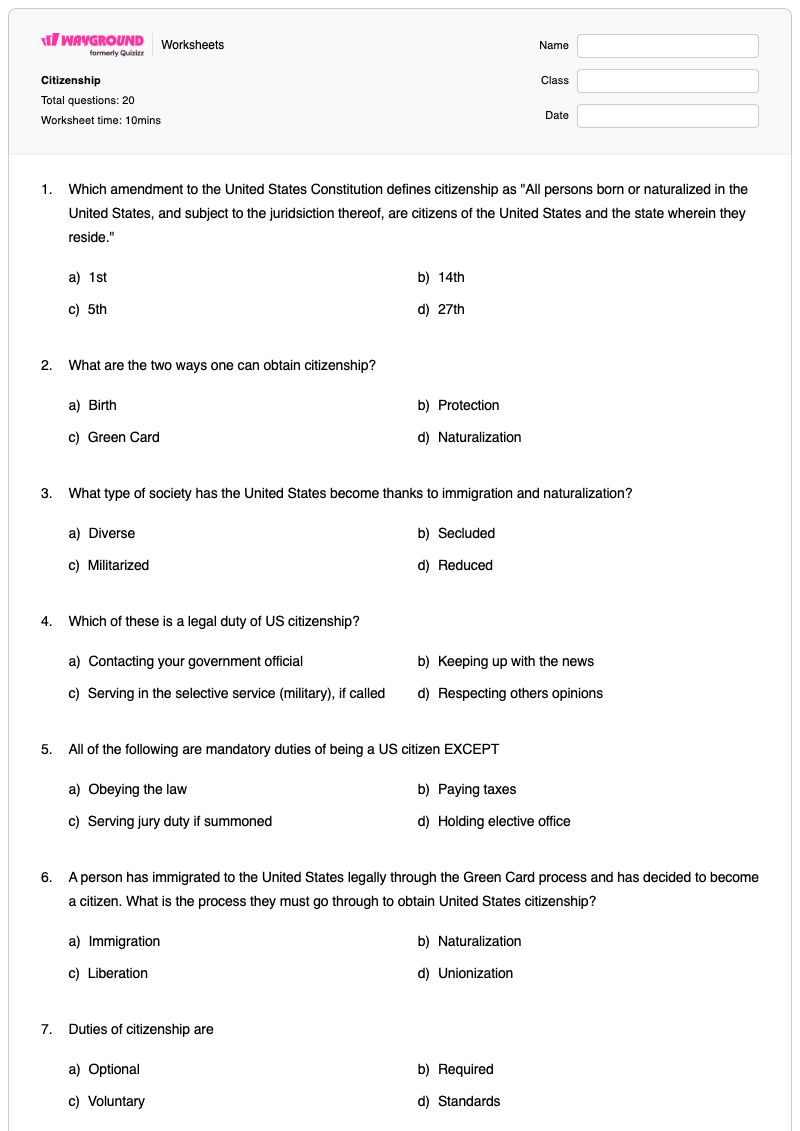
This free printable Grade 8 Social Studies worksheet builds understanding of U.S. citizenship through 20 questions: 19 multiple-choice items and 1 multiple-select item. Students identify the 14th Amendment’s citizenship provision, distinguish birth from naturalization as pathways to citizenship, and classify legal duties, civic responsibilities, and community-service actions. They also connect citizenship to the Bill of Rights and identify First Amendment protections, including press, speech, religion, assembly, and petition. The worksheet uses scenario-based and definition-based questions to help students distinguish required duties from voluntary responsibilities and recognize possible legal consequences for failing to fulfill civic duties. It is suitable for civics instruction, review, independent practice, or formative assessment in Grade 8. A complete answer key is included to support efficient checking and discussion of questions such as naturalization after obtaining a Green Card and the difference between due process and First Amendment rights.

Worksheet settings

Font size

S
M
L
XL
Worksheets

Citizenship

Total questions: 20

Name
Class
Date
1.

Which amendment to the United States Constitution defines citizenship as "All persons born or naturalized in the United States, and subject to the juridsiction thereof, are citizens of the United States and the state wherein they reside."

a)

1st

b)

14th

c)

5th

d)

27th

2.

What are the two ways one can obtain citizenship?

a)

Birth

b)

Protection

c)

Green Card

d)

Naturalization

3.

What type of society has the United States become thanks to immigration and naturalization?

a)

Diverse

b)

Secluded

c)

Militarized

d)

Reduced

4.

Which of these is a legal duty of US citizenship?

a)

Contacting your government official

b)

Keeping up with the news

c)

Serving in the selective service (military), if called

d)

Respecting others opinions

5.

All of the following are mandatory duties of being a US citizen EXCEPT

a)

Obeying the law

b)

Paying taxes

c)

Serving jury duty if summoned

d)

Holding elective office

6.

A person has immigrated to the United States legally through the Green Card process and has decided to become a citizen. What is the process they must go through to obtain United States citizenship?

a)

Immigration

b)

Naturalization

c)

Liberation

d)

Unionization

7.

Duties of citizenship are

a)

Optional

b)

Required

c)

Voluntary

d)

Standards

8.

Citizens will face these if they do not fulfil their civic duties?

a)

Legal Consequences

b)

A warning

c)

Small Punishment

d)

A monetary fine

9.

All of the following are responsibilities of citizenship EXCEPT

a)

Register and vote

b)

Participate in political campaigns

c)

Serve in voluntary, appointed government positions

d)

Obeying the law

10.

Civics responsibilities are

a)

Required

b)

Forced

c)

Voluntary

d)

Mandatory

11.

A way to participate in community service is

a)

Volunteer at a food bank

b)

Make your payments on time

c)

Talk a walk outside

d)

Go to school

12.

Which of the following actions IS NOT a characteristic of a good citizen?

a)

Attending a Veterans Day parade to honor servicemembers

b)

Letting your cell phone constantly ring on loud at the movies

c)

Organizing a blood donation drive

d)

Driving slow in a school zone

13.

The first ten amendments to the Constitution are considered

a)

The Bill of Rights

b)

Declaration of Independence

c)

Preamble

d)

Statement

14.

Which of the following is NOT a right protected by the 1st amendment?

a)

Speech

b)

Religion

c)

Assembly

d)

Due Process

e)

Petition

15.

The media is able to put out new stories that are both positive and negative about our government officials. This is because of the First Amendment right to

a)

Press

b)

Religion

c)

Speech

d)

Petition

16.

There are 6 requirements to become a citizen through the naturalization process. Which is NOT one?

a)

At least 18 years old

b)

A legal resident of the US for 3-5 years

c)

Be of good moral characted

d)

Be employed by an American corporation

e)

Pass a naturalization test (read, write, and speak English, and pass the Civics test)

17.

What duty of citizenship ensures every person has the right to a fair trial?

a)

Paying federal tax

b)

Serving in the military

c)

Serving on a jury

d)

Becoming a judge

18.

Ms. Slaybaugh was born in Virginia, USA. When she was 18, she went to college in Germany and lived there for 7 years. That makes her a German citizen.

a)

True

b)

False

19.

Which of the following is NOT an example of effectively participating in civic life:

a)

Asking questions about a law

b)

Researching who I want to vote for before going to the polls

c)

Expressing my opinion about a political issue

d)

Unfriending someone because we have different political views

20.

Ms. Slaybaugh is at the grocery store and the check-out line has a long wait. She see's a friend who invites her to cut. Ms. Slaybaugh kindly declines and waits her turn. Which personal trait of a good citizen is she displaying?

a)

Respect

b)

Self-reliance

c)

Trustworthiness

d)

Patriotism

Answer Key

Citizenship

Total questions: 20

1.
b)

14th

2.
a)

Birth

, d)

Naturalization

3.
a)

Diverse

4.
c)

Serving in the selective service (military), if called

5.
d)

Holding elective office

6.
b)

Naturalization

7.
b)

Required

8.
a)

Legal Consequences

9.
d)

Obeying the law

10.
c)

Voluntary

11.
a)

Volunteer at a food bank

12.
b)

Letting your cell phone constantly ring on loud at the movies

13.
a)

The Bill of Rights

14.
d)

Due Process

15.
a)

Press

16.
d)

Be employed by an American corporation

17.
c)

Serving on a jury

18.
b)

False

19.
d)

Unfriending someone because we have different political views

20.
a)

Respect

FAQs

What does this citizenship worksheet cover?

This Grade 8 worksheet uses 19 multiple-choice questions and 1 multiple-select question to assess U.S. citizenship concepts, including the 14th Amendment, birth and naturalization, legal duties, civic responsibilities, and community service. Students also identify the Bill of Rights and match First Amendment protections such as press, speech, religion, assembly, and petition to specific examples.

How can I use this worksheet to teach U.S. citizenship and civic duties?

Introduce the worksheet by reviewing the distinction between how citizenship is obtained, what duties are required, and what responsibilities are voluntary. As students work through the questions, pause to discuss why serving in the selective service if called, obeying the law, and paying taxes are treated differently from voting, campaigning, and community service. Use the First Amendment items to have students explain which protected right supports press coverage or freedom of speech.

What mistakes should I watch for when students complete this citizenship worksheet?

Students may confuse the 14th Amendment with the Bill of Rights or select due process as a First Amendment right, even though the worksheet separates those concepts. They may also mistake immigration or obtaining a Green Card for naturalization, or treat voluntary civic responsibilities as mandatory duties. Watch for errors on the multiple-select item, where students must choose both birth and naturalization rather than only one pathway.

How do I assign and grade this citizenship worksheet?

The citizenship worksheet is available as a printable PDF and as a digital quiz on Wayground, with a complete answer key for all 20 questions. You can grade printable submissions by scanning student work with the Wayground for Teachers app, or review responses through the digital quiz.

How can I differentiate this citizenship worksheet for my students?

Use the worksheet’s Advanced Settings to adjust font spacing and font size so the citizenship questions and answer choices are easier to scan. You can also enable a dyslexia-friendly font or translate the worksheet into another language when helpful for students working with civics vocabulary. These options can support access to items about naturalization, civic duties, and First Amendment rights without changing the questions.

Where can I find more worksheets like this on Wayground?

Wayground offers a comprehensive collection of free printable worksheets and practice problems across subjects, with downloadable PDFs and answer keys to help students master essential skills and concepts. Browse more resources at https://wayground.com/en-us/worksheets.