Potential and Kinetic Energy Review is a free printable science worksheet for students in Grades 5–8. It contains 12 questions—10 multiple-choice items and 2 fill-in-the-blank items—that review how potential energy relates to an object’s height and mass, how kinetic energy relates to speed and mass, and how motion distinguishes kinetic energy from stored potential energy. Students also identify the joule as the unit used to measure both forms of energy and compare energy values in different situations.
The final items ask students to interpret kinetic energy and potential energy values to identify the correct car label, applying the concepts rather than recalling definitions alone. This worksheet supports review, independent practice, or a quick formative assessment after instruction on energy. It includes a complete answer key, making it easy for teachers to check understanding of key energy relationships and vocabulary.
Worksheet settings
Font size
S
M
L
XL
Worksheets
Potential and Kinetic Energy Review
Total questions: 12
Name
Class
Date
1.
When you do work you are exerting
a)
Pull
b)
Push
c)
Power
d)
Energy
2.
The energy stored in an object is called
a)
Potential
b)
Joule
c)
Transformed
d)
Kinetic
3.
The unit of measure for potential and kinetic energy is the
a)
Watt
b)
Joule
c)
Meter
d)
Newton
4.
Distance (height) and mass determine the amount of ___________ energy in an object.
a)
Kinetic
b)
Solar
c)
Potential
d)
Thermal
5.
An object falling from 75 m will have __________ potential energy than an object falling from 25 m.
a)
Less
b)
Greater
c)
Lower
d)
Equal
6.
If you have 2 objects with different masses about to fall from the same height, which one will have the greatest potential energy?
a)
Smallest
b)
Largest
c)
Flattest
d)
Roundest
7.
The amount of kinetic energy in an object is determined by its
a)
Speed and Mass
b)
Height and Velocity
c)
Speed and Velocity
d)
Height and Mass
8.
This type of energy is caused by motion.
a)
Potential
b)
Solar
c)
Electrical
d)
Kinetic
9.
The faster an object moves the greater its ___________ energy.
a)
Thermal
b)
Kinetic
c)
Solar
d)
Chemical
10.
An objects potential energy will increase with
a)
Speed and mass
b)
Height and velocity
c)
Height and mass
d)
Speed and velocity
11.
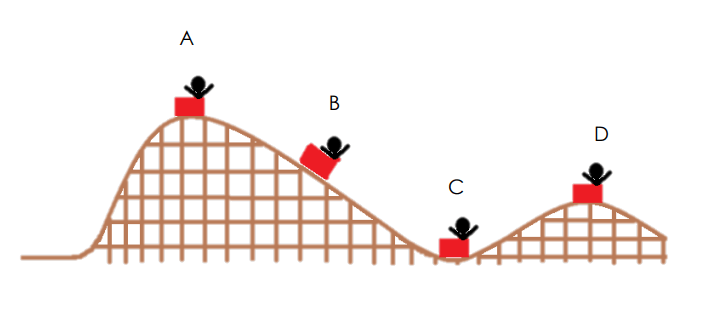
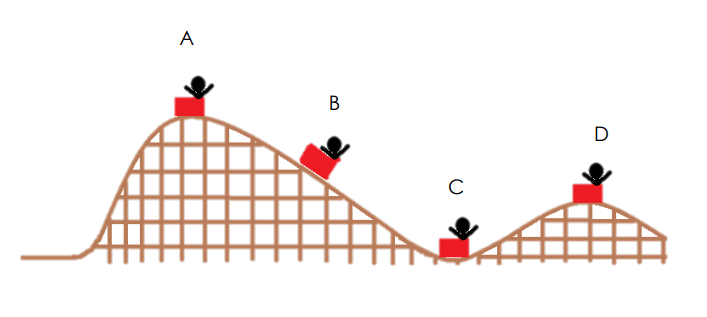
Which car has KE = 100 PE = 0
(a)
12.
Which car has KE = 0 PE =100?
(a)
Answer Key
Potential and Kinetic Energy Review
Total questions: 12
1.
d)
Energy
2.
a)
Potential
3.
b)
Joule
4.
c)
Potential
5.
b)
Greater
6.
b)
Largest
7.
a)
Speed and Mass
8.
d)
Kinetic
9.
b)
Kinetic
10.
c)
Height and mass
11.
C, c
12.
a, A
140 %
Browse by subjects
Browse by grades
Browse by format
FAQs
What does the Potential and Kinetic Energy Review worksheet cover?
This Grade 5–8 science worksheet reviews the differences between stored potential energy and motion-based kinetic energy. Its 10 multiple-choice questions ask students to connect potential energy to height and mass, kinetic energy to speed and mass, and both forms of energy to the joule; two fill-in-the-blank items require students to interpret KE and PE values and identify a car label.
How can I use this worksheet to teach potential and kinetic energy?
Introduce the worksheet by having students sort examples into stored energy and energy caused by motion, then discuss how height and mass affect potential energy and how speed and mass affect kinetic energy. Use the multiple-choice comparisons as guided practice, asking students to explain why the taller or heavier object has more potential energy and why the faster object has more kinetic energy before they complete the KE/PE car-label items independently.
What mistakes should I watch for when students complete this energy worksheet?
Students may confuse potential energy, which the worksheet associates with height and mass, with kinetic energy, which it associates with speed and mass. Watch for students selecting a unit such as watt, meter, or newton instead of joule, reversing the comparison between objects at different heights or masses, or choosing a car label without matching the given KE and PE values.
How do I assign and grade the Potential and Kinetic Energy Review worksheet?
You can assign this worksheet as a printable PDF or as a digital quiz on Wayground, and it includes a complete answer key for all 12 items. For printable submissions, scan student work with the Wayground for Teachers app to help grade responses efficiently.
How can I differentiate this potential and kinetic energy worksheet for my students?
Use the worksheet’s Advanced Settings to adjust font spacing or choose a larger font size so the multiple-choice options and KE/PE fill-in items are easier to read. You can also enable a dyslexia-friendly font or translate the worksheet into another language when those options better support access to the energy vocabulary and comparisons.
Where can I find more free worksheets like this on Wayground?
Wayground offers a comprehensive collection of free printable worksheets and practice problems across all subjects, with downloadable PDFs and answer keys to help students master essential skills and concepts. Browse more resources at https://wayground.com/en-us/worksheets.

 Worksheets