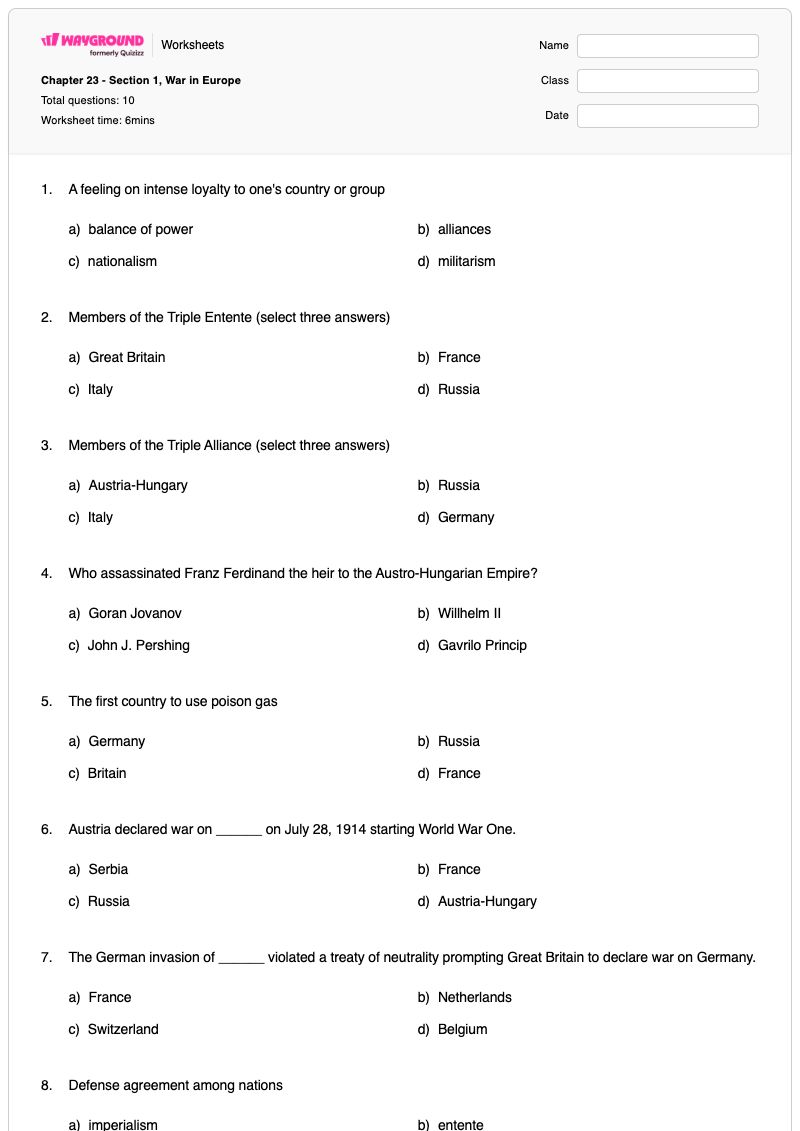
Chapter 23 - Section 1: War in Europe is a Grade 7 history worksheet that checks students’ understanding of the alliances, events, and technologies that shaped the beginning of World War I. Its 10 questions include 8 multiple-choice items and 2 multiple-select items covering nationalism, the Triple Entente, the Triple Alliance, the assassination of Franz Ferdinand, Austria’s declaration of war on Serbia, and Germany’s invasion of Belgium.
Students also distinguish the wartime roles of poison gas, airplanes, and U-boats while identifying the alliance system as a defense agreement among nations. The focused question set helps teachers assess whether students can recognize key people, countries, terms, and cause-and-effect connections in the opening of the war. This free printable worksheet includes a complete answer key for quick review, independent practice, or classroom assessment.
Worksheet settings
Font size
S
M
L
XL
Worksheets
Chapter 23 - Section 1, War in Europe
Total questions: 10
Name
Class
Date
1.
A feeling on intense loyalty to one's country or group
a)
balance of power
b)
alliances
c)
nationalism
d)
militarism
2.
Members of the Triple Entente (select three answers)
a)
Great Britain
b)
France
c)
Italy
d)
Russia
3.
Members of the Triple Alliance (select three answers)
a)
Austria-Hungary
b)
Russia
c)
Italy
d)
Germany
4.
Who assassinated Franz Ferdinand the heir to the Austro-Hungarian Empire?
a)
Goran Jovanov
b)
Willhelm II
c)
John J. Pershing
d)
Gavrilo Princip
5.
The first country to use poison gas
a)
Germany
b)
Russia
c)
Britain
d)
France
6.
Austria declared war on ______ on July 28, 1914 starting World War One.
a)
Serbia
b)
France
c)
Russia
d)
Austria-Hungary
7.
The German invasion of ______ violated a treaty of neutrality prompting Great Britain to declare war on Germany.
a)
France
b)
Netherlands
c)
Switzerland
d)
Belgium
8.
Defense agreement among nations
a)
imperialism
b)
entente
c)
alliance system
d)
sedition
9.
The most dramatic new weapon available in WWI added a new dimension to fighting
a)
airplane
b)
machine gun
c)
poison gas
d)
tank
10.
This new type of technology helped to prevent supplies, including food, from reaching Great Britain
a)
tanks
b)
airplanes
c)
poison gas
d)
U-boats
Answer Key
Chapter 23 - Section 1, War in Europe
Total questions: 10
1.
c)
nationalism
2.
a)
Great Britain
, b)
France
, d)
Russia
3.
a)
Austria-Hungary
, c)
Italy
, d)
Germany
4.
d)
Gavrilo Princip
5.
a)
Germany
6.
a)
Serbia
7.
d)
Belgium
8.
c)
alliance system
9.
a)
airplane
10.
d)
U-boats
140 %
Browse by subjects
Browse by grades
Browse by format
FAQs
What does this War in Europe worksheet cover?
This Grade 7 history worksheet uses 8 multiple-choice and 2 multiple-select questions to assess students’ understanding of the alliances, events, and technologies connected to the start of World War I. Students identify nationalism, members of the Triple Entente and Triple Alliance, Gavrilo Princip, Austria’s declaration of war on Serbia, Germany’s invasion of Belgium, and the roles of poison gas, airplanes, and U-boats.
How can I use this worksheet to teach the alliances and causes of World War I?
Introduce the alliance system by having students sort the countries into the Triple Entente and Triple Alliance before completing the questions. Then use the items about Franz Ferdinand, Serbia, Belgium, and wartime technology as prompts for a class discussion about how political agreements and specific events contributed to the wider conflict.
What mistakes should I watch for when students complete this worksheet?
Watch for students selecting Russia as a member of the Triple Alliance or Italy as a member of the Triple Entente; the two multiple-select questions require exactly three correct countries each. Students may also confuse Gavrilo Princip with other figures, identify France instead of Germany as the first user of poison gas, or mix up airplanes and U-boats when matching technologies to their effects.
How do I assign and grade this War in Europe worksheet?
Wayground provides this worksheet as both a printable PDF and a digital quiz, and it includes a complete answer key. You can grade digital responses through Wayground or scan printable student work with the Wayground for Teachers app.
How can I differentiate this World War I worksheet for my students?
Use the worksheet’s Advanced Settings to adjust font spacing or choose a larger font size so the multiple-choice and multiple-select options are easier to read. You can also apply a dyslexia-friendly font or translate the worksheet into another language when those changes support access to the history vocabulary and country names.
Where can I find more worksheets like this on Wayground?
Wayground offers a broad collection of free printable worksheets and practice problems across subjects, with downloadable PDFs and answer keys to support essential skills and concepts. Browse more resources at https://wayground.com/en-us/worksheets.


 Worksheets