

Wayground
How did early Europeans come to California? - Printable Math Worksheets 4th Grade - Wayground

How did early Europeans come to California?

Jenny Lane-Raya

Created by Jenny Lane-Raya

15 questions

4th Grade

Math

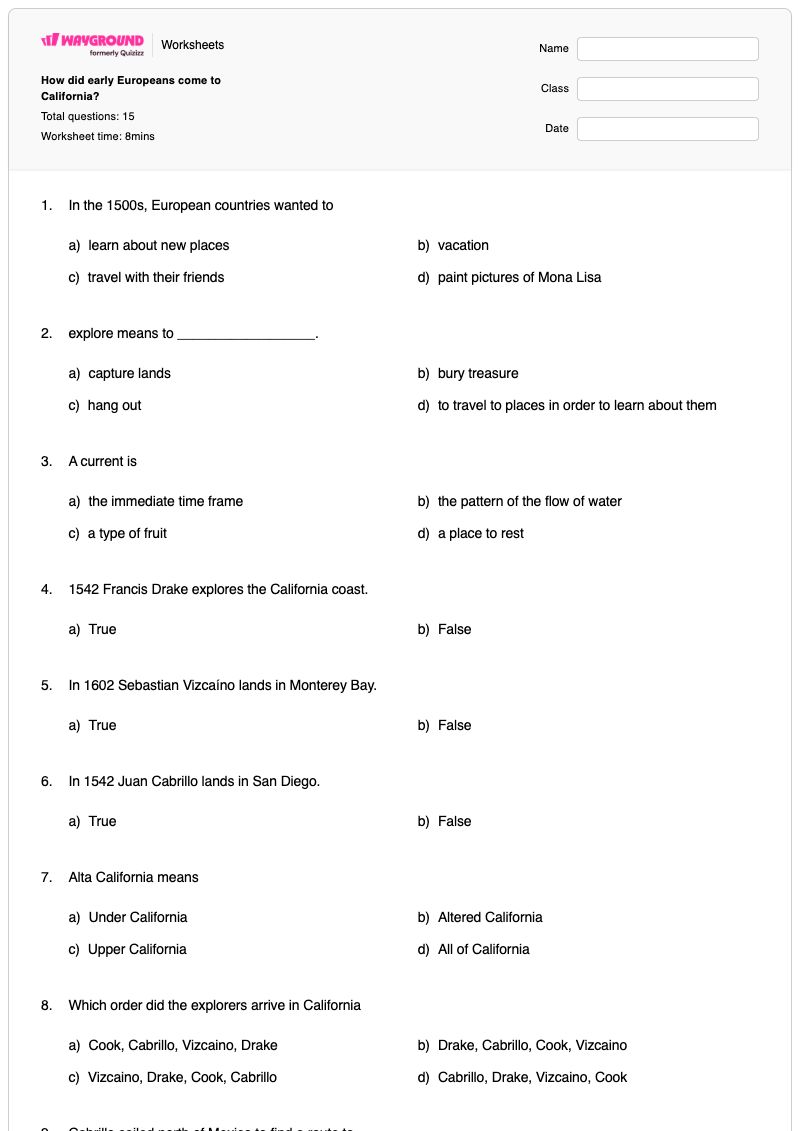
How Did Early Europeans Come to California? is a Grade 4 social studies worksheet that builds students’ understanding of early European exploration along the California coast. Students define key terms such as explore, current, and Alta California; identify why Europeans explored, where explorers traveled, and the challenges they faced; and connect explorers with locations, destinations, ships, and historical details. The 15-question set includes 12 multiple-choice questions and 3 multiple-select questions. Students distinguish accurate and inaccurate claims about Juan Cabrillo, Francis Drake, Sebastian Vizcaíno, and James Cook, arrange explorers in arrival order, and recall details such as New Albion’s older name and Cook’s ships Endeavour and Resolution. This free printable worksheet includes a complete answer key for classroom practice, review, or assessment.

Worksheet settings

Font size

S
M
L
XL
WaygroundWorksheets

How did early Europeans come to California?

Total questions: 15

Name
Class
Date
1.

In the 1500s, European countries wanted to

a)

learn about new places

b)

vacation

c)

travel with their friends

d)

paint pictures of Mona Lisa

2.

explore means to __________________.

a)

capture lands

b)

bury treasure

c)

hang out

d)

to travel to places in order to learn about them

3.

A current is

a)

the immediate time frame

b)

the pattern of the flow of water

c)

a type of fruit

d)

a place to rest

4.

1542 Francis Drake explores the California coast.

a)

True

b)

False

5.

In 1602 Sebastian Vizcaíno lands in Monterey Bay.

a)

True

b)

False

6.

In 1542 Juan Cabrillo lands in San Diego.

a)

True

b)

False

7.

Alta California means

a)

Under California

b)

Altered California

c)

Upper California

d)

All of California

8.

Which order did the explorers arrive in California

a)

Cook, Cabrillo, Vizcaino, Drake

b)

Drake, Cabrillo, Cook, Vizcaino

c)

Vizcaino, Drake, Cook, Cabrillo

d)

Cabrillo, Drake, Vizcaino, Cook

9.

Cabrillo sailed north of Mexico to find a route to ....

a)

Asia

b)

Africa

c)

Australia

d)

Russia

10.

Drake originally named the area near San Francisco Bay and named it New Albion.. this was an older name for the island of...

a)

Australia

b)

England

c)

Greenland

d)

Iceland

11.

California was not an easy place to explore. Sailors had to deal with ______, ________ and a _________.

a)

ocean currents

b)

strong winds

c)

rocky coastline

d)

dangerous sea creatures

12.

If explorers found themselves over the mountains in Southern California, they found themselves in ________.

a)

paradise

b)

a desert

c)

a tundra

d)

another beach

13.

James Cook in his early years was an apprentice to both a _________ and a _________.

a)

store owner

b)

map maker

c)

ship owner

d)

chef

14.

James Cook's travels led him to explore the.....

a)

East Coast of North America

b)

West Coast of North America

c)

South West of North America

d)

South East of North America

15.

Name James Cook's ships

a)

Endeavour

b)

Revelation

c)

Resolution

d)

Inspiration

WaygroundAnswer Key

How did early Europeans come to California?

Total questions: 15

1.
a)

learn about new places

2.
d)

to travel to places in order to learn about them

3.
b)

the pattern of the flow of water

4.
b)

False

5.
a)

True

6.
a)

True

7.
c)

Upper California

8.
d)

Cabrillo, Drake, Vizcaino, Cook

9.
a)

Asia

10.
b)

England

11.
c)

rocky coastline

, b)

strong winds

, a)

ocean currents

12.
b)

a desert

13.
c)

ship owner

, a)

store owner

14.
b)

West Coast of North America

15.
a)

Endeavour

, c)

Resolution

FAQs

What does this worksheet cover about early European exploration of California?

This Grade 4 social studies worksheet uses 12 multiple-choice and 3 multiple-select questions to examine why Europeans explored, what terms such as explore, current, and Alta California mean, and how explorers connected to California locations and events. Students also sequence Cabrillo, Drake, Vizcaíno, and Cook, identify exploration challenges, and recall James Cook’s West Coast travels and ships.

How can I use this worksheet to teach how early Europeans came to California?

Introduce the vocabulary and exploration goal first, then use a map and timeline to place San Diego, Monterey Bay, and the California coast in context. Before students complete the questions, have them predict the arrival order of Cabrillo, Drake, Vizcaíno, and Cook; afterward, discuss how ocean currents, strong winds, rocky coastline, and desert terrain affected exploration. Use the multiple-select items to prompt students to explain why more than one answer can be correct.

What mistakes should I watch for when students complete this California exploration worksheet?

Students may confuse the meanings of current and explore, or select a familiar-sounding definition instead of the one describing water flow or travel for learning. Watch for reversed explorer sequences and confusion between Cabrillo’s 1542 landing in San Diego and Vizcaíno’s 1602 landing in Monterey Bay. In the multiple-select questions, students may choose every plausible option rather than selecting all and only the documented challenges, Cook’s apprenticeships, or Cook’s ships.

How do I assign and grade this early California exploration worksheet?

Assign it as a printable PDF or as a digital quiz on Wayground, depending on whether students are working on paper or online. The worksheet includes a complete answer key, and printable submissions can be graded by scanning student work with the Wayground for Teachers app. The printable version can also support classrooms that are reducing screen time.

How can I differentiate this worksheet for my students?

Use the worksheet’s Advanced Settings to adjust font spacing and font size so the definitions, explorer timeline questions, and multiple-select options are easier to read. You can also enable a dyslexia-friendly font or translate the worksheet into another language, helping students access the historical vocabulary and California exploration details in a format that works for them.

Where can I find more worksheets like this on Wayground?

Wayground offers a comprehensive collection of free printable worksheets and practice problems across subjects, with downloadable PDFs and answer keys to help students master essential skills and concepts. Browse more resources at https://wayground.com/en-us/worksheets.