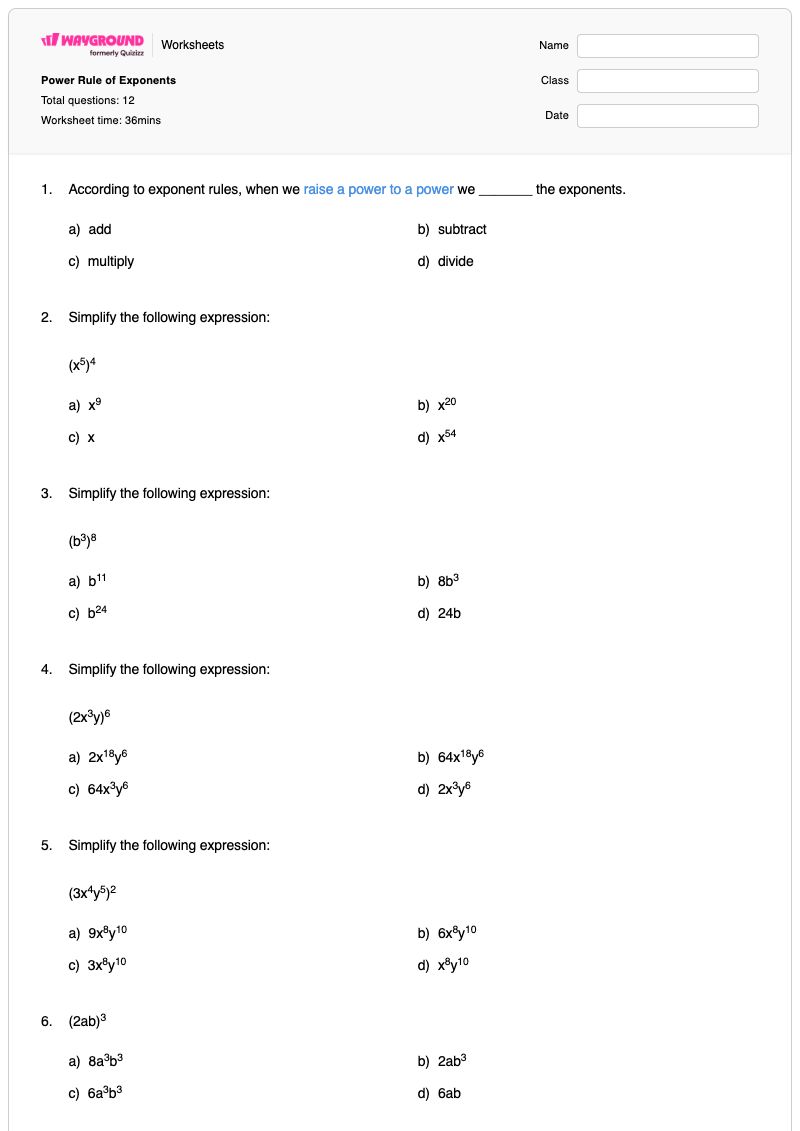
This Grade 7–8 mathematics worksheet gives students focused practice applying the power-of-a-power rule to numerical and algebraic expressions. Across 12 multiple-choice questions, students multiply exponents when a power is raised to another power, simplify powers of numbers and variables, and apply the outer exponent to coefficients and each factor in monomials such as (2x³y)⁶. The set also includes negative bases, helping students attend to signs and even exponents.
The questions require students to select equivalent simplified expressions, including expanded-factor reasoning such as recognizing that (2x)³ equals (2x)(2x)(2x). This free printable worksheet with an answer key is designed for Grade 7 and Grade 8 math instruction, independent practice, review, or a quick check of students’ ability to use exponent rules accurately in algebraic expressions.
Worksheet settings
Font size
S
M
L
XL
Worksheets
Power Rule of Exponents
Total questions: 12
Name
Class
Date
1.
According to exponent rules, when we raise a power to a power we _______ the exponents.
a)
add
b)
subtract
c)
multiply
d)
divide
2.
Simplify the following expression:
(x5)4
a)
x9
b)
x20
c)
x
d)
x54
3.
Simplify the following expression:
(b3)8
a)
b11
b)
8b3
c)
b24
d)
24b
4.
Simplify the following expression:
(2x3y)6
a)
2x18y6
b)
64x18y6
c)
64x3y6
d)
2x3y6
5.
Simplify the following expression:
(3x4y5)2
a)
9x8y10
b)
6x8y10
c)
3x8y10
d)
x8y10
6.
(2ab)3
a)
8a3b3
b)
2ab3
c)
6a3b3
d)
6ab
7.
Simplify the following expression:
(-2m)4
a)
16m4
b)
-8m4
c)
16m5
d)
-8m5
8.
Simplify the following expression:
(-2r3p2m)3
a)
-8r9p6m3
b)
-8r9p6m
c)
-6r6p5m4
d)
-6r9p6m3
9.
(52)3
a)
56
b)
55
c)
57
d)
58
10.
(2⁸)²
a)
2¹⁶
b)
2¹⁰
c)
2⁶
d)
2⁴
11.
Simplify the following expression:
(3x3y5)4
a)
3x12y20
b)
81x12y20
c)
12x12y20
d)
81x7y9
12.
Which of the following expressions is equivalent to (2x)3 ?
a)
(2x)(2x)(2x)
b)
2(x)(x)(x)
c)
2x + 2x + 2x
d)
2x⋅3
Answer Key
Power Rule of Exponents
Total questions: 12
1.
c) multiply
2.
b)
x20
3.
c)
b24
4.
b)
64x18y6
5.
a)
9x8y10
6.
a)
8a3b3
7.
a)
16m4
8.
a)
-8r9p6m3
9.
a) 56
10.
a) 2¹⁶
11.
b)
81x12y20
12.
a) (2x)(2x)(2x)
140 %
Browse by subjects
Browse by grades
Browse by format
FAQs
What does the Power Rule of Exponents worksheet cover?
This 12-question multiple-choice worksheet focuses on simplifying expressions when a power is raised to another power, including numerical powers, single variables, coefficients, and multivariable monomials. Students build accuracy by multiplying exponents, raising coefficients to the outer power, applying that power to every variable factor, and recognizing equivalent repeated multiplication such as (2x)³ = (2x)(2x)(2x).
How can I use this worksheet to teach the power rule of exponents?
Begin by modeling a simple item such as (x⁵)⁴ and have students identify the inner and outer exponents before multiplying them. Then work through a mixed expression such as (2x³y)⁶, prompting students to apply the outer exponent to 2, x³, and y separately; use the multiple-choice options to discuss why incomplete or incorrectly combined expressions are not equivalent. Finish with the negative-base examples so students can explain how an even outer exponent affects the sign.
What mistakes should I watch for on this power rule worksheet?
Students may add the exponents instead of multiplying them, as in choosing x⁹ for (x⁵)⁴, or apply the outer exponent only to the variables while leaving the coefficient unchanged. They may also forget to multiply each variable’s existing exponent, omit a factor in a multivariable expression, or mishandle the sign of expressions such as (-2m)⁴ and (-2r³p²m)³. The distractors are useful for identifying these specific errors.
How do I assign and grade this Power Rule of Exponents worksheet?
The worksheet is available as a printable PDF and as a digital quiz on Wayground, and it includes a complete answer key for the 12 multiple-choice questions. You can grade printable submissions by scanning student work with the Wayground for Teachers app, or review responses through the digital quiz. The printable option can also support instruction when a class is reducing screen time.
How can I differentiate this worksheet for my students?
In the worksheet’s Advanced Settings, adjust font spacing or choose a larger font size so the exponent notation and answer choices are easier to read. You can also apply a dyslexia-friendly font or translate the worksheet into another language while keeping the practice focused on simplifying powers such as (3x⁴y⁵)².
Where can I find more worksheets like this on Wayground?
Wayground offers a broad collection of free printable worksheets and practice problems across subjects, with downloadable PDFs and answer keys to help students master essential skills and concepts. Browse more resources at https://wayground.com/en-us/worksheets.


 Worksheets