The Power of Yet Pretest is a free printable Grade 6 Instructional Technology worksheet with 10 questions: 8 multiple-choice items and 2 multiple-select true-or-false items. It introduces and checks core growth-mindset ideas, including learning from mistakes and failures, applying effort, using “yet” to reframe “I can’t do it,” and recognizing that challenges exercise the brain. Students also identify the meanings of mindset and fixed and consider how failure can lead to success.
Use this pretest to gauge students’ existing understanding before a lesson or unit on growth mindset and the Power of Yet. The questions combine vocabulary recognition, application of a key phrase, interpretation of statements about effort and mistakes, and a question about an invention that was not accidental. A complete answer key is included, making the worksheet useful for quick baseline assessment, guided discussion, or independent review.
Worksheet settings
Font size
S
M
L
XL
Worksheets
The Power of Yet Pretest
Total questions: 10
Name
Class
Date
1.
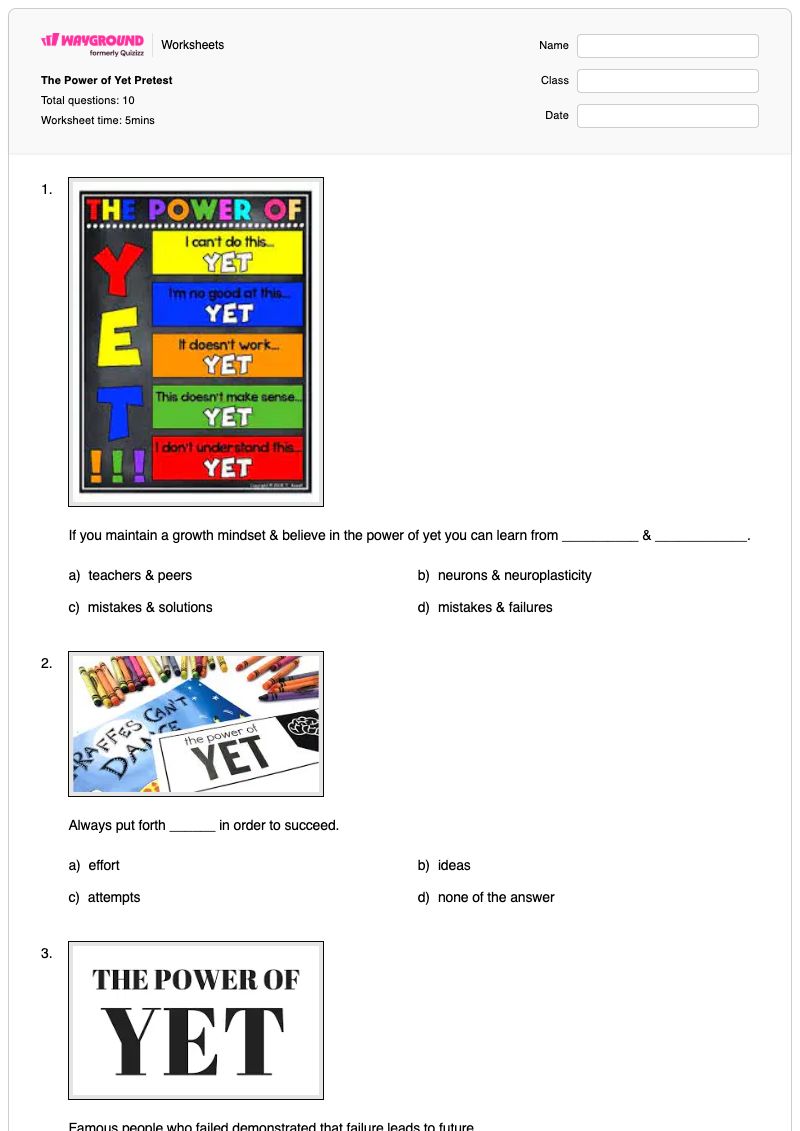
If you maintain a growth mindset & believe in the power of yet you can learn from __________ & ____________.
a)
teachers & peers
b)
neurons & neuroplasticity
c)
mistakes & solutions
d)
mistakes & failures
2.
Always put forth ______ in order to succeed.
a)
effort
b)
ideas
c)
attempts
d)
none of the answer
3.
Famous people who failed demonstrated that failure leads to future ___________.
a)
choices
b)
success
c)
jobs
d)
money
4.
The Power of Yet demonstrates that some things are worth...
a)
time
b)
work
c)
effort
d)
all of the answers
5.
Which of the following was NOT an accidental invention?
a)
super glue
b)
safety glasses
c)
3 D Printer
d)
microwave oven
6.
What word can we add to the following statement to make it better?
I can't do it.
a)
yet
b)
ever
c)
good
d)
now
7.
A way of thinking.
a)
mindset
b)
neuron
c)
confront
d)
validation
8.
Not changing; stays the same.
a)
mindset
b)
perspective
c)
fixed
d)
validation
9.
Challenges are exercise for the brain.
a)
True
b)
False
10.
Making too many mistakes means you are not good at something.
a)
True
b)
False
Answer Key
The Power of Yet Pretest
Total questions: 10
1.
d)
mistakes & failures
2.
a)
effort
3.
b)
success
4.
d)
all of the answers
5.
c)
3 D Printer
6.
a)
yet
7.
a)
mindset
8.
c)
fixed
9.
a)
True
10.
b)
False
140 %
Browse by subjects
Browse by grades
Browse by format
FAQs
What does The Power of Yet Pretest cover?
This Grade 6 worksheet assesses students’ understanding of growth-mindset ideas through 8 multiple-choice questions and 2 multiple-select true-or-false items. Students identify mindset and fixed, connect effort and failure with learning and success, use “yet” to improve “I can’t do it,” and evaluate statements about challenges and mistakes.
How can I use this worksheet to teach the Power of Yet?
Use the pretest before instruction to surface students’ current thinking about effort, failure, challenges, and the phrase “I can’t do it yet.” After students complete the multiple-choice and true-or-false-style items, discuss why “yet” changes the statement and why making mistakes does not mean someone is bad at a skill. Revisit the same items after teaching to help students explain how their thinking has changed.
What mistakes should I watch for when students complete this worksheet?
Watch for students choosing “mistakes and solutions” instead of the worksheet’s answer, confusing effort with attempts or ideas, or treating “fixed” as a positive growth-oriented mindset. Students may also select “now” instead of “yet” in the revised statement, or mark the claim that too many mistakes show a lack of ability as true. Review the distinction between a challenge being brain exercise and a mistake proving inability.
How do I assign and grade The Power of Yet Pretest?
The worksheet is available as a printable PDF and as a digital quiz on Wayground, and it includes a complete answer key for all 10 items. For printable submissions, teachers can scan student work with the Wayground for Teachers app to help grade responses. The printable format also gives schools an option for reducing screen time.
How can I differentiate this growth-mindset worksheet for my students?
In the worksheet’s Advanced Settings, adjust font spacing and font size to make the multiple-choice and true-or-false-style items easier to read. You can also enable a dyslexia-friendly font or translate the worksheet into another language while preserving its questions about effort, failure, mindset, and “yet.”
Where can I find more worksheets like this on Wayground?
Wayground offers a comprehensive collection of free printable worksheets and practice problems across subjects, with downloadable PDFs and answer keys to support mastery of essential skills and concepts. Browse more resources at https://wayground.com/en-us/worksheets.


 Worksheets


