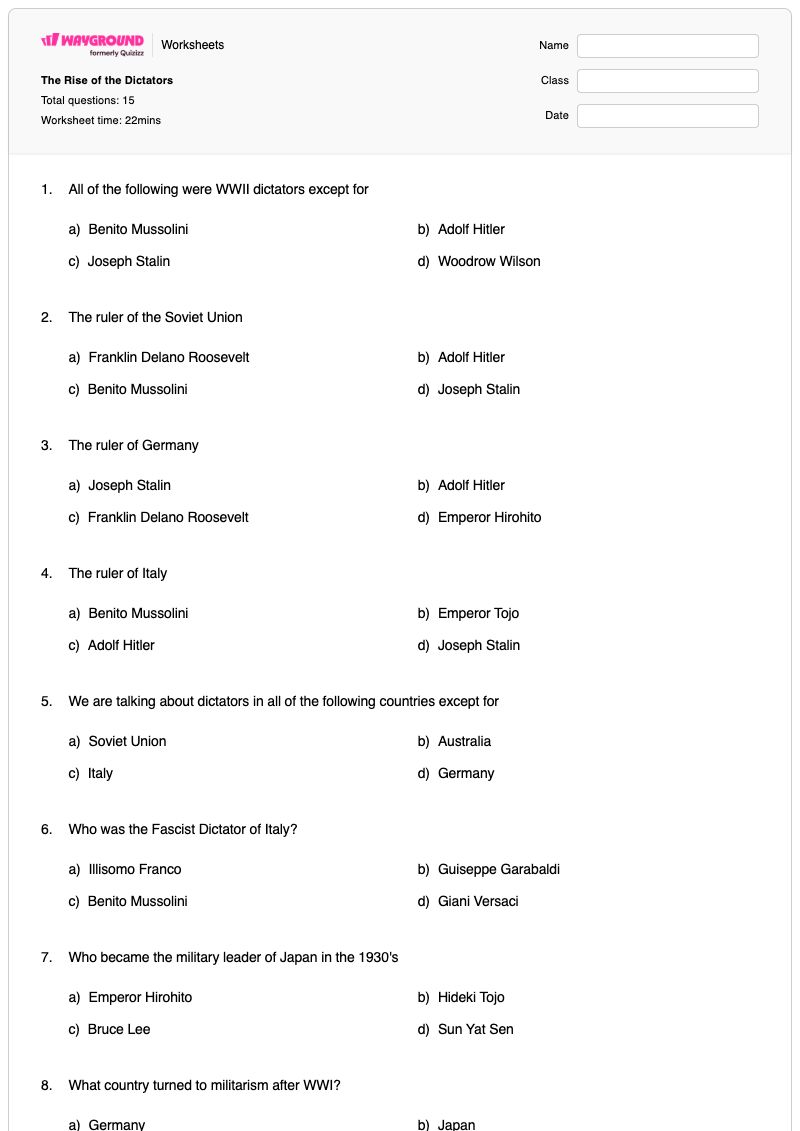
The Rise of the Dictators is a Grade 6 social studies worksheet that reviews key leaders, countries, ideologies, and terms associated with the rise of dictators before and during World War II. Students complete 15 multiple-choice questions identifying rulers such as Adolf Hitler, Benito Mussolini, Joseph Stalin, and Hideki Tojo; connecting leaders to their countries; and recognizing Japan’s turn toward militarism, anti-Semitism, Stalin’s Five-Year Plans, and Mussolini’s title “Il Duce.”
The worksheet also asks students to define or identify the Axis Powers, isolationism, and Manchuria, while distinguishing relevant historical figures and countries from incorrect choices. It is a free printable worksheet with a complete answer key, suitable for introducing or reviewing the vocabulary and factual relationships students need to understand the rise of authoritarian leadership in the World War II era.
Worksheet settings
Font size
S
M
L
XL
Worksheets
The Rise of the Dictators
Total questions: 15
Name
Class
Date
1.
All of the following were WWII dictators except for
a)
Benito Mussolini
b)
Adolf Hitler
c)
Joseph Stalin
d)
Woodrow Wilson
2.
The ruler of the Soviet Union
a)
Franklin Delano Roosevelt
b)
Adolf Hitler
c)
Benito Mussolini
d)
Joseph Stalin
3.
The ruler of Germany
a)
Joseph Stalin
b)
Adolf Hitler
c)
Franklin Delano Roosevelt
d)
Emperor Hirohito
4.
The ruler of Italy
a)
Benito Mussolini
b)
Emperor Tojo
c)
Adolf Hitler
d)
Joseph Stalin
5.
We are talking about dictators in all of the following countries except for
a)
Soviet Union
b)
Australia
c)
Italy
d)
Germany
6.
Who was the Fascist Dictator of Italy?
a)
Illisomo Franco
b)
Guiseppe Garabaldi
c)
Benito Mussolini
d)
Giani Versaci
7.
Who became the military leader of Japan in the 1930's
a)
Emperor Hirohito
b)
Hideki Tojo
c)
Bruce Lee
d)
Sun Yat Sen
8.
What country turned to militarism after WWI?
a)
Germany
b)
Japan
c)
USSR
d)
United States
9.
Anti-Semitism is a hostility and prejudice towards what group?
a)
Jews
b)
Germans
c)
Christians
d)
Muslims
10.
Joseph Stalin had _ year plans.
a)
Three
b)
Two
c)
Five
d)
Ten
11.
Germany, Italy, Japan
a)
isolationism
b)
Axis Powers
c)
fascism
d)
Mein Kampf
e)
Manchuria
12.
Idea that a country should focus on its own problems and avoid international commitments
a)
isolationism
b)
Axis Powers
c)
fascism
d)
Mein Kampf
e)
Manchuria
13.
resource-rich province of China invaded by the Japanese
a)
isolationism
b)
Axis Powers
c)
fascism
d)
Mein Kampf
e)
Manchuria
14.
Who was a fervent anti-Communist and a great admirer of Benito Musolini?
a)
Adolf Hitler
b)
Joseph Stalin
c)
Francisco Franco
d)
Vladimir Lenin
15.
Mussolini called himself “Il Duce” which means ___________________________?
a)
The leader
b)
Iron ruler
c)
Fist of steel
d)
Great guy
Answer Key
The Rise of the Dictators
Total questions: 15
1.
d)
Woodrow Wilson
2.
d)
Joseph Stalin
3.
b)
Adolf Hitler
4.
a)
Benito Mussolini
5.
b)
Australia
6.
c) Benito Mussolini
7.
b)
Hideki Tojo
8.
b)
Japan
9.
a)
Jews
10.
c)
Five
11.
b)
Axis Powers
12.
a)
isolationism
13.
e)
Manchuria
14.
a)
Adolf Hitler
15.
a) The leader
140 %
Browse by subjects
Browse by grades
Browse by format
FAQs
What does The Rise of the Dictators worksheet cover?
This Grade 6 social studies worksheet uses 15 multiple-choice questions to build students’ ability to identify WWII-era dictators, match leaders such as Hitler, Mussolini, Stalin, and Hideki Tojo with their countries, and recognize related terms. Students also review Japan’s militarism, anti-Semitism, Stalin’s Five-Year Plans, the Axis Powers, isolationism, Manchuria, and the meaning of “Il Duce.”
How can I use this worksheet to teach the rise of dictators before World War II?
Introduce the worksheet by building a leader-and-country chart for Germany, Italy, the Soviet Union, and Japan, then preview the key terms in the answer choices. Have students complete the multiple-choice items independently or in pairs, and use questions about Japan’s militarism, the Axis Powers, and isolationism to discuss how leaders, policies, and international relationships shaped the period.
What mistakes should I watch for when students complete this worksheet?
Students may confuse dictators with the countries they ruled, especially Hitler and Germany, Mussolini and Italy, and Stalin and the Soviet Union. They may also mix up Hideki Tojo with Emperor Hirohito, confuse Manchuria with an ideology or alliance, or select fascism when a question asks for the Axis Powers. Review the distinction between a leader, a country, an ideology, and a historical term.
How do I assign and grade The Rise of the Dictators worksheet?
The worksheet is available as a printable PDF and as a digital quiz on Wayground, with a complete answer key for all 15 multiple-choice questions. You can grade printable submissions by scanning student work with the Wayground for Teachers app, while the digital version supports online completion and grading.
How can I differentiate this worksheet for my students?
Use the worksheet’s Advanced Settings to adjust font spacing or increase the font size so the multiple-choice options and historical terms are easier to read. You can also apply a dyslexia-friendly font or translate the worksheet into another language when students need additional support accessing the questions about dictators, countries, and World War II vocabulary.
Where can I find more worksheets like this on Wayground?
Wayground offers a comprehensive collection of free printable worksheets and practice problems across subjects, with downloadable PDFs and answer keys to help students build essential skills and concepts. Browse more resources at https://wayground.com/en-us/worksheets.


 Worksheets