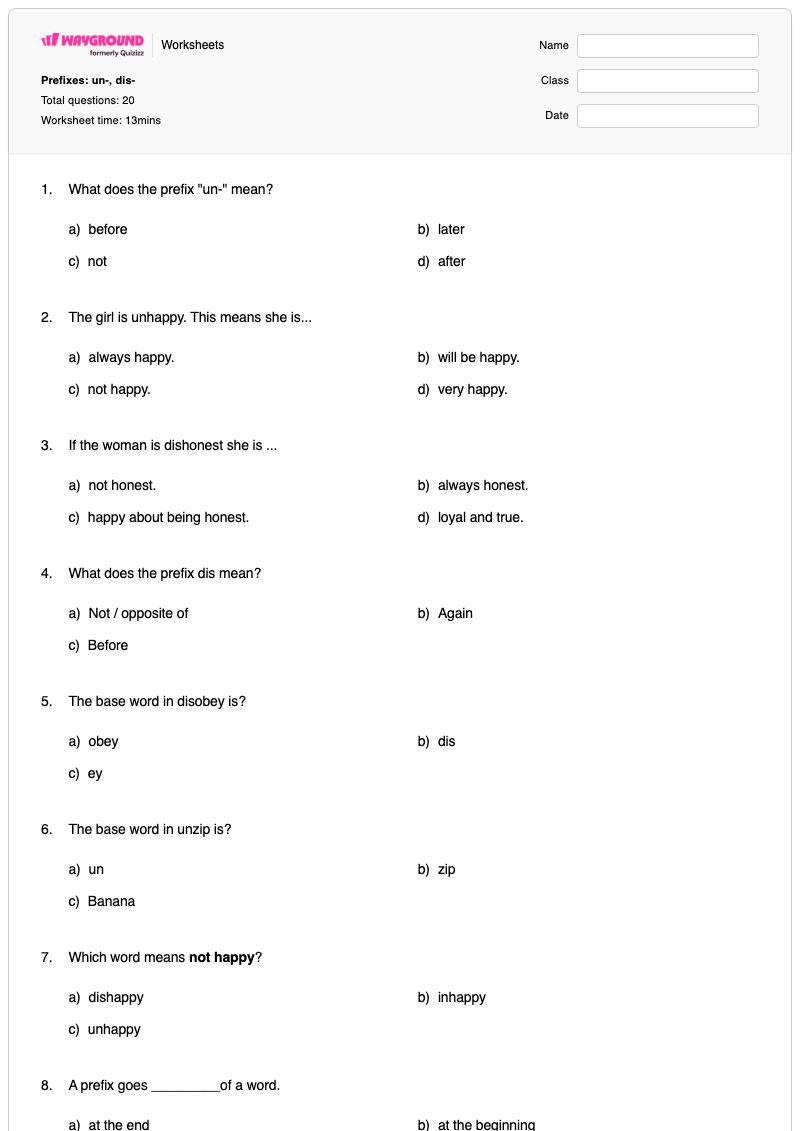
This Grade 2 English worksheet helps students understand how the prefixes un- and dis- change the meaning of base words. Through 20 questions—one multiple-select item and 19 multiple-choice items—students identify that prefixes come at the beginning of words, explain that un- and dis- can mean “not” or “opposite of,” and determine the meanings of words such as unhappy, dishonest, and untidy.
Students also identify base words in words such as unzip and disobey, choose the appropriate prefix for words including kind and lucky, and apply prefix knowledge in context. The mix of definition, word-part analysis, meaning, and application questions supports early morphology and vocabulary instruction. This free printable worksheet includes an answer key, making it suitable for independent practice, guided review, homework, or a quick Grade 2 English skills check.
Worksheet settings
Font size
S
M
L
XL
Worksheets
Prefixes: un-, dis-
Total questions: 20
Name
Class
Date
1.
What does the prefix "un-" mean?
a)
before
b)
later
c)
not
d)
after
2.
The girl is unhappy. This means she is...
a)
always happy.
b)
will be happy.
c)
not happy.
d)
very happy.
3.
If the woman is dishonest she is ...
a)
not honest.
b)
always honest.
c)
happy about being honest.
d)
loyal and true.
4.
What does the prefix dis mean?
a)
Not / opposite of
b)
Again
c)
Before
5.
The base word in disobey is?
a)
obey
b)
dis
c)
ey
6.
The base word in unzip is?
a)
un
b)
zip
c)
Banana
7.
Which word means not happy?
a)
dishappy
b)
inhappy
c)
unhappy
8.
A prefix goes _________of a word.
a)
at the end
b)
at the beginning
c)
in the middle
9.
If tidy means clean, what does untidy mean?
a)
clean it properly
b)
not clean
c)
clean it again
10.
A prefix is a group of letters added to the beginning of a root word
a)
True
b)
False
11.
A prefix changes the meaning of a word
a)
True
b)
False
12.
Can you ----plug the charger?
a)
un
b)
dis
13.
Choose the correct prefix for:
___kind
a)
un-
b)
dis-
14.
Choose the correct prefix for:
___lucky
a)
un-
b)
dis-
15.
The base word in disobey is?
a)
obey
b)
dis
c)
ey
16.
The base word in unzip is?
a)
un
b)
zip
c)
Banana
17.
A prefix goes _________of a word.
a)
at the end
b)
at the beginning
c)
in the middle
18.
If tidy means clean, what does untidy mean?
a)
clean it properly
b)
not clean
c)
clean it again
19.
Choose the correct prefix for:
___lucky
a)
un-
b)
dis-
20.
Can you ----plug the charger?
a)
un
b)
dis
Answer Key
Prefixes: un-, dis-
Total questions: 20
1.
c)
not
2.
c)
not happy.
3.
a)
not honest.
4.
a)
Not / opposite of
5.
a) obey
6.
b) zip
7.
c)
unhappy
8.
b) at the beginning
9.
b)
not clean
10.
a)
True
11.
a)
True
12.
a)
un
13.
a)
un-
14.
a)
un-
15.
a) obey
16.
b) zip
17.
b) at the beginning
18.
b)
not clean
19.
a)
un-
20.
a)
un
140 %
Browse by subjects
Browse by grades
Browse by format
FAQs
What does the Prefixes: un-, dis- worksheet help Grade 2 students learn?
This Grade 2 English worksheet teaches students to recognize un- and dis- as prefixes that can mean “not” or “opposite of” and to notice that a prefix comes at the beginning of a word. Its 20 multiple-select and multiple-choice questions ask students to interpret words such as unhappy, dishonest, and untidy, identify base words in unzip and disobey, and choose a suitable prefix in context.
How can I use this worksheet to teach the prefixes un- and dis-?
Introduce the worksheet by modeling how to separate a prefix from its base word, such as un- plus zip or dis- plus obey. Then have students explain how adding the prefix changes the meaning of words such as happy, honest, and tidy before completing the multiple-choice items. Use the prefix-selection questions as a discussion point: ask students why un- fits words such as kind and lucky and how the resulting word changes meaning.
What mistakes should I watch for when students complete this prefixes worksheet?
Students may choose a prefix based only on its appearance, use dis- for every word that means “not,” or confuse the prefix with the base word—for example, selecting dis or ey instead of obey in disobey. They may also identify the prefix as being at the end or middle of a word, or misread unhappy and untidy as positive meanings. Ask students to remove the prefix and say the remaining base word, then explain the new word’s meaning.
How do I assign and grade the Prefixes: un-, dis- worksheet?
The worksheet is available on Wayground as a printable PDF and as a digital quiz, with a complete answer key for all 20 questions. You can grade printable submissions by scanning student work with the Wayground for Teachers app, or review responses through the digital quiz. The printable format can also support schools that are reducing screen time.
How can I differentiate this worksheet for my students?
Use the worksheet’s Advanced Settings to adjust font spacing or choose a larger font size so the short prefix-definition and word-meaning questions are easier to read. You can also enable a dyslexia-friendly font for students who benefit from that presentation, or translate the worksheet into another language while students work with examples such as unhappy, untidy, and disobey.
Where can I find more worksheets like this on Wayground?
Wayground provides a comprehensive collection of free printable worksheets and practice problems across subjects, with downloadable PDFs and answer keys to help students build essential skills and concepts. Browse more resources at https://wayground.com/en-us/worksheets.

 Worksheets