
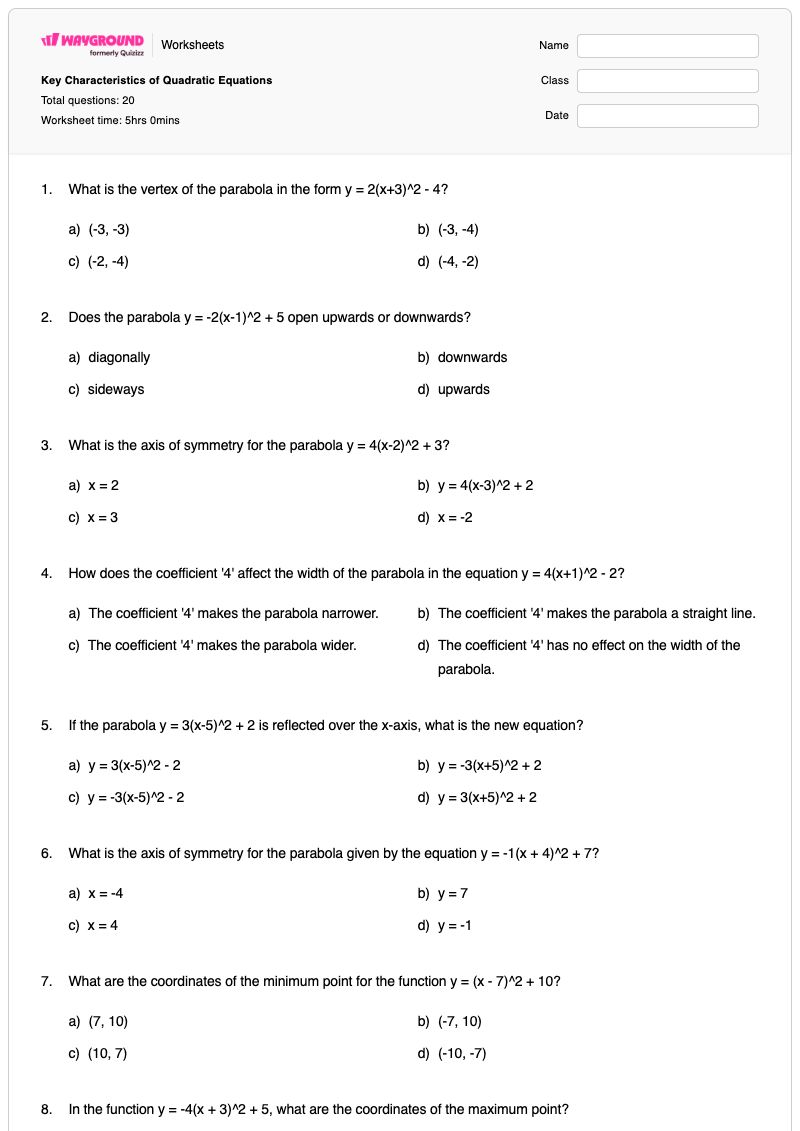

This Grade 11 mathematics worksheet gives students focused practice interpreting key characteristics of quadratic equations in vertex form. Across its 20 multiple-choice items, students identify vertices, axes of symmetry, opening direction, width, maximum or minimum points, and selected graph features such as y-intercepts. They also reason about how a coefficient and an x-axis reflection affect a parabola.
This resource is designed for Grade 11 math instruction, review, or an individual check of understanding after students have learned vertex-form notation. The consistent multiple-choice format lets teachers quickly see whether students can read coordinates and transformations from an equation. It is a free printable worksheet with a complete answer key, suitable for independent practice, guided discussion, or a short assessment.
Worksheet settings
Font size
S
M
L
XL
Worksheets
Key Characteristics of Quadratic Equations
Total questions: 20
Name
Class
Date
1.
What is the vertex of the parabola in the form y = 2(x+3)^2 - 4?
a)
(-3, -3)
b)
(-3, -4)
c)
(-2, -4)
d)
(-4, -2)
2.
Does the parabola y = -2(x-1)^2 + 5 open upwards or downwards?
a)
diagonally
b)
downwards
c)
sideways
d)
upwards
3.
What is the axis of symmetry for the parabola y = 4(x-2)^2 + 3?
a)
x = 2
b)
y = 4(x-3)^2 + 2
c)
x = 3
d)
x = -2
4.
How does the coefficient '4' affect the width of the parabola in the equation y = 4(x+1)^2 - 2?
a)
The coefficient '4' makes the parabola narrower.
b)
The coefficient '4' makes the parabola a straight line.
c)
The coefficient '4' makes the parabola wider.
d)
The coefficient '4' has no effect on the width of the parabola.
5.
If the parabola y = 3(x-5)^2 + 2 is reflected over the x-axis, what is the new equation?
a)
y = 3(x-5)^2 - 2
b)
y = -3(x+5)^2 + 2
c)
y = -3(x-5)^2 - 2
d)
y = 3(x+5)^2 + 2
6.
What is the axis of symmetry for the parabola given by the equation y = -1(x + 4)^2 + 7?
a)
x = -4
b)
y = 7
c)
x = 4
d)
y = -1
7.
What are the coordinates of the minimum point for the function y = (x - 7)^2 + 10?
a)
(7, 10)
b)
(-7, 10)
c)
(10, 7)
d)
(-10, -7)
8.
In the function y = -4(x + 3)^2 + 5, what are the coordinates of the maximum point?
a)
(-3, 5)
b)
(3, -5)
c)
(5, -3)
d)
(-5, 3)
9.
For the quadratic function y = 2(x - 4)^2 - 9, what are the coordinates of the vertex?
a)
(4, -9)
b)
(-4, 9)
c)
(-9, 4)
d)
(9, -4)
10.
y=−x2+6x+5
Find the vertex.
a)
(4,-3)
b)
(-3,-22)
c)
(-4,3)
d)
(3, 14)
11.
y=3x2−5x+7
Find the y-intercept
a)
(0,7)
b)
(7,0)
c)
(0,-5)
d)
(5,0)
12.
Given that the x-coordinate of the vertex is 2, what is the y-coordinate of this equation? y=2x2−8x+10
a)
y=0
b)
y=2
c)
y=−4
d)
y=18
13.
Given that the x-coordinate of the vertex is 2, what is the axis of symmetry?
a)
x=−2
b)
(2,0)
c)
(0,−2)
d)
x=2
14.
y=2x2−8x+10 Find the x-coordinate of the vertex.
a)
x=2
b)
x=−2
c)
x=41
d)
x=−4
15.
y=−4x2−2x+8 This parabola has a...
a)
Minimum
b)
Maximum
16.
y=−2x2+3x−7 This parabola opens...
a)
Upward
b)
Downward
17.
Write a quadratic equation that opens up, has a vertex of (1, -3)and passes through (-4, 6)
a)
y = 2(x - 1)2 - 3
b)
y=3(x+1)2 + 3
c)
y = 9/25(x - 1)2 - 3
d)
x = 9/25(y + 3)2 - 1
18.
Write a quadratic equation that opens up, has a vertex of (2, -2) and passes through (5, 7)
a)
y = 3(x - 2)2 - 2
b)
y = (x - 2)2 - 2
c)
y = 9/9(x - 2)2 - 2
d)
y = 3/1(x + 2)2 + 2
19.
Formulate a quadratic equation that opens downwards, has a vertex of (3, 2) and passes through (5, -6)
a)
y = -3(x - 3)2 + 2
b)
y = -4(x + 3)2 - 2
c)
y = -2(x - 3)2 + 2
d)
x = -2(y - 2)2 + 3
20.
What is the y-intercept of the parabola given by the equation y=4x2−12x+9 ?
a)
(0, 9)
b)
(0, -12)
c)
(0, 4)
d)
(9, 0)
Answer Key
Key Characteristics of Quadratic Equations
Total questions: 20
1.
b)
(-3, -4)
2.
b)
downwards
3.
a)
x = 2
4.
a)
The coefficient '4' makes the parabola narrower.
5.
c)
y = -3(x-5)^2 - 2
6.
a)
x = -4
7.
a)
(7, 10)
8.
a)
(-3, 5)
9.
a)
(4, -9)
10.
d)
(3, 14)
11.
a)
(0,7)
12.
b)
y=2
13.
d)
x=2
14.
a)
x=2
15.
b)
Maximum
16.
b)
Downward
17.
c)
y = 9/25(x - 1)2 - 3
18.
b)
y = (x - 2)2 - 2
19.
a)
y = -3(x - 3)2 + 2
20.
a)
(0, 9)
140 %
Browse by subjects
Browse by grades
Browse by format
FAQs
What does this quadratic equations worksheet cover?
This Grade 11 worksheet uses 20 multiple-choice questions to practice reading quadratic equations in vertex form. Students identify the vertex, axis of symmetry, opening direction, width, maximum or minimum point, y-intercept, and the effects of transformations such as reflection over the x-axis. Selecting among coordinate and equation choices reinforces how each part of the equation describes a parabola.
How can I use this worksheet to teach the characteristics of quadratic equations?
First model how to read y = a(x − h)² + k, connecting h and k to the vertex and axis of symmetry before students work independently. Use the worksheet’s questions about opening direction, coefficient-based width, maximum or minimum points, and x-axis reflection as a sequence for think-aloud examples. Ask students to explain why a chosen coordinate or transformed equation matches the original expression, not just identify the option.
What mistakes should I watch for when students complete this quadratic equations worksheet?
Watch for sign errors when students read the vertex from expressions such as (x + 3)², since the x-coordinate is the opposite of the sign shown inside the parentheses. Students may also confuse the axis of symmetry with the vertex, reverse the effect of a positive or negative leading coefficient, or treat a larger absolute coefficient as making the parabola wider rather than narrower. In reflection questions, check that they change the sign of the entire output expression while keeping the horizontal shift consistent.
How do I assign and grade this quadratic equations worksheet?
The worksheet is available as a printable PDF and as a digital quiz on Wayground, and it includes a complete answer key for checking the 20 multiple-choice responses. Teachers can grade printable submissions by scanning student work with the Wayground for Teachers app.
How can I differentiate this quadratic equations worksheet for my students?
Under the worksheet’s Advanced Settings, adjust font spacing or font size to make the equation choices and coordinate options easier to read. You can also apply a dyslexia-friendly font or translate the worksheet into another language while preserving its multiple-choice format.
Where can I find more free worksheets like this on Wayground?
Wayground offers a comprehensive collection of free printable worksheets and practice problems across all subjects, with downloadable PDFs and answer keys to support mastery of essential skills and concepts. Browse more resources at https://wayground.com/en-us/worksheets.